Painting Deborah by Angela Yarber

angelaDeborah is one of the few women in scripture depicted as a strong leader who does not need the help of a man. The start to Deborah’s story appears bland, a mere introduction to a narrative that will later become juicy, surprising, and even a bit gory. Judges chapter four merely introduces us to a woman named Deborah, a judge over Israel. Judges is a book that records a time when Israel was without a king, so judges had to arbitrate justice, command, lead, and settle disputes. The book of Judges involves a constant downward spiral in which the people of Israel experience God’s grace; they forget God and do evil; they get into trouble and cry out for help; a judge arrives to help; the people get better; the judge dies and the people repeat the cycle.

When Deborah appears on the scene, the people have gotten themselves into trouble. We, as readers, know that because she is a judge, she will deliver them. But it’s easy to pass over Deborah’s uniqueness in reading her seemingly boring introduction. As in most texts, when we take time, we realize there is much more than meets the eye. Continue reading “Painting Deborah by Angela Yarber”
Feminist Freedom: Finding, Following, and Painting Freya Stark by Angela Yarber

“There can be no happiness if the things we believe in are different from the things we do.” –Freya Stark

angelaOk. I’ll admit it. We all have our secret indulgences, don’t we? It is Valentine’s Day, after all. Shouldn’t we indulge a moment? After years of having my mind mired in the esoteric quandaries of the academy and the heart-yearnings of ministry, I needed an outlet, an escape. And when I couldn’t literally escape to some beautiful far-flung land via travel, I found my freedom nestled up with a good travel memoir. Travel essays, memoirs of finding oneself in another land, became my way of wandering, wondering, and learning about the world. A shelf full of dusty travel essays became my secret indulgence.

Along the way I decided to support feminist and women writers, pouring through every edition of The Best Women’s Travel Writing, sometimes in one sitting. Over and over I found these thoughtful writers referring back to one person, the pioneer of women’s travel, the founder of this far-flung freedom. Her name was Freya Stark. Years ago I began researching her life, reading The Passionate Nomad, and some of her many writings based on her travels all over the world.

Born in Paris in 1893, she was one of the first European women to travel and write about the Middle East, adding Arabic and Persian to the English, French, Italian, and Latin she already knew. There are tales of her riding camels through rebel territory, taking refuge in Bedouin camps, diving into shark-infested waters off the coast of Turkey simply because the water called to her and was too beautiful to avoid immersion, or in her old age (she lived to age 100), driving wildly in her hand-crafted “camper” through the Italian countryside. She lived boldly, going where few women had gone. She lived wildly, caring little about the restraints of decorum. She claimed, “It is the beckoning that counts, not the clicking latch behind you.” It’s no wonder that she inspired and empowered the many women travel writers that have followed in her fearless footsteps. Continue reading “Feminist Freedom: Finding, Following, and Painting Freya Stark by Angela Yarber”

Painting Lottie Moon, Redeeming Lottie Moon by Angela Yarber

angelaI never imagined I’d paint her. Though I was not raised in church, I have vivid memories of worshiping in Southern Baptist Churches, churches where women’s voices were not permitted behind the pulpit, churches where women could never dream of ordination, churches that damned LGBTQ folks to hell with a pound of a fiery fist on a well-worn bible perched atop an angry pulpit. Canonize a Southern Baptist woman into the sainthood of Holy Women Icons? No, thank you.

Though I am an ordained Baptist minister myself, it’s important to remember that there is a vast spectrum of belief and practice when it comes to the Baptist church. Because our polity is non-hierarchical and we are anti-creedal, one cannot easily say, “All Baptists believe ______ or all Baptists practice _______.” Whether you are as conservative as the Southern Baptist Convention or as liberal as the Association of Welcoming and Affirming Baptists, we all share some core Baptist distinctives: the separation of church and state, believer’s baptism, the autonomy of the local church, freedom of conscious, and the priesthood of all believers. Learning of these distinctives as a young feminist searching for a faith to call my own, I was immediately drawn to the core Baptist tradition. They reject hierarchy. All are supposed to be equal. It is up to the individual conscious to determine what one believes. And it is up to the individual church to determine how that particular community of faith will practice those beliefs. It is feminist to its core. Southern Baptists feel otherwise, which is why they refrain for ordaining women and claim that they should be submissive to their husbands.

Continue reading “Painting Lottie Moon, Redeeming Lottie Moon by Angela Yarber”

Painting Aurora by Angela Yarber

angelaFor those of us in the northern hemisphere, December is one of the darkest months. The days are shorter. Night comes earlier. Each morning I eagerly await the dawn, the potential sliver of sunshine seeping through my window and warming my otherwise cold wintery skin. For those of us who struggle with seasonal depression, December can be difficult. The colder and shorter days cast shadows on our spirits as we yearn for the warm glow of light. Each December as we inch toward the winter solstice, I am reminded of the Goddess of the Dawn, Aurora, and of the unique ways in which a variety of wisdom traditions invoke the coming of light amidst the stark December night skies.

So, this December I welcome Aurora into the vast witness of Holy Women Icon with a folk feminist twist that I feature each month: Virginia Woolf , the Shulamite, Mary Daly, Baby Suggs, Pachamama and Gaia, Frida Kahlo, Salome, Guadalupe and Mary, Fatima, Sojourner Truth, Saraswati, Jarena Lee, Isadora Duncan, Miriam, Lilith, Georgia O’Keeffe, Guanyin, Dorothy Day, Sappho, Jephthah’s daughter, Anna Julia Cooper, the Holy Woman Icon archetype, Maya Angelou, Martha Graham, Pauli Murray, La Negrita, Tiamat/tehom, Mother Teresa, and many others.

Aurora is the Goddess of the dawn in Roman mythology; each morning she soars across the sky to announce the arrival of the sun. As the nights grow longer and longer, I can think of few other goddesses I hope for more than Aurora. In fact, many faith traditions invoke the coming of light during this month of long nights and short days.

In my own tradition, we are not yet celebrating Christmas (despite the capitalist consumer onslaught that has been on full throttle since October). Rather, we still dwell in the deep blue darkness of Advent, when we wait, long, and prepare for light to be birthed into our world. For most Christians, a candle is lit each Sunday during Advent and the light grows brighter as they anticipate the birth of Christ. Continue reading “Painting Aurora by Angela Yarber”

Painting Mother Teresa by Angela Yarber

angelaOf all my Holy Women Icons, Mother Teresa joins Blessed Mary in being one of the most familiar, and often the one least cited for the cause of feminism. Joining Virginia Woolf , the Shulamite, Mary Daly, Baby Suggs, Pachamama and Gaia, Frida Kahlo, Salome, Guadalupe and Mary, Fatima, Sojourner Truth, Saraswati, Jarena Lee, Isadora Duncan, Miriam, Lilith, Georgia O’Keeffe, Guanyin, Dorothy Day, Sappho, Jephthah’s daughter, Anna Julia Cooper, the Holy Woman Icon archetype, Maya Angelou, Martha Graham, Pauli Murray, La Negrita, Tiamat/tehom, and all my other Holy Women Icons with a folk feminist twist is this holy Catholic nun.

When I first began the Holy Women Icons project, she was an obvious woman who came to mind, but I resisted painting her for several years. Perhaps it’s because her story is so familiar. Maybe it’s because this pillar of humility and service embodies so many virtues that have been used to oppress women for centuries. I cannot quite articulate my resistance, but it was real. Continue reading “Painting Mother Teresa by Angela Yarber”

Painting Tiamat/Tehom by Angela Yarber

angelaToday I am honored to give a lecture on “Queering Iconography: Holy Women Icons from Sappho to Pauli Murray” at the North Star LGBT Center in Winston-Salem, NC. So, I want to continue the theme of featuring some of my queer Holy Women Icons. Joining Virginia Woolf , the Shulamite, Mary Daly, Baby Suggs, Pachamama and Gaia, Frida Kahlo, Salome, Guadalupe and Mary, Fatima, Sojourner Truth, Saraswati, Jarena Lee, Isadora Duncan, Miriam, Lilith, Georgia O’Keeffe, Guanyin, Dorothy Day, Sappho, Jephthah’s daughter, Anna Julia Cooper, the Holy Woman Icon archetype, Maya Angelou, Martha Graham, Pauli Murray, La Negrita, and all my other Holy Women Icons with a folk feminist twist is the often overlooked and misunderstood primordial goddess of creation: tehom.

In Genesis 1 we read, “In beginning, God created the heavens and the earth, the earth was a formless void and darkness covered the face of the deep, while a wind from God swept over the face of the waters.” It is the creation narrative held dear, formative, and meaningful for countless Jews and Christians. Interestingly, this word, deep, in Hebrew is tehom. Tehom translates as “deep or depths,” but it’s also a cognate for Tiamat, a Babylonian Goddess of creation. Out of the face of the deep, the world begins. Out of tehom, God creates. Out of Tiamat, the earth comes into being. This dancing Babylonian goddess syncretistically intermingles with the creation myth so pivotal to the faith of Christians and Jews in a way that could be terrifying, or beautiful, or—like the chaotic body of Tiamat that brings the world into being—both. Continue reading “Painting Tiamat/Tehom by Angela Yarber”

Painting La Negrita by Angela Yarber

angelaOne week ago thousands of Costa Ricans made a pilgrimage to visit their patron saint on August 2. Some penitents walked the 22 kilometers on their knees from the capital of San José to the Nuestra Señora de los Angeles Basilica in Cartago where the small statue of La Negrita is now on display. Joining Virginia Woolf , the Shulamite, Mary Daly, Baby Suggs, Pachamama and Gaia, Frida Kahlo, Salome, Guadalupe and Mary, Fatima, Sojourner Truth, Saraswati, Jarena Lee, Isadora Duncan, Miriam, Lilith, Georgia O’Keeffe, Guanyin, Dorothy Day, Sappho, Jephthah’s daughter, Anna Julia Cooper, the Holy Woman Icon archetype, Maya Angelou, Martha Graham, Pauli Murray, and all my other Holy Women Icons with a folk feminist twist is this seemingly small saint who has done big and mighty things: La Negrita.

Also known as La Virgen de los Angeles, the Black Virgin is a very small representation of the Virgin Mary. She was originally discovered by an indigenous woman on August 2, 1635. When the poor indigenous woman tried to take the stone statuette, it miraculously reappeared. The people responded by building a shrine around her. Continue reading “Painting La Negrita by Angela Yarber”

Queering Iconography, Painting Pauli Murray by Angela Yarber

angelaEven as my book, Holy Women Icons, is printed, bound, and available for purchase, filled with the stories of nearly fifty holy women, my project of painting these beloved saints continues. Joining all my other Holy Women Icons with a folk feminist twist is the brave, bold, and revolutionary Pauli Murray.

This month is a celebration of Murray’s life and witness is several meaningful ways. The first of July was her feast day, as she was deemed an Episcopal saint in 2012. LGBTQ author and activist, Kittredge Cherry, detailed Murray’s feast day, celebrating her as a “Human rights champion and queer saint…renowned civil rights pioneer, feminist, author, lawyer and the first black woman ordained as an Episcopal priest.” And the celebration of Pauli Murray’s radical witness continues as the icon bearing her image joins seventeen of my other Holy Women Icons at the North Star LGBTQ Center Gallery in Winston-Salem, NC for an exhibition entitled, “Queering Iconography: Holy Women Icons from Sappho to Pauli Murray.” Continue reading “Queering Iconography, Painting Pauli Murray by Angela Yarber”

Painting Martha Graham by Angela Yarber

angela

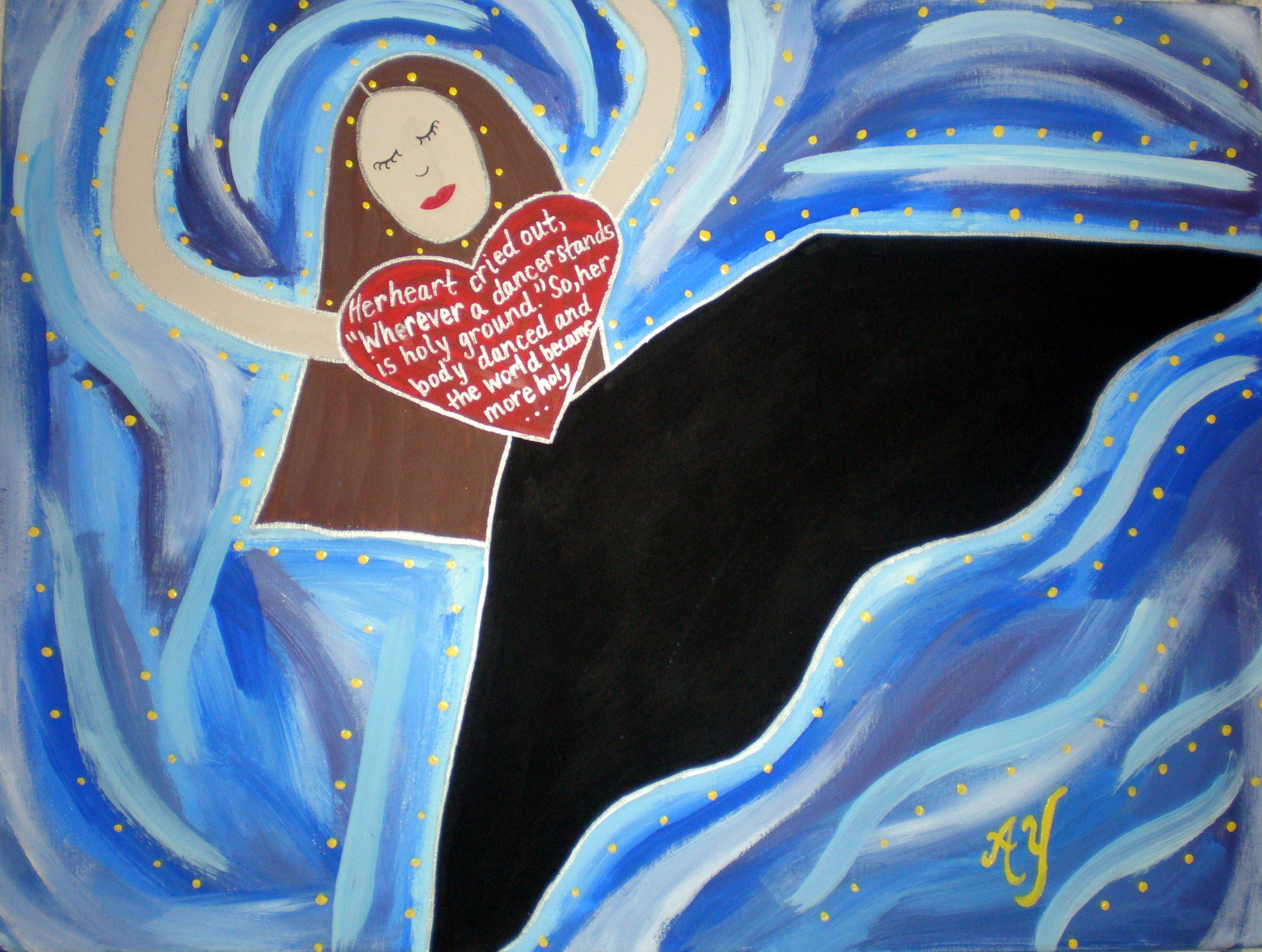
Joining Virginia Woolf , the Shulamite, Mary Daly, Baby Suggs, Pachamama and Gaia, Frida Kahlo, Salome, Guadalupe and Mary, Fatima, Sojourner Truth, Saraswati, Jarena Lee, Isadora Duncan, Miriam, Lilith, Georgia O’Keeffe, Guanyin, Dorothy Day, Sappho, Jephthah’s daughter, Anna Julia Cooper, the Holy Woman Icon archetype, Maya Angelou, and all my other Holy Women Icons with a folk feminist twist  is the dancing revolutionary Martha Graham. So, as the contemporary and modern dancers on So You Think You Can Dance continue to amaze us this summer, let us remember from whence they came.

Martha Graham’s contribution to the world of dance cannot be overestimated. She is regaled as the Picasso of the dance world, revolutionizing it by introducing an entirely new quality of movement known as modern dance. Not only did Graham revolutionize the dance world, like Isadora Duncan before her, she also made great contributions to feminist spirituality. One of her most famous statements may well have been “wherever a dancer stands is holy ground.” Like most dancers who are so in tune with their bodies, Graham new the holiness therein, the ways in which the body can express the ineffable when words alone simply cannot. “The body never lies,” she famously reminds us.

Martha Graham Continue reading “Painting Martha Graham by Angela Yarber”

Writing Holy Women Icons by Angela Yarber

angelaFor two years I have had the great privilege of writing a monthly article about one of my Holy Women Icons with a folk feminist twist for Feminism and Religion. Virginia Woolf , the Shulamite, Mary Daly, Baby Suggs, Pachamama and Gaia, Frida Kahlo, Salome, Guadalupe and Mary, Fatima, Sojourner Truth, Saraswati, Jarena Lee, Isadora Duncan, Miriam, Lilith, Georgia O’Keeffe, Guanyin, Dorothy Day, Sappho, Jephthah’s daughter, Anna Julia Cooper, the Holy Woman Icon archetype, Maya Angelou, and many others that will follow in the months and years ahead have guided, empowered, and inspired me as an artist, activist, feminist, scholar, and preacher.

I knew from that outset that writing about them would deepen my relationship with each of these amazing women. I also knew that their power and efficacy monumentally increases when they join together. This colorful cloud of witnesses has filled myriad galleries, reminding viewers of the powerful women who have paved the way for us today. Many have left the group, finding a resting place in the homes, offices, and galleries of friends, colleagues, and strangers who have purchased or commissioned an icon along the way. And those that remain erupt the hallways of my home with a cavalcade of color, daily reminders of who I am called to be and become.

Between researching their stories, painting them, hanging them in galleries, and selling them, I knew that one day I would bind their stories together in a book. So, it is with tremendous joy that this dream has become a reality. Parson’s Porch Publishing, a non-profit publishing house whose mission is to “turn books to bread” by giving their profits to feed the poor, has lifted up the stories and images of nearly fifty of my beloved Holy Women Icons in a book. So, along with originals, commissions, and prints, Holy Women Icons are now available as a book and as individual greeting cards. It is my sincere hope that by binding the stories of these holy women together, they may provide inspiration and empowerment for all readers, binding all our diverse stories together in a collective cry for beautiful, unabashed, prophetic justice for all. Continue reading “Writing Holy Women Icons by Angela Yarber”