Uprising! by Beth Bartlett

“ . . . the uprising of [our] nature is but the effort to give to [our] whole being the opportunity to expand into all [our] essential nobility.” – Sarah Grimké [i]

It wasn’t the first time I had stood in protest on that street corner.  I’m sure it won’t be the last. But the gathered crowd was by far the largest I’d been a part of there, covering not just the plaza on the western corner of Lake Avenue and Superior Street, but all the other corners as well, and up and down the sidewalks for half a block.  We were a motley crew, from young people perhaps at their first protest to the many well-seasoned grey-haired. Though I met a few indigenous friends there, I was struck by the overwhelming perceived whiteness of the crowd.  I imagine Black and Brown people were more reluctant to join a street protest where they might be targeted. Indeed, on my way home I heard a report that the number of “driving while Black and Brown” traffic stops has increased in recent days.

Standing in the wet snow, chanting, “This is what democracy looks like!” and “What do we want? Democracy! When do we want it? Now!,” the atmosphere was more of a party than of a wake.[ii]  Yet, when the chants began, I found myself near tears, wanting to sob rather than shout.  As some report seeing their lives flash before their eyes when facing imminent death, I saw my protest life flashing before my eyes – all the anti-war marches – from Vietnam to Iraq to the recent Israeli attacks on Gaza, the marches for the ERA, the Take Back the Night marches, the MMIW marches, the Standing Rock and Line 3 protests, the Women’s Marches, the march for science, the vigils after school shootings and nightclub shootings and the murder of George Floyd, the rallies to protect trans rights,  . . . the list goes on and on. And I felt like weeping, for all these efforts to bring peace and justice and equality to this land were being trampled on and were under threat of being destroyed.

Continue reading “Uprising! by Beth Bartlett”
Letter from a Palestinian Political Prisoner in Louisiana Dictated over the phone from ICE Detention March 18, 2025

Moderator’s Note: Below is a letter from Mahmoud Khalil in its entirety, dictated over the phone from Immigrations and Customs (ICE) detention in Louisiana. A permanent resident taken by the government for his political speech. The phrase “who has the right to have rights?” was coined by Hannah Arendt who escaped Nazi Germany and wrote poignantly and pointedly about the rise of fascism. While on the surface, this letter doesn’t have an obvious link to FAR’s mission, we feel it is deeply intertwined. Who has the right the have rights? Women once had no rights and it appears we are losing them again at breakneck speed. Immigrant’s rights in this country are being stripped also at breakneck speed. And that is just the tip of the iceberg. If we can’t answer “EVERYONE” to Arendt and Khalil’s question, then human rights mean nothing for any of us.

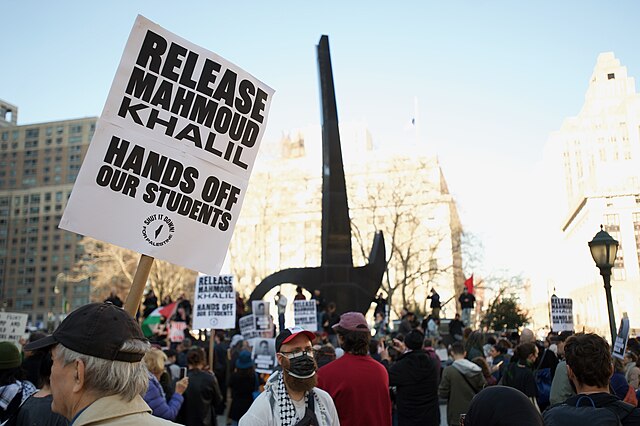
Wikimedia Commons: Protests in Thomas Paine Park against the detention of Palestinian activist and Columbia student Mahmoud Khalil. [SWinxy]

My name is Mahmoud Khalil and I am a political prisoner. I am writing to you from a detention facility in Louisiana where I wake to cold mornings and spend long days bearing witness to the quiet injustices underway against a great many people precluded from the protections of the law.

Who has the right to have rights? It is certainly not the humans crowded into the cells here. It isn’t the Senegalese man I met who has been deprived of his liberty for a year, his legal situation in limbo and his family an ocean away. It isn’t the 21-year-old detainee I met, who stepped foot in this country at age nine, only to be deported without so much as a hearing.

Justice escapes the contours of this nation’s immigration facilities.

On March 8, I was taken by DHS agents who refused to provide a warrant, and accosted my wife and me as we returned from dinner. By now, the footage of that night has been made public. Before I knew what was happening, agents handcuffed and forced me into an unmarked car. At that moment, my only concern was for Noor’s safety. I had no idea if she would be taken too, since the agents had threatened to arrest her for not leaving my side. DHS would not tell me anything for hours — I did not know the cause of my arrest or if I was facing immediate deportation. At 26 Federal Plaza, I slept on the cold floor. In the early morning hours, agents transported me to another facility in Elizabeth, New Jersey. There, I slept on the ground and was refused a blanket despite my request.

Continue reading “Letter from a Palestinian Political Prisoner in Louisiana Dictated over the phone from ICE Detention March 18, 2025”

We’ve Seen This Playbook Before by Janet Maika’i Rudolph

Wikimedia Commons

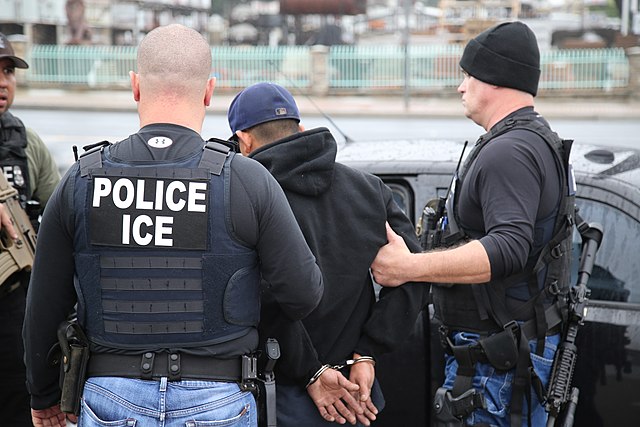
ICE has been doing mass round-ups of anyone who looks like “the other.” The people cheered.  “This is my country,” they shouted to the deportees. “Go back where you came from.” The people are flush with excitement thinking this is what we voted for, meanwhile ignoring that they came from someplace too. We know this is a publicity stunt. How? Dr. Phil tagged along on one of round-ups.  Newly minted secretary Kristi Noem also took her role in the spotlight attending one in NYC and saying dehumanizing words I will not repeat here. 

We’ve seen this playbook before. Creating chaos, disorientation and suffering for political points, TV or other publicity ratings. It doesn’t end well – EVER!

The NY Times had a report of how deportees were treated in a dehumanizing manner, being held on a broken plane in the Amazonian heat with no AC, people shackled, children were on board.  There are always people available to treat other people as less than human. “I was just doing my job.”  “I was only following orders.” 

We’ve seen this playbook before.  It doesn’t end well – EVER!

Continue reading “We’ve Seen This Playbook Before by Janet Maika’i Rudolph”

Dear Anti-Harris Progressives: Here’s how to help Palestine (and the economy, and everything else) by Trelawney Grenfell-Muir

First, understand without doubt: I agree with the anti-genocide protesters (and the progressives who are frustrated about our rigged economy). I couldn’t agree more that we need an arms embargo against Israel. I support the progressives who are protesting at Harris rallies, saying they refuse to vote for any candidate who does not commit to an arms embargo, so that no more US arms will be sent to wage ethnic cleansing against the civilians (mostly women and children) of Palestine. Harris has advocated for a ceasefire, she has met with the protesters, and she has responded politely to their protests against the genocide. But when they continue to chant that they won’t vote for her, she responds, “You know what? If you want Donald Trump to win, then say that. Otherwise, I’m speaking.”

I do not like the hand we’ve been dealt. Our democracy, always deeply flawed, has become increasingly weak and unstable. In fact, many professors and analysts increasingly define the US as a plutocracy – governed by and for the top 1%, in which the average citizen has little to no voice or impact on policies. Monopolies have consolidated in order to help destroy democracy, driving costs of living up and wages down. The Military Industrial Complex, with its staggering domination of the international markets, has locked the US into endless war, often in support of autocracies over democracies. And the same billionaires who are causing climate change, are investing in high tech solutions to save themselves from the apocalypse while the rest of us go extinct or become their slaves. 

Continue reading “Dear Anti-Harris Progressives: Here’s how to help Palestine (and the economy, and everything else) by Trelawney Grenfell-Muir”

An Incantation for 2024, USA by Marie Cartier

-please repeat and/or use in ritual, if needed

There was a time (there was a time)

We were waiting for something (we were waiting for something)

We were wanting something (we were wanting something)

We needed it to be different (we needed it to be different)

We were. We are. We are here: this is it.

We want something. We want something. We need something. We need something.

There was a time when we could make something happen.

Continue reading “An Incantation for 2024, USA by Marie Cartier”

Women’s Bodies As Battlefield by Janet Maika’i Rudolph

Elizabeth Cady Stanton wrote in the introduction to her book The Women’s Bible:

The Bible teaches that woman brought sin and death into the world, that she precipitated the fall of the race, that she was arraigned before the judgement seat of Heaven, tried, convicted and sentenced. Marriage for her was to be a condition of bondage, maternity, a period of suffering and anguish, and in silence and subjection, she was to play the role of a dependent on man’s bounty for all her material wants . .

We are facing the long-term results of these biblical writings. This upcoming election is so unsettling because it is showing patriarchy in all its ugliness. We see how this is being played out, especially regarding abortion, but in all areas of the functioning of women’s bodies. The reason abortion is at the foundation of it all is that the drive to police women’s bodies is the crux which justifies all sorts of cruelties. It is the same with racism. These are issues that span the pantheon of rights; human, economic, healthcare, bodily autonomy. It takes a police state to quell all of these.

Continue reading “Women’s Bodies As Battlefield by Janet Maika’i Rudolph”

Incredibly! The Inquisitional Cultural Mechanism Rears its Hydra Head by by Elisabeth Sikie

As a young witch hungry for feminist sisterhood and spiritual wisdom in the 90s, before the blooming of the internet, I discovered a mag called The Beltane Papers. I remember devouring an article featuring channeled material of women killed during the European witch hunts. This transmission revealed past voices of everyday people living their lives until they were snagged by the slow creep of an increasingly oppressive cultural trajectory. What struck me was the normalcy of their voices, the deceased echoes of regular women trying to make sense of events beyond their control until they were taken by a system that destroyed them. What stayed with me is the author’s observation that even at their violent end these women’s voices remained “incredulous”. 

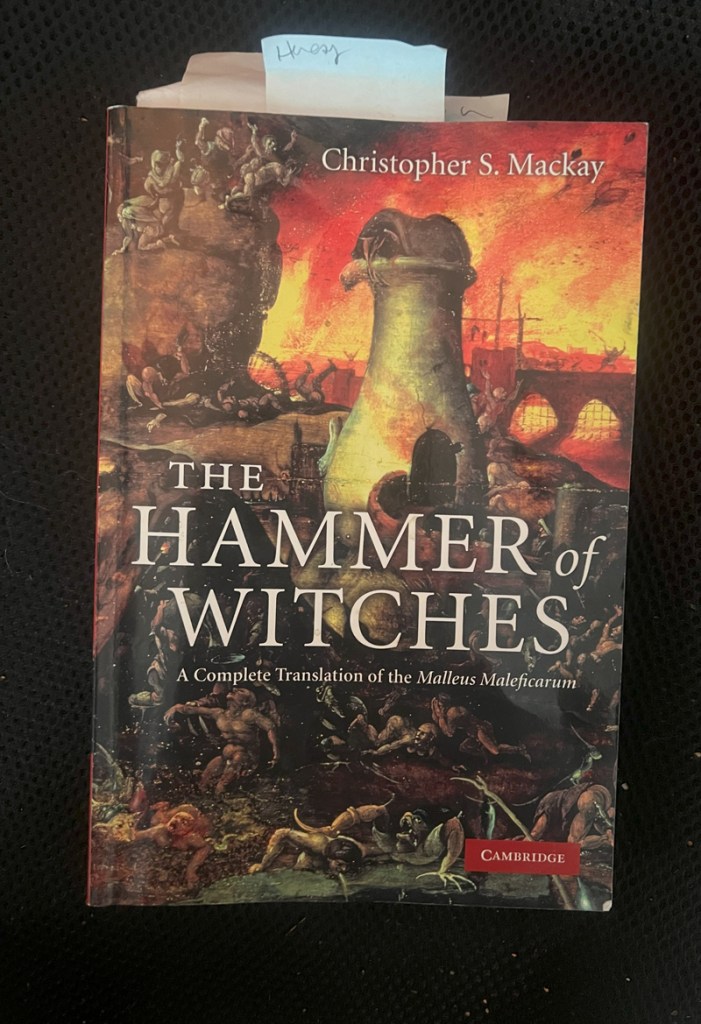
Decades, and seemingly lifetimes later, I completed my dissertation for my PhD in Religion and Philosophy in which I excavated some of the subaltern history of my European Ancestors and their female shamanic practices. At one inevitable point in my research – kicking and screaming – I reluctantly faced the inquisitions and witch trials. After waving a sage wand and cracking a sacred beer, I cracked open the Malleus Maleficarum, the infamous “Hammer of the Witches”.[1] This notorious guidebook, a how-to for career Christian Inquisitors written by two Dominican Friars[2] during the Middle Ages, details moral arguments supporting the legalized suppression, interrogation, and eradication of women designated by the church-state as heretics.

Continue reading “Incredibly! The Inquisitional Cultural Mechanism Rears its Hydra Head by by Elisabeth Sikie”

Hal’s Backyard Hustle directed by Annie Spiegelman

All female Bay Area film crew. Photo credit: William Buzbuzian

An email with a video titled “Hal’s Backyard Hustle” and a short introduction came into our inbox recently. The video is meant as comedy but with the serious intent of inspiring younger adults to vote. It made us (the behind-the-scenes FAR co-weavers) chuckle a couple of times. We’re delighted that people are creatively finding ways to encourage voting and, with that, protect our rights.

As the imitable Carol P. Christ started writing and teaching us so many years ago, the underlying purpose of patriarchy is to control women’s bodies and fertility.

We are seeing this taken to the extremes in our own country here in the U.S. Women who can’t access the most basic standards of care are left traumatized and some are dying. Police forces have been pressed into the duty of policing women’s bodies. Legislatures are writing laws for maximum cruelty. Exceptions (for rape, incest, blah, blah, blah) are nothing more than gaslighting projects to make the law makers seem more compassionate because in practice they are meaningless. Just how close to death does a women need to be before she can be treated? Does the rapist have to be convicted before a pregnant rape-survivor can access care? Because, really, according to patriarchy, you can’t trust women. Nor doctors.

Continue reading “Hal’s Backyard Hustle directed by Annie Spiegelman”

Convivencia, poems by Annelinde Metzner

For this post, I’ve collected five of my poems from the past ten years up to the present, which are centered around the people and cultures of the Middle East. Like the region, the poems are filled with hope and unspeakable grief.

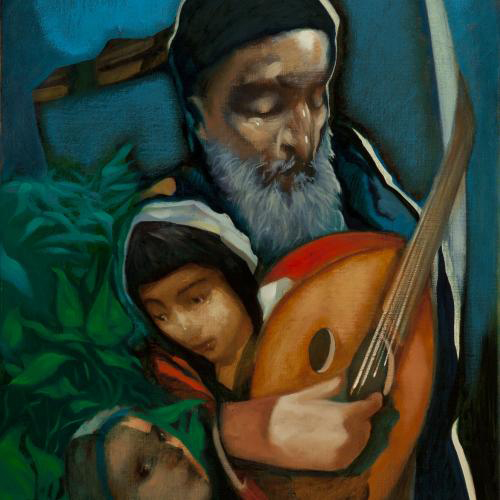
Ladino singer
Continue reading “Convivencia, poems by Annelinde Metzner”

Women’s Rights: How Far Back in Time Will our Legal System Go? by Janet Maika’i Rudolph

Wikimedia Commons

I was in the process of writing this blogpost last week when the Arizona supreme court decided to turn abortion rights back to the civil war era (1864). This was a time when women had no rights at all and abortion from conception was illegal. But civil war era laws are downright quaint and modern compared the legal underpinnings of the supreme court’s Dobbs decision.  

In his decision, Mr. Alito cited four “great” and “eminent” legal authorities, Henry de Bracton, Edward Coke, Matthew Hale, and William Blackstone. For perspective here are their dates. 

Henry de Bracton  c. 1210 – c. 1268
Edward Coke 1552 – 1634
Mathew Hale 1609-1676
William Blackstone 1723 –1780

To help me understand Alito’s logic, I read up on some conservative commentary. Here is what I learned: When the founding fathers needed to create legal documents, they didn’t create them out of thin air. They relied on the logic of the four men (and others) listed above. Yes, they did pick some enlightened aspects of these thinkers of the time, esp. in regard to the rights of the common people in relation to royalty. The thought of commoners having rights was revolutionary in its day. But as we have learned so painfully, our founding fathers limited who those rights applied to. They did not take into consideration the rights of anyone other than landowners, which at the time meant white men.

Continue reading “Women’s Rights: How Far Back in Time Will our Legal System Go? by Janet Maika’i Rudolph”