The Dark Goddess Los Angeles by Arianne MacBean

“Welcome to Hollywood! What’s your dream?” the character Happy Man says in the opening scene of Pretty Woman, a movie that epitomizes mythic Los Angeles, a place where fairy tales come true. The Dark Goddess Los Angeles, with Her lure of wealth and transformation, Her persona of glamour and aspiration, where even a down-and-out sex worker can be saved by a lawyer with a fear of heights and “save him right back.” Los Angeles calls out a westward invocation of promise. But as much as She pledges, She deceives. Her thick air, dense with unseen harmful toxins, a costly nutrient. Her sinewy highways, the blood lines of her body, sites of daily catastrophe. Our pilgrimage is the slow crawl of passing car crashes on the opposite side of the freeway divider wall. Our mantra, That could have been me. That could have been me.

Spiderweb of Freeways

I’ve been hating LA for thirty-five years. Hating Her May Grey and Her June Gloom. Hating Her maze-like web of concrete highways, Her center-less-ness. Only in Los Angeles are the freeways archetypes, “Take The 2 to The 5 to The 110 to The 10.” I’ve never felt lonelier – alone in my apartment, alone in my car, alone in my thoughts. But over time, I’ve learned to love traversing Los Angeles’ arteries. I have had some of my most profound ideas, my most aha moments, while flowing through Her pulsing veins. The neither here-no-thereness of this city is pregnant with patient possibility. Anything can happen in Her spaciousness, Her waiting.

Continue reading “The Dark Goddess Los Angeles by Arianne MacBean”
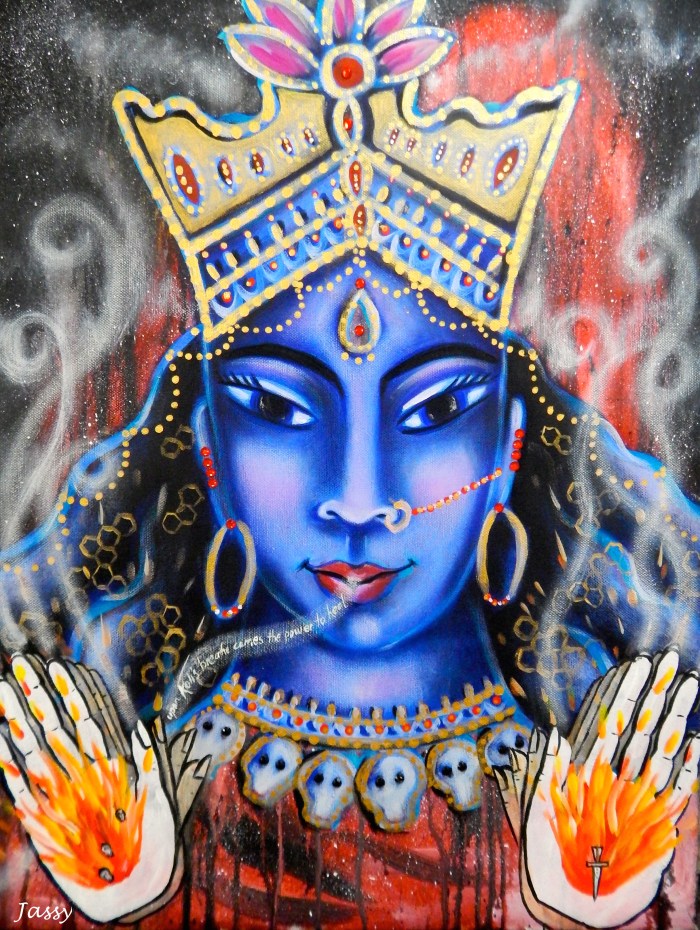
Why Feminism Needs the Fierce Goddesses by Susan Foster

Kali Ma – She who carries transformation upon Her breath.

The recent backlash against women and feminism, highlighted by the Supreme Court decision overturning Roe v. Wade, has left many people asking: Is feminism dead? Or if it isn’t dead, is it lost? The decision dealt a blow to one of the most basic freedoms of women—control over their own bodies. In the rush to protect the life of embryos and fetuses, the lives of millions of women will be compromised if not lost altogether, especially poor and BIPOC women.

The Court is inflicting its right-wing views on a country that does not share its values; a majority of Americans support a woman’s right to abortion. “The “triumphal right,” says Susan Faludi in an interview with Michelle Goldberg, “has taken the gloves off and is pursuing a scorched-earth campaign against women’s most fundamental rights.” [i] And although the feminist movement cannot be reduced to the fight for reproductive justice (with issues such as maternity leave, equal pay, childcare, healthcare, etc., still on the table), banning abortion has become the tip of the patriarchal iceberg.

Continue reading “Why Feminism Needs the Fierce Goddesses by Susan Foster”

Unorthodox; Embracing Kali on the Eve of Rosh Hashanah; ‘May you be be inscribed in the Book of Life’ by Joyce Zonana

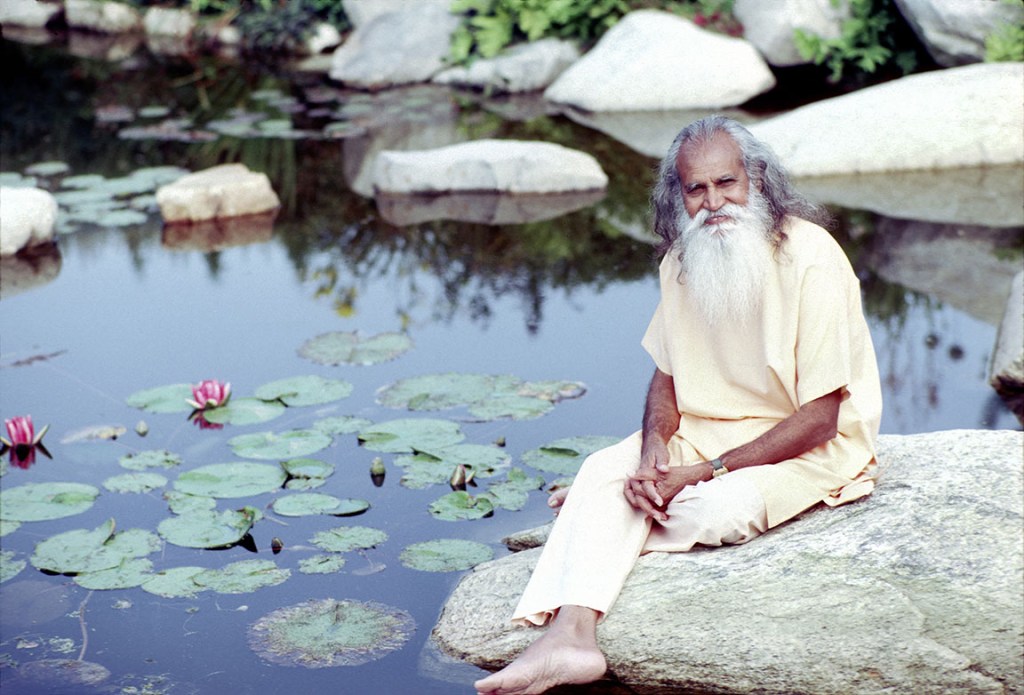
Sri Swami Satchidananda

A few weeks ago, I received a phone call from one of my spiritual teachers, a senior disciple of Sri Swami Satchidananda, whom I had immediately recognized and accepted as my guru when I first encountered him in the Summer of 1965. I was initiated by him in 2001 and received a mantra that I repeated daily for all these years. Yet here was Sary telling me I needed to adopt a new mantra, a prayer or praise and veneration for the fierce Hindu Goddess Kali. Here is exactly who I need these days, brandishing her ten arms, beheading demons and absorbing their blood, in a sari made from the skin of a Bengal tiger. She wears a belt of skulls and manifests her fierceness with a red tongue hanging from her lips. Creator and Destroyer, she is impeccable she catches their blood so that they don’t proliferate. Precisely who I need know after my diagnosis, six months ago of glioblastoma.

Continue reading “Unorthodox; Embracing Kali on the Eve of Rosh Hashanah; ‘May you be be inscribed in the Book of Life’ by Joyce Zonana”

On Ukraine, War and Goddess’s Protection by Judith Shaw

We have all been horrified by the Russian invasion of Ukraine as we witness the brutal bombardment of not only military sites but also of civilians, neighborhoods, hospitals, churches, historical sites and nuclear power plants. It has been called the first TicToc war as these images fill up our computers and cellphones, leaving peace lovers challenged to maintain their belief in peaceful resolutions to conflict

Continue reading “On Ukraine, War and Goddess’s Protection by Judith Shaw”

From the Archives: Still Practicing Her Presence By Barbara Ardinger

Moderator’s note: This marvelous FAR site has been running for 10 years and has had more than 3,600 posts in that time. There are so many treasures that have been posted in this decade that they tend to get lost in the archives. We have created this column so that we can all revisit some of these gems. Today’s blogpost was originally posted May 27, 2012. You can visit it here to see the original comments.

In my blog of May 11 about practicing the presence of the Goddess, I explained how Brother Lawrence of the Resurrection inspired me. Many thanks to everyone who read that blog and commented on it. One comment came via email from a friend, who said, “I kept thinking as I read about that expression ‘walking one’s talk.’” But of course. It would be lovely if anyone outside a nunnery or monastery could be as filled with their god or goddess as Brother Lawrence was. Though we try to be as mindful as we can, we obviously don’t always succeed as well as we’d like. But surely it’s better to have a positive intention than a negative one.

So let’s get practical. Instead of filling our heads with what’s been called monkey-chatter, let’s fill ourselves with the Goddess so that our thoughts of Her can go on autopilot. Instead of obsessing over, say, if the Lakers, Packers, or Cardinals are going to win their next whatever-they-play or who’s gonna win this week on Dancing With the Stars, let’s set our minds on the Goddess so our thoughts go to Her when we don’t have to concentrate on some specific, important task at hand.

Continue reading “From the Archives: Still Practicing Her Presence By Barbara Ardinger”

Prayers to Black Madonna and Kali Rising by Natalie Weaver

Natalie Weaver editedThis past Saturday, I had an opportunity to sweat in a traditional Lakota sweat lodge for the first time.  It was, above all, an interesting cognitive experience for me.  I found myself sort of shaking hands with the ritual, the heat, the stones, the songs, and so on, saying, “Hi, I’m Natalie.  I have an open mind.  I am excited to know about you.  Thanks for letting me see what you are all about.”  I didn’t know whether I would pass out, have visions, or learn something new and wonderful about myself or the others.  I was curious, still, and grateful for the opportunity. I was gifted by generous people, good fellowship, and new ideas.  I will go back, even though I didn’t exactly find some thing… or maybe I did.  Maybe, I found someone, or, better, maybe someone found me.
Two days before the sweat, I received an email from one of my companions on the journey, saying something I still do not understand about the Constellation Sagittarius, the Galactic Center, and the Rising of the Black Madonna.  Although I did not understand the astronomy, I was intrigued by the call to recognize and confirm the Black Madonna.  For, without particular reason or impetus that I could identify in myself, I had been dreaming of a Black Madonna statue for some time.  After trying to find out what it was, I was able to identify it as the Black Madonna of Prague.  I have never been to Prague and was basically unaware of the rich tradition of Black Madonnas in Europe, despite four semesters of art history in college.  So, I made note of my dreams, with a promise to myself to seek them out whenever and wherever I travel.  I also purchased little trinket at a Canadian gift shop, which sits on my desk as a guide and companion.
Continue reading “Prayers to Black Madonna and Kali Rising by Natalie Weaver”

I Am Queen by Vibha Shetiya

VibahI started this post just after getting back from an India trip, always very challenging because of memories that haunt me not only through their high negative recall value, but also in that I often find myself reverting to the diffident, fearful person I used to be while living there. In fact, palpitation is the first to greet me at Bombay airport even now after nearly seventeen years of being an expat. But with every trip, I also find myself evolving as a person, as a woman. And of course, it is always fun to meet up with family and old friends, all of whom I hold very dear. But the highlight of this trip was Queen.

Queen is a Bollywood movie unlike any other I’ve seen. As mentioned in a previous post, B-wood cinema if you can call it that, is made mostly of predictable, formulaic themes centering on impossible flights of fancy, not-so-subtle patriarchy, and gendered stereotypes. The good news is that in recent years, film makers have been trying to push boundaries in their own small ways, no doubt a laudable attempt in an industry where success still depends on mass consumption; box office success over critical acclaim. Queen, however, stands out in its portrayal of the protagonist Rani Mehra, a middle class young lady from Delhi (“rani” is “queen” in Hindi). Even more remarkable is that it portrays Rani’s female friends – “scantily” dressed women and prostitutes – without judgment, as human beings who are far from detrimental to Rani or the plot. Continue reading “I Am Queen by Vibha Shetiya”

And Then There Was Sita by Vibha Shetiya

VibaWe have been hearing a lot about Kali and Durga lately, manifestations of the great goddess (“Kali Ma,” by Jassy Watson, July 3; “What Would Durga Do?” by Barbara Ardinger, August 2). Nancy Vedder-Shults’ three-part series on Kali (August-October, 2014) too helped shed light on an often misunderstood deity. Both Kali and Durga personify the power or shakti within women, a force that can be empowering and terrifying at once. Kali represents uncontrolled female energy, whereas Durga is portrayed as one in control of her abundant power. These images, especially the one of Kali are double-edged; they can prove problematic for women insofar as – from the male perspective – they confirm the fact that women possess an alarming energy, especially a sexual one, which in turn justifies the need for men to subdue them.

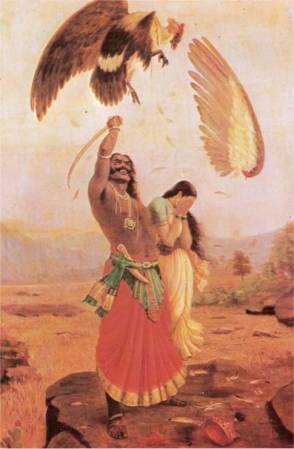
Sita's abduction by Ravana. Artist: Raja Ravi Verma
Sita’s abduction by Ravana. Artist: Raja Ravi Verma

Within this context, I would like to talk about Sita, who, one could argue, is the antithesis of the two. Sita is the gentle wife of Lord Rama, hero of the Ramayana, a two-thousand year old Sanskrit epic. In the Ramayana, Rama, the crown-prince of Ayodhya, is exiled to the forest for fourteen years. His loyal and faithful wife, the princess and goddess Sita, insists on accompanying him to the wilderness. There, the demon king, Ravana kidnaps her leading to a battle between Rama and Ravana. Almost a year and thousands of casualties later, Rama succeeds in slaying Ravana and reclaiming Sita.

But alas, Rama rejects his wife in the presence of the hundreds of onlookers, eagerly awaiting the reunion of the couple, on the grounds that her chastity was suspect; after all, says Rama, surely Ravana couldn’t have resisted her ravishing beauty? If she is to be worthy of Rama, Sita has to undergo a trial by fire to prove that she had indeed remained chaste throughout her captivity. Although she passes with flying colors, Rama eventually gives in to gossip and banishes her to the wilderness a few years later – while she is pregnant with his twins – where she is left to die (she, however, does not). Continue reading “And Then There Was Sita by Vibha Shetiya”

Kali Ma (Part 3 of 3) by Nancy Vedder-Shults

nancymug_3In contrast to the linearity of our time concept in the West, Indians view life as infinite and cyclical.  Although Hindus, like ancient Greeks, believe in four ages of humanity (the so-called yugas), these occur not just once, but repeat cyclically every several million years.  Similarly, the creator god Brahma is said to have a daily cycle which has recurring effects on the existence of the world.  When Brahma awakes the world is created anew, and when he falls asleep it dissolves once again into the primal waters of eternity.  Fortunately for us, Brahma’s day lasts 4,320,000,000 human years.
Holland Cotter, in reflecting on Eastern art, once brought these temporal differences into sharp focus when he contrasted two of the major icons of East and West  — Christ on the cross and the dancing Shiva.  He said, “The Christ figure embodies the Judeo-Christian concept of divine history as a straight, purposeful line from the Fall of Man (sic.) to redemption, but with a tragic human story of self-sacrifice, loss and atonement at its heart.  The dancing Shiva is, by contrast, a dynamic, joyous cyclical image: a poised, uplifted foot and hands form a circle echoing the nimbus of flames surrounding the figure.  The image represents a culture which…views both humans and gods as participants in a cosmic game that periodically grinds to a catastrophic halt only to begin again.”[i]

Like Shiva, Kali has been depicted surrounded by a halo of flames.  But unlike Shiva, her portrait is far from a joyous image.  In one example, a 17th or 18th century North Indian sculpture, Kali is personified as a voracious, old hag squatting on a victim whose entrails she eats.  Slicing open the belly of the anonymous corpse, Kali scoops out its intestines with her bony fingers and gobbles them with her protruding teeth.  The anonymity of the victim brings home to the viewer the fact that ultimately we are all Kali’s prey.  And the flames burning around her head reemphasize this point, for as the aureole of the Dancing Shiva, they are the fires of the final conflagration at the end of each world period.  But in this image we realize that such flames flicker constantly, since time erodes all that has ever existed and Kali swallows all she has ever birthed.[ii] Continue reading “Kali Ma (Part 3 of 3) by Nancy Vedder-Shults”

Ramakrishna Devotion to Kali-Ma (Part 2 of 3) by Nancy Vedder-Shults

nancymug_3Ramakrishna was one of the major poets who popularized Kali’s worship in Bengal, the northeasternmost province of India. Born in the early part of the 19th century, he was a Hindu saint in a tradition known as bhakti, where devotees lovingly surrender their hearts, minds and spirits to their chosen deity in a practice which leads to ecstatic union with the divine. Such devotion is easier for us in the West to imagine when the beloved is the playful Krishna with his sublime flute-playing and sacred lovemaking. But in Ramakrishna’s case, the object of his devotion was the fierce Kali, the wild and uncontrollable aspects of the sacred, to whom he devoted himself as a child would to its mother.

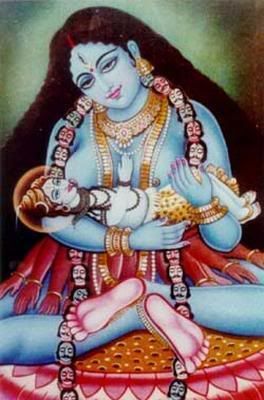
Kali with baby
Kali as the mother of Shiva

In his best-known evocation of the Goddess, Ramakrishna observes her as a graceful young woman sinuously emerging from the waters of the Ganges. As her belly breaks forth from the waves, we realize that she is late in pregnancy, coming to dry land to deliver her child. When she reaches the shore, she gives birth to a beautiful baby whom she fondles affectionately and lifts to her breast, where the child suckles until it is content. Holding her baby once more in her arms, the woman becomes the Kali we are more familiar with, a frightening old hag, gaunt with age and hunger. In her ferocious aspect, Kali then lifts the infant to her mouth, crushes it between her teeth and swallows the baby whole. Without a backward glance, she returns to the waters from which she emerged, disappearing again from view. Continue reading “Ramakrishna Devotion to Kali-Ma (Part 2 of 3) by Nancy Vedder-Shults”