Becoming Scrub by Sara Wright

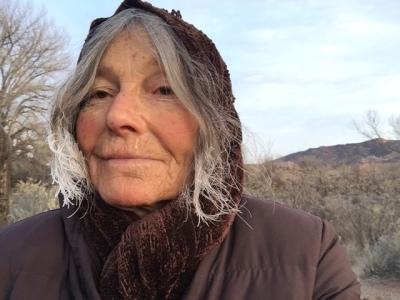
In the precious hour before dawn I walk down to a river that no longer empties into the sea – the circle of life has been broken – the earth’s veins and arteries are hopelessly clogged by human interference (stupidity) – the birds and animals that used to be able to rely on the river waters for food and resting places can no longer do so because dams control the water flow and westerners “own” the water. This morning black stone sculptures appeared overnight because the water level has been dropped another foot. And yet, acknowledging the flowing waters in their death throws seems like an important thing to do. For now, at least, the river turns crimson, reflecting the raging beauty of a pre dawn sky, and I am soothed by water rippling quietly over round stone.

I open the rusty gate to enter the Bosque, a place of refuge, for the cottonwoods and for me. Now I am surrounded by desert scrub and graceful matriarchs arc over my head. As I traverse the well  – trodden path I enter a meditative state without effort. Soon I am walking in circle after circle passing through the same trees and desert scrub hearing voices.

Continue reading “Becoming Scrub by Sara Wright”

The Caves Beneath My Roots or Psychological Spelunking by Darla Graves Palmer

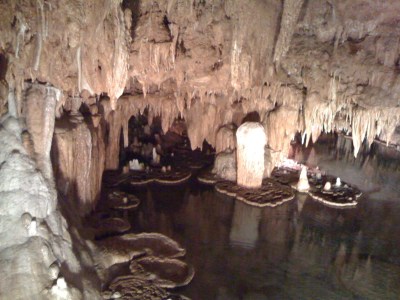
I’ve spent much of the past four years – since returning to the state of my birth after more than forty years’ intentional absence – trying to understand and make peace with a particular slice of southern culture that I avoided most of my adult life. Part of that process was a deep dive into my family roots which led me to also consider the caverns further below those roots. If landscape contributes to shaping our human nature, what might that mean for my family?

Here in the Missouri Ozarks, my roots extend a hundred and fifty years deep; my ancestors on both sides of my family are buried in the karst of the Ozark Plateau, and their bones have leached into the thousands of caves that honeycomb the area, mixing with the limestone and other minerals through the abundance of flowing water. I grew up being cautioned to watch out for sinkholes, often a sign that there was a cave system below.

Continue reading “The Caves Beneath My Roots or Psychological Spelunking by Darla Graves Palmer”

The Man with the Hat by Sara Wright

I met a man on a rumbling train who had hooks in his hat.

A fisherman, I thought with the usual dismay – brutal images of dying fish gasping for air exploded in thin air. Memories of my grandmother who took her eight year old granddaughter fly fishing also flooded my mind (my grandmother was a professional fly fisherwoman). I caught my first fish in the brook – a six inch trout. After landing the desperate creature my grandmother said, “ now we must kill it so the fish does not suffer.” And she looked for a stone.

“Hit it over the head” she instructed handing me a rock she picked up nearby, and I did.  Tears welled up. It broke my child’s heart to murder such a shimmering rainbowed creature.

When we got home that day, my grandmother praised me lavishly for my catch, promptly gutted the fish and fried it in a pan for me to eat. I forgot the anguish I had experienced, basking in my grandmother’s approval. The fish tasted delicious, and to this day I eat fish and other seafood.

As a lobsterman’s wife I learned quickly how to cook crustaceans by sticking their heads in boiling water so they would die almost instantly.

Continue reading “The Man with the Hat by Sara Wright”

Ant Hill by Sara Wright

Yesterday I gave a poetry reading at a local library beginning and ending with thoughts about how Climate Change is affecting all living things. I am a naturalist who holds the radical belief that all living things are sentient. I also argue that we must not equate animal intelligence with that of humans.

Almost every poem I read was about my intimate relationship with some aspect of the natural world, for example, the changing seasons, my friendship with sagebrush lizards, steadfast trees, Sandhill cranes, beloved Black bears. Intimacy and inter –relationship are part of every experience I have with nature and by sharing these poems I hoped might draw others in to new ways of perceiving the earth and her creatures.

The whole point of my focusing on non – human species was to raise awareness that these animals and plants desperately need our help. Perhaps I wasn’t clear enough about how critical it is to bring animals, plants, trees, mushrooms into the picture in this age of the Anthropocene, that is, the period in which we live where a few men with power rule. Today, it is not an exaggeration to say that humans control every aspect of our fragile planet.

I repeat: Perhaps I wasn’t clear enough or perhaps almost no one was capable of listening? Maybe both. As soon as I concluded my reading one woman did actually bring up an incident involving a very difficult child who became attached to a lizard, so she at least, was on the track I hoped I had laid….

Continue reading “Ant Hill by Sara Wright”

A Place Below the Cattails by Sara Wright

As a woman with Passamaquoddy roots when I first came to Abiquiu I was invited to participate in the six pueblo celebrations along the Rio Grande which made me feel blessed, grateful, included, and at “home.”

My own people’s lives and traditions were  destroyed by colonial peoples centuries ago.

Yesterday I was invited to attend a river blessing on what I call Red Willow River a tributary of the Rio Grande by folks of Spanish and Indigenous descent who live here in Abiquiu on the mesa. These people, although local, are of mixed descent and do not follow the seasons and cycles of the year as the surrounding pueblos do. There is a heavy overlay of Spanish colonialism along with a restrictive (to me) Catholicism that sets this village apart from the pueblos.

Still, I was looking forward to this celebration

That was supposed to be led by Tewa Women United from the neighboring pueblos. It was a beautiful day, and of course we were all on “Indian Time” which means practically that ceremonies start when the time was right.

However, this blessing of the river didn’t come together at all. People milled around aimlessly. Some left. The children some of whom were dressed in regalia played for a while and eventually got hungry. Some complained they had to get back to school for a game.

Continue reading “A Place Below the Cattails by Sara Wright”

THREE POEMS OF LIFE by Janet Maika’i Rudolph

As Above So Below

Yes, I believe we are made in god’s image.

If god is the wild, passionate, loud, sexual, sizzling, dancing fires of creation.

And should I ever forget my fiery, heavenly vision, the sun comes out every day to remind me.


And I ask myself, which is more miraculous? Our local star feeding earthly life?

Or me, reflecting the sun, feeling the passion, sizzling in response?

Jacob Dreams and So Do We

(inspired by Genesis 28:12)

As darkness slips into light,

dawn,

with its unique melody,

grows brighter.

As light slips into darkness,

dusk,

with its mysterious possibilities,

settles softly upon the land.


Creation is oneness, but we need duality to experience sex, symphonies, hot fudge sundaes.

Creation is pure love, but it is to the passions of the human heart that we owe our earthwalk


Dawn and dusk hold open the thresholds of mystery inviting our human hearts to experience . . .

The sacred dance where one becomes two becomes three.

The sacred song where three becomes two becomes one.
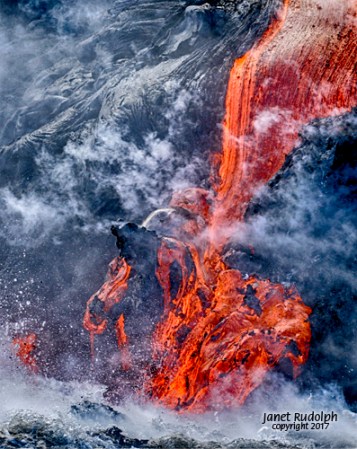
 

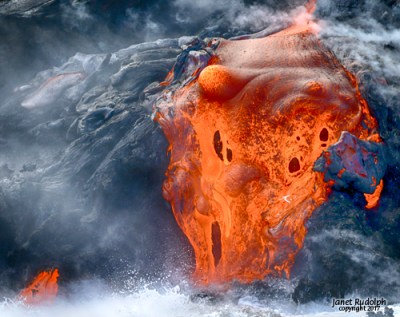
Pele’s Birth Dance

Twinkling stars ignite waves of fire that explode into a tumultuous, joyful noise:

“EH YEH, EH YEH, EH YEH.”


And Mother Earth awakens.


Matter bathed in Pele’s cauldron flares up, erupting into waves of baby earth while roaring:

“EH YEH, I AM, EH YEH.”


As seeds rise from great watery oceans of fire, my heart swells, breathing air into newly forged matter and causing my breath to become song:

“I AM, EH YEH, I AM.”


Fire,

that reflects flame-drenched stars,

that reflects Pele’s dance,

that reflects the passionate seed,

echoes within my belly until I glow with waves of love which burst forth to sing:

“I AM, I AM, I AM.”


And then . . .

Riding a watery wave that gushes forth new life, my newborn erupts from my body, then twinkles, then cries tumultuous joyful noise:

“EH YEH, EH YEH, WAHHHHhhhhhh.”

(Note: “Eh yeh” is God’s name in phonetic Hebrew as given to Moses in Genesis 3:14. “I am” is its traditional translation into English)
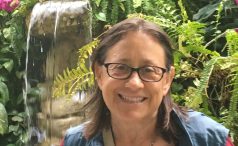
 

Janet Rudolph has written three books on the subject of ancient Biblical Teachings.  One Gods: The Mystic Pagan’s Guide to the Bible, When Eve Was a Goddess: A Shamanic Look at the Bible, and the just recently released book, When Moses Was a Shaman. For more information visit her website at /www.mysticpagan.com/

 

A Blinding Light? by Sara Wright

Nature is a Living Being. Animals and plants have souls, and a spirit. Each species is unique, and yet we are all interconnected, human and non – human species alike. This is more than a both and perspective; its multi-dimensional.

Many books are written about using nature to heal humanity of its ills. ‘Recreate’. Climbing a mountain, or taking a walk are common examples of using nature to help ourselves, but how many of us are asking the question of how we can give back?

This is a question I was obsessed with for about thirty years and may be the reason I gained entrance into this seemingly secret world that we call Nature.* When I experienced unconditional love from both animals and plants I needed to reciprocate in kind. This idea of reciprocity between humans and the rest of Nature is probably similar to what Indigenous peoples experienced because they loved (or feared) and learned directly from animals, plants and trees. They respected animals, for example, for their unique qualities. Indigenous people never psychologized Nature the way westerners routinely do.

I rarely read books about Nature anymore because I am so troubled by this psychologizing. From my point of view psycho-babble is just another way of dismissing the reality of Nature as a living feeling, sensing, sentient Being.

Continue reading “A Blinding Light? by Sara Wright”

The Truth About Humans by Natalie Weaver

I have greatly enjoyed an odd little book I read over the summer.  It is Lucy Cooke’s The Truth About Animals (Basic Books, 2018). Cooke takes us through a journey of animal behavior, chronicling the curious narratives that naturalists, philosophers, theologians, and other high-thinking professionals impose on animals to render their behaviors meaningful, moral, and relevant.  Cooke shows us how tempting it has been historically for people to seek and discover confirmation of human values in all those other pairs so happily coupled on Noah’s Ark.

It has often been an important tool for feminists, as with other sets of thinkers, to make these connections as well.  And, as one familiar with the classical charges that women are more inherently corporeal than their spiritual-intellectual male counterparts, and that therefore women are more animal than the more accurately “human” form that their male counterparts represent, I understand the feminist investment in nature.  I appreciate that it involves a sort of ownership and redefinition of the slur; an acceptance of space and place as limited and essentially animal; an awareness of environmental sustainability; a deep sense of connection to the continuum of creaturely being that is the giant ecology of our planet.

Continue reading “The Truth About Humans by Natalie Weaver”

Insect Conversations by Barbara Ardinger

“She’s doing it again,” Mrs. Cockroach is saying to her friend Old Mrs. Spider. “You know? The giant? She’s been blowing on me and telling me to live somewhere else. Like, I’d leave a good home?”


Old Mrs. Spider looks up from her weaving. “Yes,” she says in a weary voice. “But you know she’s not a giant. She’s just a normal human being, well, overweight, as I understand humans measure their bodies. And if she’s going to blow on us and ask us to live somewhere else, well…..I think she needs to brush her teeth.”

Mrs. Cockroach chuckles. “Indeed. We insects, maybe with the exceptions of fleas and termites, we don’t have bad breath. Blood-breath and wood-breath are sour! I was sitting on the wall in her bathroom, keeping an eye on things and telling the termites to get away from the window, and she just walks up. Doesn’t she know we insects and arachnids are protecting her house?”

Continue reading “Insect Conversations by Barbara Ardinger”

Greenness, Whiteness, Blackness, and the Nature of the World by Marisa Goudy

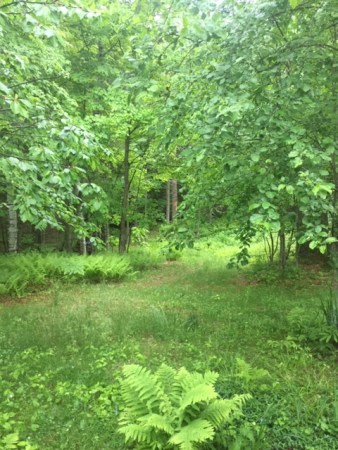
There’s magic in hiking alone, but as women, we’ve been taught to worry about venturing far on our own. In fact, we’ve been taught to worry about a lot more than that.

Though once I merely shrugged off the warnings and the horror stories, confident that I was wrapped in some sort of “not me” protective veil, I don’t usually take my safety for granted anymore. Maybe it’s because I’ve outgrown the belief that I’m invincible. Maybe it’s because I’m a mother and have a different understanding of the fragility of life and the female body. Maybe it’s because that murderer on the Appalachian Trail went by the nickname “Sovereign,” appropriating the powerful, beautiful word that is so essential to my life’s work.

This particular day, however, my desire to be outside was more compelling than my new bend toward caution. I called my husband to tell him just where I’d be, joking that he needed to know where to look for me if I didn’t pick up the girls from camp on time.

Continue reading “Greenness, Whiteness, Blackness, and the Nature of the World by Marisa Goudy”