

Body of Nature by Oxana Poberejnaia

oxanaIn the medieval European philosophy, woman’s body was seen as a vessel filled with sins, while man was regarded as a more spiritual being. This is one of the reasons why the concept of body is reassessed in feminist studies and why body is elevated in neo-paganism and Goddess spirituality. My fear is that nowadays body can be treated as an instrument for social advancement.
OLYMPUS DIGITAL CAMERA

We still live in a society that is deeply hostile to women’s bodies. Alla Demidova, an actress I respect for her talent and her critical mind, did a programme of Christmas-related poetry. I could not listen to more than five minutes of it.

The poems have been all written by men. I am not saying that men do not have the right to write about birth. I am saying that our prevalent image of Christmas should not be based on male view alone. In this sense I much better like the Carol from “The Vicar of Dibley” (one of my favourite British comedy series, about a female Vicar), which describes the movement of baby Jesus through Mary’s birth canal.

Continue reading “Body of Nature by Oxana Poberejnaia”

Drop the sense of entitlement towards life by Oxana Poberejnaia

oxanaAt the time of climate change and crises of capitalism we need to drop our sense of entitlement to comfortable life or even to life at all. Nature will not spare us just because we are humans. When the meltdown of economic and environmental systems occurs, we are all going down: humans and non-humans, women and men, spiritual or not. We have almost run out of time.

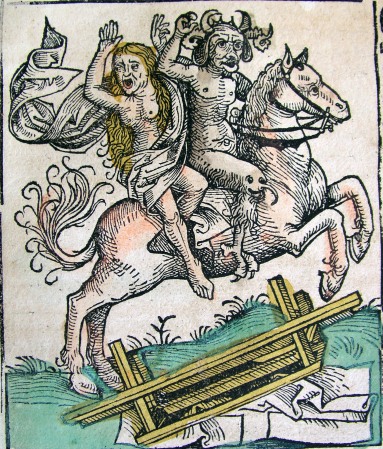
Victor Pelevin, my favourite contemporary Russian author, has a novel called “The Sacred Book of the Werewolf“. I love it in part because, like Kill Bill, it is a rare creation by a male author, which manages to capture the female warrior spirit.

surprise___you__re_a_werewolf_by_mightywarlordIt starts with the main character, a Chinese Buddhist Were Fox who lives in present-day Moscow, consoling herself: “What else (or What the fuck) did you expect from life, A Huli?” A Huli is her name, supposedly meaning Fox A in Chinese. It is also a swear phrase in Russian, meaning “What the fuck?”

Continue reading “Drop the sense of entitlement towards life by Oxana Poberejnaia”

Pause, Stop and Re-evaluate your place within patriarchy and capitalism by Oxana Poberejnaia

oxanaThere are three vicious circles: patriarchy, samsara and wanton destruction of environment. All three lead ultimately to annihilation of life. All three are incredibly difficult to escape. One of the reasons for this difficulty is that there are pay-offs. Someone or something benefits from keeping the cycles going.

Men and Mothers-in-Law seemingly benefit from patriarchy. However, the privileges granted by patriarchy are based on a pyramid scheme of tyranny. You get to bully people who are below you on the patriarchal pecking order: women, men of the lower status, daughters-in-law. Everyone at the higher level gets to bully you. The top man lives in constant fear of de-throning. Continue reading “Pause, Stop and Re-evaluate your place within patriarchy and capitalism by Oxana Poberejnaia”

Complete in Incompleteness by Oxana Poberejnaia

oxanaA former monk and hospice worker Rodney Smith, now the Founding teacher in Seattle Insight Meditation Society uses the phrase: “Be complete in incompleteness” quite a lot.

When applied to Feminism, to me it means a couple of things. First, I find it hard, but I have to accept the fact that I will not probably experience the fullness of triumph of Feminism in my lifetime. I am of the “I want it all and I want it now” variety, but in this case I will have to come to terms with the fact that even my closest loved ones might not be fully feminist.

Angela_Merkel_(G8_2007)Only recently a woman close to me criticised Angela Merkel for her masculine style of clothing. I honestly thought that we had stopped judging politicians based on their gender or the clothes we think appropriate to that gender.

Continue reading “Complete in Incompleteness by Oxana Poberejnaia”

Relaxing Into an All-Encompassing World by Oxana Poberejnaia

oxanaI believe that as feminists what we are striving towards is not just equality between women and men, although this aspect is crucial. Feminism has contributed to developing of such disciplines and practices as deconstruction, environmentalism, LGBT rights, and animal rights.

Feminism walks in step with all the movements for more justice and freedom in the same way as patriarchy goes along with capitalism, exploitation and environmental degradation. Continue reading “Relaxing Into an All-Encompassing World by Oxana Poberejnaia”

Is it harmful to assign positive qualities to women? by Oxana Poberejnaia

oxanaI have recently learnt about features assigned to women and men by a Tibetan Lama. Women are seen as having better access to qualities of space and therefore holding special kinds of wisdom that lead to Enlightenment. Men, on the other hand are better suited to create and act within space, and this they are rightful owners of the actions that lead to Enlightenment.

In popular Goddess spirituality it is also normal to find distinction between women and men’s core traits. The properties assigned to the “feminine” and the “masculine” usually follow the same pattern: Goddess stands for interconnectedness, and thus relations and caring for others. God (if there is a place for him) is about protection and action.

restroom-304986_640I am afraid to say that to me, this approach only embeds patriarchal order by putting women firmly in the sphere of domesticity, even if in the elevated role of “Domestic Goddess”, while men are still expected to go out, fight and thus organise and rule society, which women are expected to preserve.

Continue reading “Is it harmful to assign positive qualities to women? by Oxana Poberejnaia”

Where does your conviction come from? By Oxana Poberejnaia

oxanaI sometimes feel a bit awkward about not having read a lot of feminist books and not knowing a lot of feminist theory. However, I draw support from the example of Zen, “the teaching beyond letters.”

zen_logo_by_vargux-d4lwlr5The number and scope of different Buddhist traditions might overwhelm non-Buddhists reading my ramblings or any other writings about Buddhism. Even Buddhists, as those who come to Manchester Buddhist Convention, of which I am a co-organiser, every year discover new Buddhist groups that have been hitherto unknown to them.

All these traditions claim to be an authentic form of Buddhism and those that are concerned with such things, trace direct lineage of teaching coming all the way from the Buddha. As the editor of the volume “Buddhist Scriptures” Donald S Lopez Jr notes (Penguin Classics, 2004), such diversity requires certain means of ensuring that this school’s particular teachings are still in line if not with the letter, then with the spirit of the historic Buddha’s teaching.

Continue reading “Where does your conviction come from? By Oxana Poberejnaia”

Cheeky Buddha by Oxana Poberejnaia

oxanaFeminism can be loud and in your face. Feminists can be unapologetic and radical in their statements. I could never bring myself to be abrupt with proponents of patriarchal views. Being a middle class Brit from a Soviet background, I withdraw from awkward situations and prefer to keep discussion within civil forms of defined discourse at conferences and letters to my MPs and to the BBC.

People who know that I practise Buddhist disciplines might say that this also plays a part in my avoiding direct confrontation. It is true but only up to a point. I do not rush into an argument mostly because of my training not to rush into anything, but to first become mindful and see where the impetus for my action is coming from: is it something worthwhile or is it some undigested trauma from childhood? It is usually the latter. Continue reading “Cheeky Buddha by Oxana Poberejnaia”

Bodies of More and Less Value by Oxana Poberejnaia

oxanaThere is a story in the collection called Avadanasataka (One Hundred Legends) of the Sarvastivadin school, one of the schools of early Indian Buddhism that did not survive to present day, relating one episode from the Buddha’s previous lives. The story is about king Padmaka who sacrificed his life to cure his subjects of a disease. Here is an academic article about this episode.

The Buddha was prompted to tell this story of his previous life in order to illustrate to his monks, once again, the workings of karma. All of the monks in the Buddha’s milieu were sick with a digestive disorder, while he remained well. The Buddha presented the story of king Padmaka as a proof that no good deed is ever lost and that what he had done then has an effect now in that the Buddha has good digestion.

Continue reading “Bodies of More and Less Value by Oxana Poberejnaia”

The Difficult Issue of the Origins of the Buddhist Nuns’ Order by Oxana Poberejnaia

oxanaThe origins of the Buddhist Nuns ‘ Order are a contentious issue in Theravada Buddhism. Paradoxically, it is also the issue that is not discussed a lot. Which is surprising, as in current Buddhism there is a gaping hole where a Theravada Bhikkhuni (Nuns) community should be. The prevailing view is that the nuns’ full ordination line was irrevocably lost long in the past and cannot be restored.

There are separate attempts here and there to bring Theravada Nuns’ Order back, including Ajahn Brahm’s ordaining a group of nuns in Dhammasara Monastery in Australia in 2009. This resulted in severe criticism by some Theravada religious leaders and expulsion of Ajahn Brahm and the monastery he leads from the organisation of the Sangha of Wat Nong Pah Pong.

AniPemaChodronMahayana Nuns receive full ordination, as it is considered that historically the Order did not lose continuity since the Buddha’s times. However, for both Theravada and Mahayana something called “The Eight Garudhammas” – the eight heavy rules – remain a painful issue. These are the rules that the historical Buddha is supposed to have given the first nuns to whom he gave ordination. These eight rules were the condition on which the Buddha would even allow women to become Bhikkhuni.

Continue reading “The Difficult Issue of the Origins of the Buddhist Nuns’ Order by Oxana Poberejnaia”