Women, Blame, and Patriarchy by Mary Gelfand

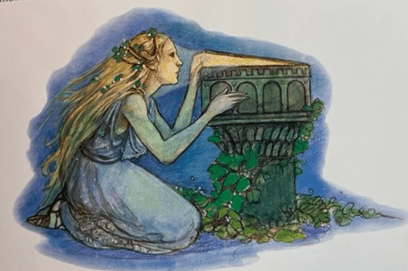
Pandora by Rebecca Guay

Last May I had a vision in the shower. It wasn’t the kind of vision I like to have—where the Goddess and I dance across a meadow with flowers springing up as we pass and cool breezes bringing sweet fragrances. This was the kind of vision I’d rather not have, but probably needed to. This is from my journal.

Something happened during my shower recently that feels relevant. As I stepped into the shower, a phrase thrust itself into my mind: “I was forced to watch them die and it was all my fault.” As I ‘stood’ there with water pouring over my body and that statement vibrating in my brain, it attached itself to a scene where I was the spiritual leader of a community that came under attack. I was forced to watch the women and men who believed in what I taught as they were executed. Many of them were friends and relatives. I was restrained and couldn’t intervene to save them, or join them in execution. Having to witness this was part of my punishment. Instead I was carried to a bigger town, publicly humiliated and beaten, and then executed in some painfully unpleasant way I can’t recall–probably because I don’t want to.

Continue reading “Women, Blame, and Patriarchy by Mary Gelfand”

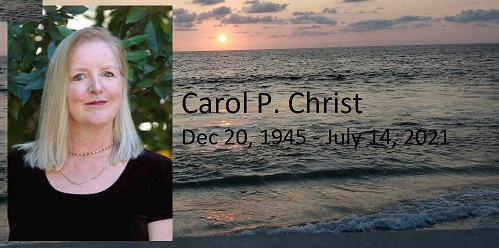
Legacy of Carol P. Christ: “What Would Happen If One Woman Told the Truth about Her Life?”

This was originally posted on September 24, 2018

According to poet Muriel Rukeyser, “the world would split open.”

This poem accurately describes what many women experienced in consciousness raising in the 1970s and what many women experience today in the #MeToo movement.

For many of us the world did split open. We began to take ourselves and our experiences seriously. To do so we had to question received wisdom encoded in such questions as: “What was she doing there in the first place?” “Was she drinking too?” “Why didn’t she change out of her bathing suit?” Underlying these questions is the assumption that: “whatever happened, she must have asked for it.”

A lot of people are wondering why congressmen and voters who claim to uphold Christian principles are not more outraged about credible allegations of sexual assault against a child whose name was Christine Blasey. What this question fails to address is the fact that the Christian principles (if any) held by conservatives are steeped in patriarchy. Liberals may argue that Jesus would have cared about the girl, and I believe they are right. But the Christianity that developed after his death was centered on the Father, Son, and Holy Spirit, all of whom are male. This Christianity is patriarchal to the core: its deep message is that power belongs the hands of males and that male power is not to be questioned.

Continue reading “Legacy of Carol P. Christ: “What Would Happen If One Woman Told the Truth about Her Life?””

Two Steps Forward, Three Steps Back By: Anjeanette LeBoeuf

It is a new year, 2023 and with it, some truly concerning elements. One of the most all consuming is that of the persistent and continual attack on women, communities of color, non-Christian communities, and the queer community.

One of my last FAR posts talked about the situations, uprising, and horrible killings done by the Iranian Fundamentalist regime. The protests are still happening, more people are being arrested, and the death toll has continued to rise. We have also seen the death of the longest reigning monarch, Queen Elizabeth II, and the surprised resignation of New Zealand Prime Minister Jacinda Ardern.

Continue reading “Two Steps Forward, Three Steps Back By: Anjeanette LeBoeuf”

The Patriarchal Dilemma by Janet Maika’i Rudolph

I was listening to a newscast when it was reported that the Ukraine sent missiles into Russia. My initial thought was “it’s about time they took it to the Russians.” The next moment I was horrified at myself.  I am a pacifist.  I think the proliferation of weapons is one of humankind’s great evils and here I was cheering on an attack.  One that could escalate an already nasty war, lead to nuclear weapons use and possibly even a world war. And yet when I look at what is happening in Ukraine, my mind simply can’t comprehend what the people are going through. The trauma of the children cuts particularly deeply. And I can see no sane reason behind the strikes other than rank cruelty.

There it is in a nutshell, what I have come to call the patriarchal dilemma. It’s a no-win situation with no right answer. While life might place us in such positions all on its own, the patriarchal form of this is created by design. It is nasty, it is cruel, and loss of human life and ecological destruction are not glitches but features.

Continue reading “The Patriarchal Dilemma by Janet Maika’i Rudolph”

From the Archives: “The Importance of Religion for Ecofeminism,” by Ivy Helman.

Author’s note: Originally published on January 8, 2017, this post still speaks to me 6 years-to-the-day later. Now, when I teach ecofeminism, I dedicate a week to religion as we cannot deny the way in which Western patriarchy and religion have coexisted and often fed off each other. The only distinction I would add to this original post is that not all religions are equal when it comes to patriarchy and its misdeeds. Christianity has had more power and influence than others. However, Christianity is not the only religion to hold patriarchal views. That needs to change. May the New Year bring more of that needed change.

“Why is religion important to ecofeminism?” A student, in the Master’s course I teach at Charles University, asked this as we began the class session dedicated to the topic. Given the overwhelming presence of atheism in the Czech Republic, I wasn’t too surprised by the inquiry.  Nonetheless, the idea has been at the back of my mind ever since: what does religion have to do with ending patriarchy and bolstering the health of the planet? While I may take the connection as obvious, it is clearly not for many feminists out there. Here is how I understand it.

Continue reading “From the Archives: “The Importance of Religion for Ecofeminism,” by Ivy Helman.”

Government Workings in Misogynyland by Barbara Ardinger

Dazed by the breakneck speed of the descending subway ride, the girl collapsed on the marble floor and just sat there for a while. Eventually she noticed a table with two full cups sitting on it and a sign that said Drink Me. “No no no,’ she said aloud. “Auntie said never drink what you don’t know you’re drinking because you never know what’s gonna happen to you.” She sat for another long minute, then said, “So where am I? I know where I was headed. To a committee meeting. But that’s not where I am. Where am I?” No reply. She looked around. To her left was a fancy garden gate, but she could see no garden beyond it, only lots of steps. To her right was a long corridor with office doors on both sides. All the doors she could see had names on them.

“Alice.” Where was that voice coming from? “Alice, you’re here for a meeting. You’re late! Hurry up! We can’t be late!” She stood up, but all she could see was a long-eared shadow (how curious!) running down the corridor. “I’m late, I’m late,” came the echoing voice.

Continue reading “Government Workings in Misogynyland by Barbara Ardinger”

The Legacy of Carol P. Christ: Was Ariadne the Most Graceful Bull-leaper of All? Deconstructing and Re-visioning Greek Mythology

This was originally posted on March 3, 2014

Sometimes we think of Greek myth as a pre-patriarchal or less patriarchal alternative to the stories of the Bible. After all, Goddesses appear in Greek myths while they are nearly absent from the Bible. Right?

So far so good, but when we look more closely we can see that Greek myth enshrines patriarchal ideology just as surely as the Bible does. We are so dazzled by the stories told by the Greeks that we designate them “the origin” of culture. We also have been taught that Greek myths contain “eternal archetypes” of the psyche. I hope the brief “deconstruction” of the myth of Ariadne which follows will begin to “deconstruct” these views as well.

bull leaping ring before 2000 bc phourni

Ariadne is a pre-Greek word. The “ne” ending is not found in Greek. As the name is attributed to a princess in Greek myth, we might speculate that Ariadne could have been one of the names of the Goddess in ancient Crete. But in Greek myth Ariadne is cast in a drama in which she is a decidedly unattractive heroine.

Continue reading “The Legacy of Carol P. Christ: Was Ariadne the Most Graceful Bull-leaper of All? Deconstructing and Re-visioning Greek Mythology”

What Would a “Good Christian Woman” Do? by Liz Cooledge Jenkins

Early morning lap swim at the local pool is generally a peaceful space for me. It’s usually pretty uneventful. I try to go three times a week; I don’t always feel like going, but I always feel better after I do. The other day, though, something happened that upset my equilibrium and got me thinking.

When I showed up at the pool, ready to mind my own business and get a good workout in, I was happy to see three empty lanes. I don’t mind splitting a lane when needed, but it is a nice little luxury to have a lane all to myself. I chose one of the empty lanes, and in the next few minutes, two other swimmers arrived and filled in the other two. I did a long, leisurely warm-up and then stopped at the wall to find that another swimmer had joined me in my lane.

As he swam back and forth on the right side of the lane and I did the same on the left, I realized that he was taking up more than his fair share of the lane. I felt a little annoyed and disrespected. But it didn’t seem like a big deal. I started on my next set.

Continue reading “What Would a “Good Christian Woman” Do? by Liz Cooledge Jenkins”

The Legacy of Carol P. Christ: What if Divine Feminine and Divine Masculine Are Not Oppositional Categories?

Moderator’s Note: The blog was originally posted May 18, 2015

A friend who is a spiritual teacher speaks often “bringing back the values associated with the Divine Feminine.” For her this has to do with helping women to understand the beauty of our bodies and the importance of ways of being such as giving and caring for others that have been associated with the undervalued so-called “feminine” side of the masculine-feminine polarity. Though she also speaks about the Goddess, I think she prefers the term “the Divine Feminine” because of the implication that men too have their “Divine Masculine.”

This friend has a wonderful husband who is a teacher in his own right and who often ends up spending a lot of his time among powerful women who enjoy talking about the Goddess. In these conversations he sometimes speaks of the need for men to “recover the Divine Masculine” if they are to become whole.

Continue reading “The Legacy of Carol P. Christ: What if Divine Feminine and Divine Masculine Are Not Oppositional Categories?”

The Fall of Patriarchy: I Got Scammed by Caryn MacGrandle

I am a few months out of my second marriage. There will be no third. I know my task right now is to become self-sufficient.

Thanks to my second husband, I have valuable Project Management skills. He set up an S-Corporation when he was out of work in Illinois and handed it over to me when he found a salaried job. I gained needed self-confidence over the past eight years and figured out that I am good at Project Management.

Now I need to convince another company of that. Because I am not good at sales and no longer have my main client in my company and with my divorce, I need a steady income.

I thought I had found one.

I was reached out to by a supposedly Swiss company called HAND-Lease that leases and sells extremely large equipment from $25,000 up to $55 million. They had just established a Pennsylvania office and were now opening a Birmingham office. I was phone screened by a customer service employee who said if they were interested, the Human Resource department would reach out to me for a longer interview. 

Continue reading “The Fall of Patriarchy: I Got Scammed by Caryn MacGrandle”