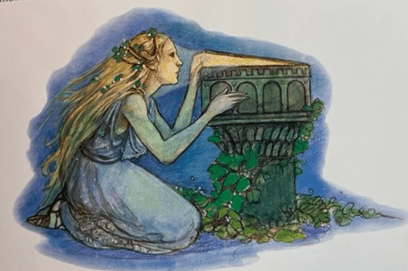
Government Workings in Misogynyland by Barbara Ardinger

Dazed by the breakneck speed of the descending subway ride, the girl collapsed on the marble floor and just sat there for a while. Eventually she noticed a table with two full cups sitting on it and a sign that said Drink Me. “No no no,’ she said aloud. “Auntie said never drink what you don’t know you’re drinking because you never know what’s gonna happen to you.” She sat for another long minute, then said, “So where am I? I know where I was headed. To a committee meeting. But that’s not where I am. Where am I?” No reply. She looked around. To her left was a fancy garden gate, but she could see no garden beyond it, only lots of steps. To her right was a long corridor with office doors on both sides. All the doors she could see had names on them.

“Alice.” Where was that voice coming from? “Alice, you’re here for a meeting. You’re late! Hurry up! We can’t be late!” She stood up, but all she could see was a long-eared shadow (how curious!) running down the corridor. “I’m late, I’m late,” came the echoing voice.

Continue reading “Government Workings in Misogynyland by Barbara Ardinger”

The Legacy of Carol P. Christ: Was Ariadne the Most Graceful Bull-leaper of All? Deconstructing and Re-visioning Greek Mythology

This was originally posted on March 3, 2014

Sometimes we think of Greek myth as a pre-patriarchal or less patriarchal alternative to the stories of the Bible. After all, Goddesses appear in Greek myths while they are nearly absent from the Bible. Right?

So far so good, but when we look more closely we can see that Greek myth enshrines patriarchal ideology just as surely as the Bible does. We are so dazzled by the stories told by the Greeks that we designate them “the origin” of culture. We also have been taught that Greek myths contain “eternal archetypes” of the psyche. I hope the brief “deconstruction” of the myth of Ariadne which follows will begin to “deconstruct” these views as well.

bull leaping ring before 2000 bc phourni

Ariadne is a pre-Greek word. The “ne” ending is not found in Greek. As the name is attributed to a princess in Greek myth, we might speculate that Ariadne could have been one of the names of the Goddess in ancient Crete. But in Greek myth Ariadne is cast in a drama in which she is a decidedly unattractive heroine.

Continue reading “The Legacy of Carol P. Christ: Was Ariadne the Most Graceful Bull-leaper of All? Deconstructing and Re-visioning Greek Mythology”

What Would a “Good Christian Woman” Do? by Liz Cooledge Jenkins

Early morning lap swim at the local pool is generally a peaceful space for me. It’s usually pretty uneventful. I try to go three times a week; I don’t always feel like going, but I always feel better after I do. The other day, though, something happened that upset my equilibrium and got me thinking.

When I showed up at the pool, ready to mind my own business and get a good workout in, I was happy to see three empty lanes. I don’t mind splitting a lane when needed, but it is a nice little luxury to have a lane all to myself. I chose one of the empty lanes, and in the next few minutes, two other swimmers arrived and filled in the other two. I did a long, leisurely warm-up and then stopped at the wall to find that another swimmer had joined me in my lane.

As he swam back and forth on the right side of the lane and I did the same on the left, I realized that he was taking up more than his fair share of the lane. I felt a little annoyed and disrespected. But it didn’t seem like a big deal. I started on my next set.

Continue reading “What Would a “Good Christian Woman” Do? by Liz Cooledge Jenkins”

The Legacy of Carol P. Christ: What if Divine Feminine and Divine Masculine Are Not Oppositional Categories?

Moderator’s Note: The blog was originally posted May 18, 2015

A friend who is a spiritual teacher speaks often “bringing back the values associated with the Divine Feminine.” For her this has to do with helping women to understand the beauty of our bodies and the importance of ways of being such as giving and caring for others that have been associated with the undervalued so-called “feminine” side of the masculine-feminine polarity. Though she also speaks about the Goddess, I think she prefers the term “the Divine Feminine” because of the implication that men too have their “Divine Masculine.”

This friend has a wonderful husband who is a teacher in his own right and who often ends up spending a lot of his time among powerful women who enjoy talking about the Goddess. In these conversations he sometimes speaks of the need for men to “recover the Divine Masculine” if they are to become whole.

Continue reading “The Legacy of Carol P. Christ: What if Divine Feminine and Divine Masculine Are Not Oppositional Categories?”

The Fall of Patriarchy: I Got Scammed by Caryn MacGrandle

I am a few months out of my second marriage. There will be no third. I know my task right now is to become self-sufficient.

Thanks to my second husband, I have valuable Project Management skills. He set up an S-Corporation when he was out of work in Illinois and handed it over to me when he found a salaried job. I gained needed self-confidence over the past eight years and figured out that I am good at Project Management.

Now I need to convince another company of that. Because I am not good at sales and no longer have my main client in my company and with my divorce, I need a steady income.

I thought I had found one.

I was reached out to by a supposedly Swiss company called HAND-Lease that leases and sells extremely large equipment from $25,000 up to $55 million. They had just established a Pennsylvania office and were now opening a Birmingham office. I was phone screened by a customer service employee who said if they were interested, the Human Resource department would reach out to me for a longer interview. 

Continue reading “The Fall of Patriarchy: I Got Scammed by Caryn MacGrandle”

From Footbinding to Abortion and Beyond – This Has to Stop! by Janet Maika’i Rudolph

Children’s Museum of Indianapolis

My husband, Marty, is a retired podiatrist.  He worked in pockets of New York City that were poor and largely immigrant. When he first started his practice, he treated women from China whose feet had been bound. Despite being officially outlawed 1912, footbinding was still being practiced well into modern times. He saw these patients in the 1970s and 80s.

For those who don’t know what it is, young girls, as young as 3-5 would have the bones in their feet broken and then the feet bound with cloth strips. Every few years, the feet would be broken again until the desired result was created. To create that affect, the toes would be flattened against the bottom of the foot and arch would be so broken and damaged that the heel would curl back to the front of the foot. At each of the breakings the girl would need to learn to walk again.  One can only imagine that pain of walking on foot bones that had been repeatedly broken. And here is an especially chilling part. The mothers would do it to their own daughters. I won’t go into further gruesome details because they can be easily looked up on the internet.  It left the girls crippled for life.

Continue reading “From Footbinding to Abortion and Beyond – This Has to Stop! by Janet Maika’i Rudolph”

The Legacy of Carol P. Christ: Who Is Jephthah’s Daughter? The Sacrifice of Women and Girls

Moderator’s Note: The was originally posted on January 20, 2014

Last week I reflected on Angela Yarber’s insightful essay and painting on Jephthah’s daughter. For those who did not read the earlier posts, the story of Jephthah’s daughter is found in the Hebrew Bible.  Jephthah’s daughter was sacrificed by her father after he swore in the heat of battle that if his side won, he would sacrifice the first person he would see on returning home.  Angela called us to reflect on who Jephthah’s daughter is in our time.

In my earlier midrash on the story, I invoked Daniel Cohen’s powerful retelling of the story of Iphigenia.  Cohen concludes that Artemis told Agamemnon that his ships would sail only if he sacrificed his daughter not because she wanted him to do it—but because she hoped this challenge would induce him to realize that the costs of war outweigh any possible gain.

Continue reading “The Legacy of Carol P. Christ: Who Is Jephthah’s Daughter? The Sacrifice of Women and Girls”

Inspired by Carol P. Christ: Patriarchy Rules the Supreme Court by Janet Maika’i Rudolph

Along with the words of Justices Sotomayer, Breyer and Kagan.

The Supreme Court ruling overturning Roe was expected, but there was nothing that could prepare me (nor likely anyone else) for the devastation of the actual decision. My gut is reeling. I thought it would be useful to survey the landscape through the lens of patriarchy. Thanks to Carol Christ for having always written insightful comments about the roles of patriarchy. This is inspired by her work.

The dissenting judges were quite eloquent, so I will work off their words.

  • “Whatever the exact scope of the coming laws, one result of today’s decision is certain: the curtailment of women’s rights, and of their status as free and equal citizens.”
  • “After today, young women will come of age with fewer rights than their mothers and grandmothers had. The majority accomplishes that result without so much as considering how women have relied on the right to choose or what it means to take that right away. The majority’s refusal even to consider the life-altering consequences of reversing Roe and Casey is a stunning indictment of its decision.”

My Commentary: Through the eyes of patriarchy here is no need to consider life-altering consequences because it only recognizes two roles for women: madonna or whore. We are never seen as full humans with civil and independent rights. Patriarchy doesn’t just hate the sexual freedom of women, it has spent millennia trying to quash it, make it into something dirty, control it. It’s a love/hate relationship with sex. Rape is really OK (look how hard it is to prosecute). Pedophilia OK too (look at the church). But a woman making her own sexual, reproductive choices . . . a bridge too far. Patriarchy will always force us to pay a price for having sex, for being alluring, for being female.

Continue reading “Inspired by Carol P. Christ: Patriarchy Rules the Supreme Court by Janet Maika’i Rudolph”

Carol P. Christ’s Legacy: Was There a “Golden Age” before Patriarchy and War? by Carol P. Christ

Marija Gimbutas coined the term “Old Europe” c.6500-3500 BCE to describe peaceful, sedentary, artistic, matrifocal, matrilineal and probably matrilocal agricultural societies that worshipped the Goddess as the power of birth, death, and regeneration in all of life. Gimbutas argued that Old Europe was overthrown by Indo-European speaking invaders who began to enter Europe from the steppes north of the Black Sea beginning about 4400 BCE.  The Indo-Europeans were patrilineal and patriarchal, mobile and warlike, having domesticated the horse, were not highly artistic and worshiped the shining Gods of the sky reflected in their bronze weapons.

In the fields of classics and archaeology, Gimbutas’s work is often dismissed as nothing more than a fantasy of a “golden age.” In contrast, scholars of Indo-European languages, Gimbutas’s original specialty, are much more likely to accept the general outlines of her hypothesis. The German linguist and cultural scientist Harald Haarmann is one of them.

Continue reading “Carol P. Christ’s Legacy: Was There a “Golden Age” before Patriarchy and War? by Carol P. Christ”

The Patriarchy of Ki Tisa and a Call to Reimagine Divinity by Ivy Helman.

This week’s Torah portion is Ki Tisa, Exodus 30:11-34:35.  Its events revolve around the theme of creation, destruction, and recreation.  From a feminist perspective, it is quite clear that this cyclical process is a result of a patriarchal understanding of the divine as jealous, distant, and rage-filled.  

Ki Tisa begins soon after the Israelites have been delivered from Egyptain slavery.  This delivery creates a new people devoted to this divine liberator.  Yet, Ki Tisa starts with both that deity and their leader, Moses, nowhere to be found. So, what do the Israelites do being in such a vulnerable spot?  They create a golden calf in order to have a spiritual connection to something.  

Continue reading “The Patriarchy of Ki Tisa and a Call to Reimagine Divinity by Ivy Helman.”