then I am holy. Made of moonbeams and shadows, darkness and light, questioned and answered, lost and retrieved;
discovered remains
If I am The Mother
then I am a reflection, a depiction, an inflexion of a cosmos in bliss and chaos, birth and destitution; a primordial sound unleashed to form planet, life, and
you and me
If I am The Mother
then I am fermented in humanity, and sour the illusions of precipices we’re told that
This was a hard book for me to review. Perhaps because she writes about such difficult issues and yet she does so in a compelling and at times even humous manner. I feel a responsibility and yet find it hard to capture how she manages a breezy manner while discussing heavy material. Perhaps, even though our backgrounds are vastly different, I was also relating to so much of what she said. Jamie also covers so much ground; it is hard to pick out individual aspects to discuss.
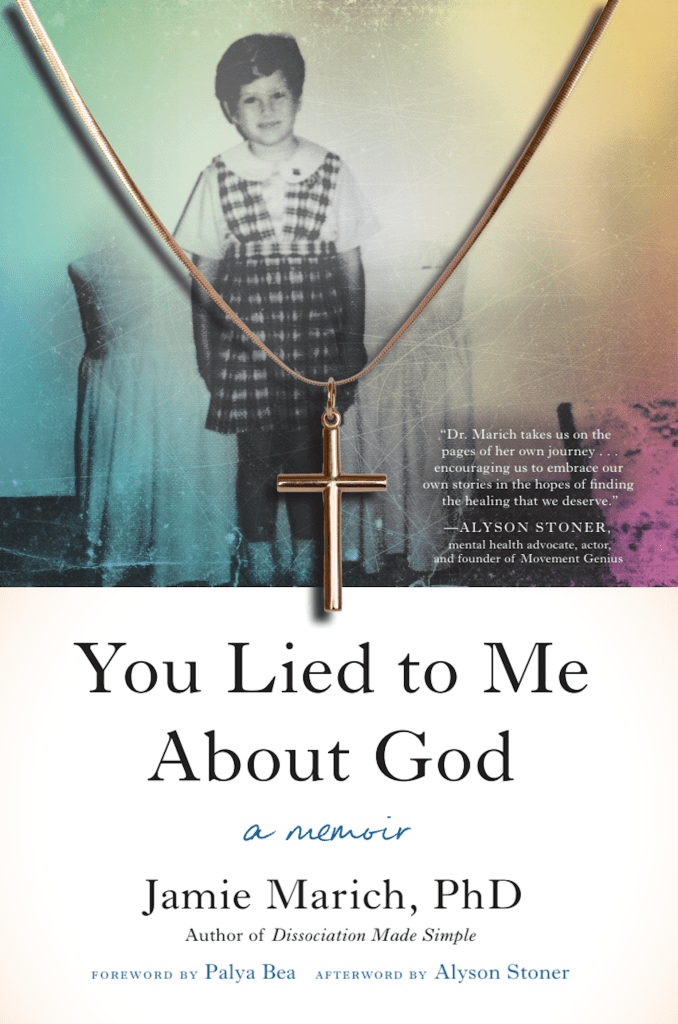
As a child Jamie Marich was caught in the web of different religious systems, Catholicism from her mother and Evangelical from her father. They were at soul-hurting odds with each other (both parents and religions). Each one proclaimed they were the one true path so there was the ever-present threat of choosing the wrong one and facing a parent’s wrath along with that of eternal damnation. She labels this spiritual trauma. It cuts to the soul of a person being trapped into a no-win situation. It’s a conflict-driven, shame-filled, guilt-ridden way to grow up.
I often find myself sitting in conservative Catholic spaces. My brother is a Roman Catholic priest in the Dominican order and I remain in support of his vocation. Every time, before a Mass officially starts, I’m overcome with a sense of: “You belong here…and you don’t.”
The part of me that has always felt at home in a Catholic setting is that love of the ritual and ceremony, the smell of the incense, the familiarity of the chants and songs. It was a Catholic priest, the late Fr. Ciaran O’Donnell, who taught me how to play the guitar and got me started with the healing practice of songwriting. When I sink into these associations, I feel connected to my Croatian ancestors and our Catholic faith. And there’s the other part of me—the queer feminist and an advocate for other queer and transgender people to live the fullest, most open expressions of themselves in all spaces of life, especially faith-based spaces. As a survivor of several forms of sexual assault and as a trauma specialist who has guided countless other survivors in their healing process over the years, I can’t sit in a Catholic Church and not feel uneasy about the legacy of abuse and silencing survivors within the church. Between my queer identity and dedication to supporting survivors, I feel that I don’t belong.
Moderator’s Note: We inadvertently left out the photos from Beth’s posts on Sojourner Truth. The photos, all by themselves, pack an emotional punch and so we want to be sure they can be seen. These are Beth’s photos from Sojourner Truth Legacy Plaza in Akron, Ohio
Most of us are quite familiar with Sojourner Truth’s “Ain’t I a Woman?” speech as recorded by Frances Gage several years later, with its powerful “ain’t I a woman” refrain. However, the actual speech as transcribed at the time by Marius Robinson, while similar in content, does not contain the refrain. Rather, Truth simply states that she is “a woman’s rights” woman.[i] It is unlikely that she spoke in the southern dialect Gage used in her transcription, since Truth grew up knowing only Dutch, eventually learning English as spoken in New York, and probably spoke with a Dutch accent. Much of the content in the Gage version was fabricated – such as the statement that she bore thirteen children, when she only had five children, though she did cry out in a mother’s grief when she learned that her only son, Peter, had been illegally sold south to Alabama.[ii]
The erasure of this web is to make women feel alone and disconnected. Maybe it would make them want to give up.
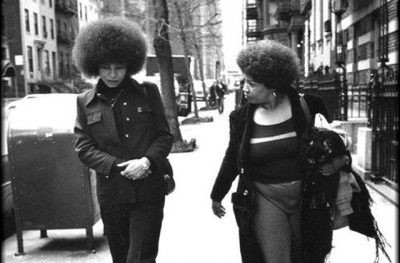
Angela Davis and Toni Morrison
This may sound extreme but imagine this scenario: You are a young woman starting out and you are told that the path you wish to follow is one of pain, loneliness and lacks any kind of support or network with other women that came before you. There are plenty of men but you are left out of that network.
Why would you want to do it? Because in your soul of souls you are a writer, or an artist or a scientist . . . So you decide to do it anyway. But instead of expecting support and connection you have already decided, based on what you have been told, that there won’t be any and so you start to not expect it.
I watched with confusion and a guilty sense of disgust – maybe this was the way things were done in India? My aunt had reached across to the cluster of letters strung together by a single piece of wire twirled around a nail on the wall, and gently dislodged one of them. They were from my father to his mother. I didn’t know what to think. After all, she went on to say, Your father is so good with language; just listen to this, just how beautifully he writes, before reading out aloud a lengthy passage. She was a good reader; gentle, perfect cadence with pauses in the right places. But I wanted to turn away on this intrusion of privacy, on this emotional voyeurism, but then thought, Wait, just last evening and the evening before that, and the many evenings before that she had spent the only free time she would get – from the large extended family who, hearing of her generous spirit, had congregated in her home in Bombay, that city of big dreams but of tiny square footage (blissfully unaware that they were now indebted to her for life) – on her rudrakshamala, deep in meditation, in union with god. So pious a woman! So pure a heart! Such a giving soul! Surely then there can’t be anything wrong here. Especially if it’s to say something nice about someone you cared for. And, after all, those letters were right there in the kitchen above the dining table, weren’t they? Not tucked away in some corner of a chest of drawers hidden from sunlight.
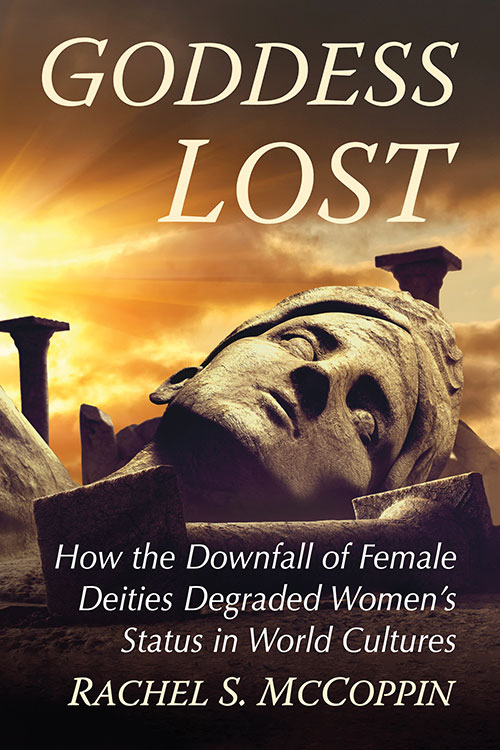
From the moment I saw the title, Goddess Lost: How the Downfall of Female Deities Degraded Women’s Status in World Cultures, by Rachel S. McCoppin, I knew I would have to read it. When it arrived in my mailbox and I saw the cover, I was imbued with inspiration. Then I read two sentences in the Preface, which articulate what for me, and for many, is one of the most vital, powerful, and, as yet, under-addressed, facts.
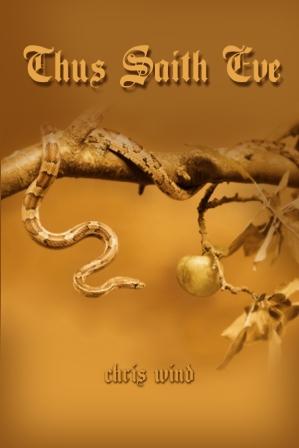
“I am the Queen of Sheba and I am not impressed.” This is the first line of one of the monologues from chris wind’s book Thus Saith Eve. This book features 18 stories of biblical women, and a 19th, Lilith, from Jewish mythology. Each monologue offers a new interpretation and gives a voice to the women that we think we know.
In this book the voices and personalities of women such as Noah’s wife, Mary of Bethany, Zipporah, and Vashti are reimagined in an exciting and empowering way. Each of the stories also features an appendix where the reader can learn more about the biblical or mythological context of the woman who is telling her story.
As in her other works, wind uses historical people, events, and understandings to build a truly wonderful source of feminist fiction. In addition to being an extremely enjoyable and thought provoking read, the monologues can also be used for audition and performance pieces. On her website wind explains that two of the monologues, “I am Eve” and “I am Mary” can be performed with specific musical selections in the background. You can find those selections linked to her website above.
We have been lost to each other for so long. My name means nothing to you. My memory is dust.
This is not your fault or mine. The chain connecting mother to daughter was broken and the word passed into the keeping of men, who had no way of knowing. That is why I became a footnote, my story a brief detour between the well-known history of my father and the celebrated chronicle of my brother.
Anita Diamant, The Red Tent
I am an expat author. My home is everywhere and nowhere. A wanderer, I have lived in many different places, from Minnesota, my birthplace, with its rustling marshes haunted by the cries of redwing blackbirds, to Bavaria with its dark forests and dazzling meadows and pure streams where otter still live, to my present home in the haunted moorlands of Pendle Witch country in Lancashire, England. My entire adult life has been a literal journey of finding myself in the great world.
For as long as I remember, I longed to be a writer. As a novelist I am on a mission to write women back into history. To tell the neglected, unwritten stories of women like my pioneering foremothers who emigrated from Bohemia (now the Czech Republic) in the 1860s to break the prairie soil of southern Minnesota.
To a large extent, women have been written out of history. Their lives and deeds have become lost to us. To uncover their buried truths, we must act as detectives, studying the sparse clues that have been handed down to us. We must learn to read between the lines and fill in the blanks. My heroine’s journey, in other words, is about reclaiming the lost heroines of history. My quest is to give voice to ancestral memory of that lost motherline.




 Feminism and Religion