
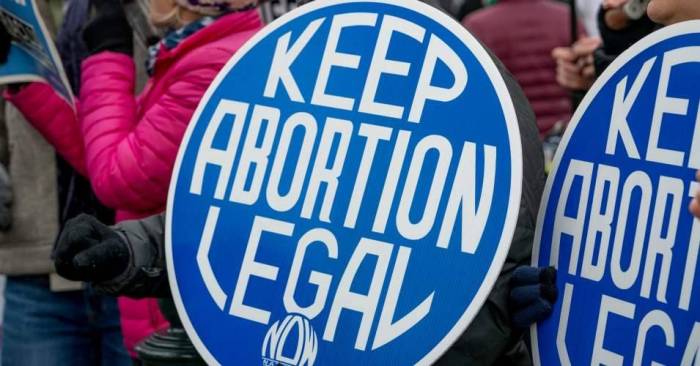
Women’s Autonomy and Well-Being v. the Patriarchy by Elizabeth Ann Bartlett

A recently leaked draft of the US Supreme Court’s opinion on Dobbs v. Jackson Women’s Health Organization suggests that the court is ready to overturn Roe v. Wade. Most people know the legal consequence of Roe, but few know the grounds for the decision. The focus was on the “important and legitimate interest” the state has in preserving and protecting the health of the pregnant woman. Defining “health” broadly, Justice Blackmun wrote:

            The detriment that the State would impose upon the pregnant woman by denying this choice altogether is apparent. Specific and direct harm medically diagnosable even in early pregnancy may be involved. Maternity, or additional offspring, may force upon the woman a distressful life and future. Psychological harm may be imminent. Mental and physical health may be taxed by child care. There is also the distress, for all concerned, associated with the unwanted child, and there is the problem of bringing a child into a family already unable, psychologically and otherwise, to care for it. In other cases, . . . the additional difficulties and continuing stigma of unwed motherhood may be involved. (410 U.S. 113, 1973) 

Psychological, physical, familial, social, present and future health of the woman are all to be taken into consideration. I would add to this the spiritual well-being of the woman, for this is a deeply personal spiritual decision as well.

Continue reading “Women’s Autonomy and Well-Being v. the Patriarchy by Elizabeth Ann Bartlett”
Patriarchy and the Supreme Court by Janet Maika’i Rudolph

I am pissed! I wrote this blogpost the day after Beltane when the leaked draft of the Supreme Court majority opinion regarding Roe v. Wade was leaked to the public. I was up anyway feeling the effects of PTSD. Lessons that Carol P. Christ wrote about and brought to my own consciousness were rattling around my head. The first is her definition of patriarchy: “patriarchy is a system of male domination in which men dominate women through the control of female sexuality with the intent of passing property to male heirs.” This definition was part of a 3-part series she wrote (and we recently re-posed in her legacy posts) beginning here.

They are all well worth reading.

I was raped in 1977 when I was 22 years old. This after being abused by my father. I never got pregnant, but I was suicidal after the rape. Had I been pregnant without recourse to ending it, I would without a doubt have stabbed myself in the stomach or reached for that metal coat hanger. (I was too young to face pregnancy when my father abused me.) Had the result been my own death, that would have been warmly welcomed on my part. To this day, I still self-mutilate at times when stress becomes too much.    

Continue reading “Patriarchy and the Supreme Court by Janet Maika’i Rudolph”

The Right to Choose is the Right to Our Lives by Marie Cartier

MarieCartierforKCETa-thumb-300x448-72405Friday, January 22nd marks the 43rd anniversary of the Roe v. Wade decision of 1973 which provided all women nationwide, for the first time, the right to get a legal abortion for any reason–the right to choose. There are celebrations, and actions for visibility planned throughout the nation. Some of them are listed on the Planned Parenthood website.
On this anniversary,  the stakes for women’s access to legal abortion are higher than ever. Politicians threaten to further restrict access and the U.S. Supreme Court soon will  hear the biggest abortion case in decades. What was life was like for women before legal abortion–and what could it again become? Politicians threaten to continue to take women’s health backwards. Continue reading “The Right to Choose is the Right to Our Lives by Marie Cartier”

Bringing African American Churches into Reproductive Justice by Mariam Williams

Mariam WilliamsI don’t expect to hear anything in church about the 40th anniversary of Roe v. Wade during the month of January,  the month marking 40 years since the U.S. Supreme Court made the decision to legalize abortion in this country. This is for a number of reasons: 1) it’s January, and at my church the pastor always starts off the year with a series of sermons that illustrate the church’s mission statement, and women’s choice may be off the subject; 2) Martin Luther King Jr. Day is this month, and if a black church is going to honor something or someone besides Jesus in the month of January, it should probably be MLK; and 3) I haven’t heard anything about abortion from the pulpit in a long time.

A local pro-choice movement leader asked me recently about how black churchgoers feel about abortion. I didn’t know what to say. The last time I heard it mentioned was in a Sunday School class in which a woman said that she almost aborted her daughter. It wasn’t a big confessional moment, just part of a longer testimony as to why she was happy her daughter was around, and it wasn’t received with any shock or fanfare. I can remember hearing once from the pulpit of my current church that while abortion might be wrong, the law shouldn’t interfere with what a woman chooses to do with her own body. Many years before that, in the church I grew up in, a preacher said that we would never find a cure for AIDS because the person who would have grown up to discover the cure was aborted. (What made him so sure of that? Who knows.) Continue reading “Bringing African American Churches into Reproductive Justice by Mariam Williams”

Hands Off By John Erickson

This post is written in conjunction with the Feminist Ethics Course Dialogue project sponsored by Claremont School of Theology in the Claremont Lincoln University Consortium,  Claremont Graduate University, and directed by Grace Yia-Hei Kao.

John Erickson is a doctoral student in Women’s Studies in Religion at Claremont Graduate University.  His research interests involve an interdisciplinary approach and are influenced by his time as the director of a women’s center and active member in the GLBTQ and women’s rights movements.  His work is inspired by the intersectionality of the feminism, queer identity, and religious political and cultural rhetoric.  He is the author of the blog, From Wisconsin, with Love and can be followed on Twitter at@jerickson85.

I find it little ironic that I am writing about Mary Daly’s formidable “anti-male” book Gyn/Ecology.  I remember reading the book when I was a sophomore in college and I owe much to Daly and her opus because they helped me to identify as a radical.

I know my position in feminism is sometimes misunderstood.  I have often found myself on the defensive end when someone asks me the question: “Why are you a feminist?”  However, although my identification as a feminist is always changing and growing, the label “RADICAL” is one I proudly wear on my chest everyday.   Continue reading “Hands Off By John Erickson”