Legacy of Carol P. Christ: Who Is Jephthah’s Daughter? The Sacrifice of Women and Girls

This post was originally published on Jan 20th, 2014.

Last week I reflected on Angela Yarber’s insightful essay and painting on Jephthah’s daughter. For those who did not read the earlier posts, the story of Jephthah’s daughter is found in the Hebrew Bible.  Jephthah’s daughter was sacrificed by her father after he swore in the heat of battle that if his side won, he would sacrifice the first person he would see on returning home.  Angela called us to reflect on who Jephthah’s daughter is in our time.

In my earlicarol p. christ 2002 colorer midrash on the story, I invoked Daniel Cohen’s powerful retelling of the story of Iphigenia.  Cohen concludes that Artemis told Agamemnon that his ships would sail only if he sacrificed his daughter not because she wanted him to do it—but because she hoped this challenge would induce him to realize that the costs of war outweigh any possible gain.

I suggested that these words be spoken whenever the story of Jephthah’s daughter is told: Continue reading “Legacy of Carol P. Christ: Who Is Jephthah’s Daughter? The Sacrifice of Women and Girls”

Legacy of Carol P. Christ: WOMEN ARTISTS AND RITUALISTS IN THE GREAT CAVES: THE BEGINNING OF THE END OF INDOLENT ASSUMPTIONS

This was originally posted October 21, 2013

In an earlier blog, I suggested that women might have blown red ocher around their hands to leave their marks in prehistoric caves.

At the time I thought this was a rather bold suggestion.

Had I been asked why I thought the images were made by women, I might have said that people have understood caves to be the womb of the Great Mother, the Source of All Life, from time immemorial. I might have added that those who performed rituals in the caves cannot have been performing simple “hunting magic,” but must also have been thanking the Source of Life for making life possible for them and for the great beasts they hunted.  Still I am not certain that I imagined women as the artists in the Paleolithic caves.

handprint peche merle cave
Continue reading “Legacy of Carol P. Christ: WOMEN ARTISTS AND RITUALISTS IN THE GREAT CAVES: THE BEGINNING OF THE END OF INDOLENT ASSUMPTIONS”

Legacy of Carol P. Christ: The Turtle Goddess from Myrtos in Ancient Crete

This was originally posted on October 15, 2012

“As we bless the Source of Life, so we are blessed.” Song by Faith Rogow

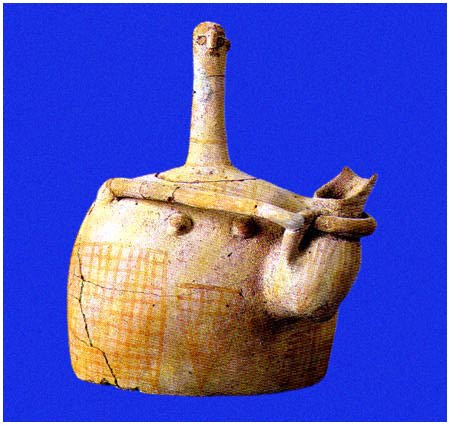
The strange and cheerful figure portrayed in this ancient Cretan vessel comes from the site known as Fournou Korifi near Myrtos, in Crete.  Dated before 2000 BCE, she was called the “Goddess of Myrtos” by the excavator, Peter Warren.  This little Goddess was found on an altar in a small room in the ritual area of a complex of small rooms on a hill above the sea that was home to up to 120 people.  The Goddess of Myrtos is a vessel holding a vessel.  In ritual libations, liquid would have been poured from the pitcher she holds onto an altar.

.She is obviously female, with breasts and a sacred triangle.

The cross-hatching on her sacred triangle and on the squares drawn on her body perhaps symbolize woven cloth and the important roles of women as weavers in the community that created her.  A side view shows that she is “stitched together” along her sides.  The many spindle whorls and loom weights recovered from the site provide material proof of the importance of weaving at Myrtos.

Continue reading “Legacy of Carol P. Christ: The Turtle Goddess from Myrtos in Ancient Crete”

Legacy of Carol P. Christ: “AS WE BLESS THE SOURCE OF LIFE, SO WE ARE BLESSED”

This was originally post May 7, 2012

Blessing the Source of Life harks back to the time when shrines were built near springs, the very literal sources of life for plants, animals, and humans.

The prayer “As we bless the Source of Life, so we are blessed,” based on a Hebrew metaphor which refers to a water source and set to music in a Jewish feminist context by Faith Rogow, has become one of the bedrocks of my Goddess practice.

In Minoan Crete, seeds were blessed on the altars of the Goddess and the first fruits of every crop were returned to Her. The ancient Minoans piled their altars high with barley, fruits, nuts, and beans, and poured libations of milk and honey, water and wine, over the offerings they placed on altars. Evidence of these actions is found in the large number of pouring vessels stored near altars.

Continue reading “Legacy of Carol P. Christ: “AS WE BLESS THE SOURCE OF LIFE, SO WE ARE BLESSED””

Legacy of Carol P. Christ: The Mountain Mother: Reading the Language of the Goddess in the Symbols of Ancient Crete

The blog was originally posted on May 22, 2017

Before he told the story of how his people received the sacred pipe, Black Elk said:

So I know that it is a good thing I am going to do; and because no good thing can be done by any man alone, I will first make an offering and send a voice to the Spirit of the World, that it may help me to be true. See, I fill this sacred pipe with the bark of the red willow; but before we smoke it, you must see how it is made and what it means. These four ribbons hanging here on the stem are the four quarters of the universe. The black one is for the west where the thunder beings live to send us rain; the white one for the north, whence comes the great white cleansing wind; the red one for the east, whence springs the light and where the morning star lives to give men wisdom; the yellow for the south, whence come the summer and the power to grow.

But these four spirits are only one Spirit after all, and this eagle feather here is for that One, which is like a father, and also it is for the thoughts of men that should rise high as eagles do. Is not the sky a father and the earth a mother, and are not all living things with feet or wings or roots their children? And this hide upon the mouthpiece here, which should be bison hide, is for the earth, from whence we came and at whose breast we suck as babies all our lives, along with all the animals and birds and trees and grasses. And because it means all this, and more than any man can understand, the pipe is holy. [italics added]

In this passage Black Elk illustrates the multivalency of symbols: the sacred pipe does not have a single meaning, but many meanings, in fact, more meanings than anyone can understand.

Continue reading “Legacy of Carol P. Christ: The Mountain Mother: Reading the Language of the Goddess in the Symbols of Ancient Crete”

Legacy of Carol P. Christ: “Fertility” and the Regeneration of Life

This was originally posted on October 12, 2020

Prehistoric and indigenous religious traditions are often disparagingly mischaracterized as primitive fertility religions, concerned not with higher morality, but rather with the processes of reproduction of humans, animals, and plants. When these religions feature a Great Mother Goddess, it may be assumed that these religions are primarily focused on birthing human babies. Nothing could be farther from the truth.

Indeed, archaeologist Marija Gimbutas discovered that in the symbol systems of Old Europe, the Goddess is only rarely imaged as pregnant or giving birth. Nor is She portrayed solely in human form. Rather, She is portrayed with a bird head, wings, and a plethora of other animal and plant features. If She is a Great Mother Goddess, She is revered as the Source of Life, not simply as a mother of human babies. Gimbutas states that in Old Europe the Goddess was worshiped in as a symbol of the powers of birth, death, and regeneration in all of life. Gimbutas said these societies were matrilineal and probably matrilocal. Recent research into matrilineal and matrilocal egalitarian matriarchies provides insight into the values of prehistoric societies. The Minangkabau of West Sumatra, Indonesia are matrilineal and matrilocal, with family ties being traced through the mother line and land being held communally and in perpetuity by the maternal clan. Though the Minangkabau trace their ancestry through their mothers and grandmothers, it is important to note that, as Peggy Reeves Sanday discusses in Women at the Center, it is not birth or the ability to give birth that is celebrated as the highest value, but rather the nurturing of the weak and the vulnerable.

Continue reading “Legacy of Carol P. Christ: “Fertility” and the Regeneration of Life”

The Legacy of Carol P. Christ: Who Is Jephthah’s Daughter? The Sacrifice of Women and Girls

Moderator’s Note: The was originally posted on January 20, 2014

Last week I reflected on Angela Yarber’s insightful essay and painting on Jephthah’s daughter. For those who did not read the earlier posts, the story of Jephthah’s daughter is found in the Hebrew Bible.  Jephthah’s daughter was sacrificed by her father after he swore in the heat of battle that if his side won, he would sacrifice the first person he would see on returning home.  Angela called us to reflect on who Jephthah’s daughter is in our time.

In my earlier midrash on the story, I invoked Daniel Cohen’s powerful retelling of the story of Iphigenia.  Cohen concludes that Artemis told Agamemnon that his ships would sail only if he sacrificed his daughter not because she wanted him to do it—but because she hoped this challenge would induce him to realize that the costs of war outweigh any possible gain.

Continue reading “The Legacy of Carol P. Christ: Who Is Jephthah’s Daughter? The Sacrifice of Women and Girls”
Carol P. Christ’s Legacy: Great Goddess, Mother Goddess, Creatrix, Source of Life

This post was originally posted on February 5, 2018

The symbol of the Goddess is as old as human history. The most ancient images of the Goddesses from the Paleolithic era are neither pregnant nor holding a child. In Neolithic Old Europe the Goddess was most commonly linked with birds or snakes and only rarely portrayed as mother. Yet we tend to equate the Goddess with the Mother Goddess. I suspect that images of the Virgin Mary with Jesus on her lap and prayers to God as Father have fused in our minds, leading us to think that the Goddess must be a Mother Goddess and primarily a Mother.

In a recent blog, Christy Croft reminded us that in our culture, women’s experiences of mothering and motherhood are not always positive:

[The mother] doesn’t always appear in our stories in simple or easy ways. Some of us mother children we did not or could not grow in our bodies; some of us birth babies who are now mothered by others. Some of us are not mothers at all. Some of us had mothers who could not love us unconditionally, or did not have mothers in our lives, or had mothers who brought us more pain and humiliation than comfort, from whose effects we are still recovering, are still healing.

Continue reading “Carol P. Christ’s Legacy: Great Goddess, Mother Goddess, Creatrix, Source of Life”

Carol P. Christ’s Legacy: Women And Weeding, The First 10,000 Years* by Carol P. Christ

Moderator’s Note: We here at FAR have been so fortunate to work along side Carol Christ for many years. She died from cancer in July, 2021. Her work continues through her non-profit foundation, the Ariadne Institute for the Study of Myth and Ritual and the Goddess Pilgrimage to Crete. To honor her legacy, as well as allow as many people as possible to read her thought-provoking and important blogs, we are pleased to offer this new column to highlight her work. We will be picking out special blogs for reposting. This blog was originally posted February 10, 2014. You can read it long with its original comments here.

Mary, Mary, quite contrary, how does your garden grow? With silver bells and cockle shells, and pretty little maids all in a row.

From the beginning of horticulture about 8000 BCE or earlier to the present day, weeding has been women’s work. Women, who were the gatherers and preparers of food in traditional nomadic societies, no doubt were the first to discover that seeds dropped at a campsite one year sometimes sprung up as plants the next year. When this discovery was systematized, agriculture was invented, and human beings began to settle down in the first villages and towns.

Continue reading “Carol P. Christ’s Legacy: Women And Weeding, The First 10,000 Years* by Carol P. Christ”

“Fertility” and the Regeneration of Life by Carol P. Christ

Prehistoric and indigenous religious traditions are often disparagingly mischaracterized as primitive fertility religions, concerned not with higher morality, but rather with the processes of reproduction of humans, animals, and plants. When these religions feature a Great Mother Goddess, it may be assumed that these religions are primarily focused on birthing human babies. Nothing could be farther from the truth.

Indeed, archaeologist Marija Gimbutas discovered that in the symbol systems of Old Europe, the Goddess is only rarely imaged as pregnant or giving birth. Nor is She portrayed solely in human form. Rather, She is portrayed with a bird head, wings, and a plethora of other animal and plant features. If She is a Great Mother Goddess, She is revered as the Source of Life, not simply as a mother of human babies. Gimbutas states that in Old Europe the Goddess was worshiped in as a symbol of the powers of birth, death, and regeneration in all of life. Gimbutas said these societies were matrilineal and probably matrilocal. Continue reading ““Fertility” and the Regeneration of Life by Carol P. Christ”