Kintsugi for the Soul – Part I – by Vanessa Rivera de la Fuente

Kintsugi2

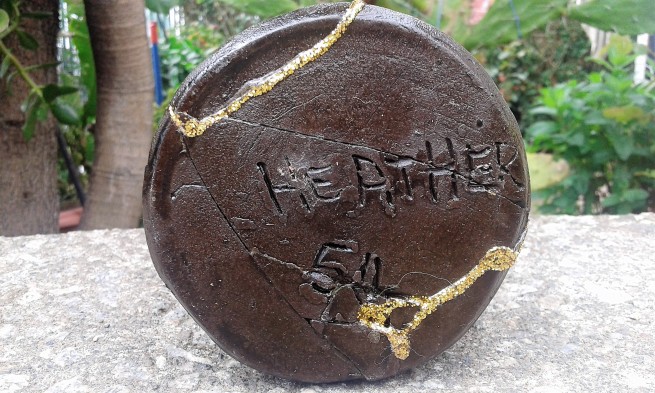
Kintsugi is a Japanese art technique that consists of repairing broken porcelain or pottery with resin varnish dusted or mixed with gold, silver or platinum powder. It is the art of fixing what has been broken with a precious metal that gives a greater value than that which the piece originally had. Kintsugi makes objects become a testimony of a particular journey.

In September 2015, in Cape Town, my fiance and I went to have lunch and listen to a concert at the Waterfront. Walking through the artisan market, we were struck by a stand where simple mugs of clay and pottery were displayed. Each one of them had been made by a woman survivor of some type of violence or trauma, which put her name and the imprint of her hands. Mugs had no handle, the way to take it was to put your hands in the hands of the woman. So, she connected with you and became part of your daily journey. Moved by the deep transcendence of the initiative, we got a pair. Mine was made by Heather, 54 years old. Continue reading “Kintsugi for the Soul – Part I – by Vanessa Rivera de la Fuente”

Who Does Islamic(s) Feminism(s) Belong To? by Vanessa Rivera de la Fuente

Who does Islamic(s) feminism(s) belong to?

The answer to this question seems obvious: Islamic feminism belongs to all Muslim women who wish to adhere to it, and feminism is for everybody, as bell hooks said.

In reality however, it is not so easy. Even the most well crafted theories must be implemented by human beings who have been socialized under the Patriarchy’s rules and practices. Lived experience reminds us that feminisms of all kinds are marked by dynamics of power, internalized misogyny, lack of intersectionality, egos, and personal interests.

In this situation I wonder: Are feminisms, and Islamic Feminisms in particular, truly for everyone?

Continue reading “Who Does Islamic(s) Feminism(s) Belong To? by Vanessa Rivera de la Fuente”

Rhetoric of a Talking Body by Vanessa Rivera de la Fuente

Werken-Pieter-klein-1


I have been thinking lately in the female body: object of foreign narratives and appropriations to their geography

Who decides what is right to say about a woman’s body? The correct answer is the most logical: The same woman who has something to say, of course. But things are not like that in real life. In everyday life, women still do not have the right to create and elaborate on a rhetoric about our own bodies. Rather, it is still subject to the rhetoric of others.

Rhetoric of Oppression

To speak of rhetoric, in this case, is to speak of the discourses, narratives and representations that dominate the bodies of women. In general, these rhetorics say that if a woman exposes any of the parts of her body that are considered sexually attractive, it is because she seeks sex. If she is covered, she is a modest and timid woman. A woman wearing a suit is considered “fit”, while another wearing a miniskirt is an easy girl in search of “action”. A woman who covers her breasts is a serious woman. A woman who does not, is not and has to endure the “compliments.”

Why? Who defines this? Continue reading “Rhetoric of a Talking Body by Vanessa Rivera de la Fuente”

Patriarchy is Killing Us by Vanessa Rivera de la Fuente

FemicideLA

And not softly..

More than 2000 died by feminicide … More than 700 disappeared in Argentina … And more in Latin America and the world.

A few days ago they found Micaela dead. Her family, friends and my fellow activists searched for her for days, campaigned on social networks, shouted her name everywhere, without quitting and  accepting her death—totally avoidable. Micaela Garcia, a 21-year-old girl, raped and murdered by a repeat sexual offender who was questionably released by Judge Carlos Alfredo Rossi in Argentina. Micaela is one more victim of the depredation with which colonial and capitalist patriarchy attacks the lives of women in Latin America.

I just completed my first six months in South Africa. I live in Cape Town. I love this city, I am delighted by its colors and flavors. I am studying a Master’s in Women and Gender Studies—a goal I had longed struggled for.

In my trip from my home to the university, I think of Micaela Garcia and also of Stasha Arend and Tracy Roman—two girls killed in Cape Town recently. Their lives were violently interrupted while they were returning home. At the end of each of my days, 27 women will be raped, likely by someone they know. Some of them will be killed and thrown in the garbage or into a soccer field, or half-buried in an abandoned house; even in death it seems that we have no right to some dignity.

No matter where, death is my guest and part of my landscape; the scenario of its violence has as background the Andean Cord or Table Mountain. It is the same, because it is the same indolence when it comes to the life of a woman, here or there. And I think: I can move my city and even change the country, and start a new life, even with another name, and my life will remain insignificant because I am a woman—a woman of color, from the south, with all the oppression surrounding me in the air.

How to deal with that pain? Well, I have enrolled as a Rape Crisis facilitator. It is not only for solidarity; it is for survival. Do you see what I see? How could I just watch?

The body of a murdered woman is becoming something so common that daily dead had to receive their own name to describe this horror: FEMICIDE. In Mexico, Susana Chavez coined the slogan “Ni Una Más” (Not One More) to lead the fight against femicides. The writer and activist was herself found murdered in 2011.

About two years ago, women from all over Latin America got together to claim “Ni Una Menos, Vivas nos Queremos” (Not One More, We Want Us Alive). And I wonder why this clamor is not yet worldwide, if everywhere patriarchy is killing us, one by one, on our way home and in broad daylight, with no shame or remorse.

Patriarchy is killing us and many murders only matter while selling magazines and newspapers. Then, the rest is silence, as the silenced femicides of indigenous women whose bodies oppose the last stronghold in territorial conflicts against agro-business or mining corporations, as silenced as those women murdered in the “tranquility of their houses” in the name of love for their jealous partners, as silenced as the girls kidnapped on the way to school to appear later killed with their hands and feet tied, with signs of having been raped.

It is no longer just about reporting and visibilizing, but also about counting them: 57 femicides in the first 43 days of 2017 in Argentina, 3 this week in Chile, 27 rapes per day in Cape Town, all of those lost in the trafficking networks. The hunting of women is systematic. Human beings have bad memories, and who has no memory tends to repeat the horrors. As Karina Bridaseca says:

We must check the systematicity. The bodies, found, disappeared, the bones in the desert, are claimed today and always. Our strength is to have managed to gather them all, to alter the regime of the invisible. This feeds the hope of making the account closed. What is important is that today we all share the same language and demand that the account closes.

Patriarchy is killing us … and not softly. Every time the news reports another woman or girl dead, I check my mother, my sister, my daughter, my friends in Chile. I double check my close friends in Cape Town, to know that they are as I saw them last time: OK. And then I can sleep, knowing that they have returned home.

In Santiago de Chile and in Cape Town we must count, dead or alive. Hope for the figthers and memory for those who are no longer here. We won’t stop asking about all of you. We want to know you have returned home. Our lives must matter.

Vanessa Rivera de la FuenteVanessa Rivera de la Fuente works in community development, gender equality and communication for social change. She has led initiatives for women’s empowerment in Ecuador, Peru, Argentina, Morocco and South Africa. As a Gender Justice advocates with a broad scope of interests, she is a social and digital entrepreneur committed with the strengthening of grass roots organizations and the developing of an independent pathway of thinking, research and academic writing around Gender, Politics and Religion. Loyal lover of books, cats and spicy chai.

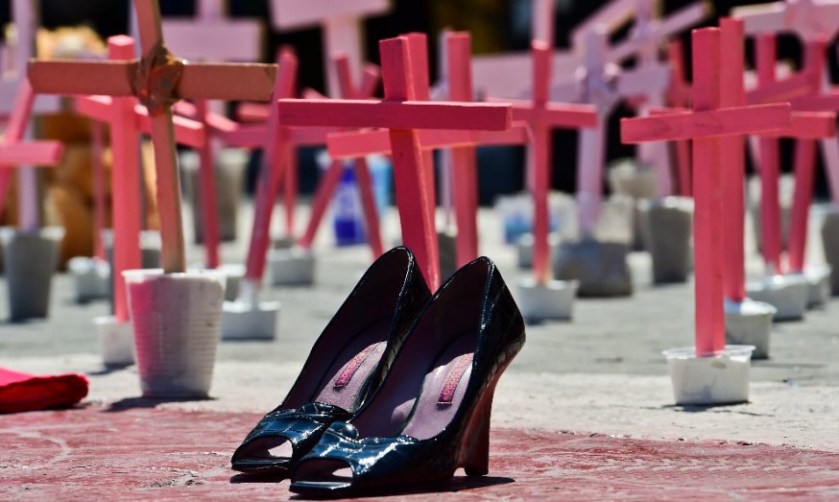
Photo: Artivism installation. Crosses represent the women dead and shoes, the gender bias of femicide. Shoes are one of the first things found at the site of a murder.

Deadly in Love: No Flowers, Dignity and Rights by Vanessa Rivera de la Fuente

Feminicidio
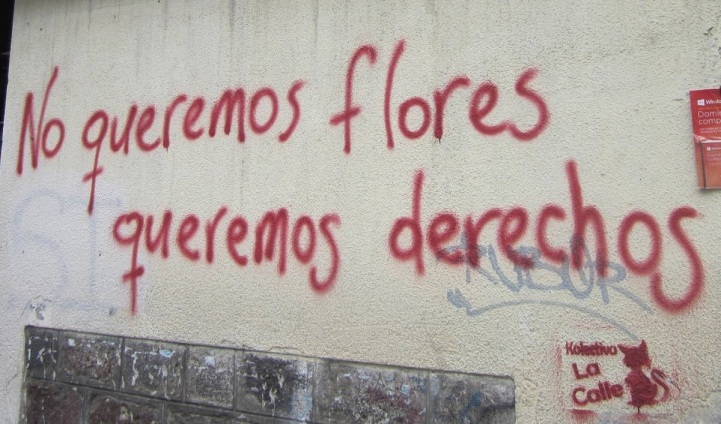
“We don’t want flowers, we want rights.” Kollectiva La Calle (The Street Collective)

Vanessa Vazquez Laba, a scholar feminist and researcher in gender studies in Argentina, with whom I share a first name, activism, and intellectual interests, hits me on Valentine’s Day with the following message:

There have been 57 femicides in the first 43 days of 2017 in the country, and the government has suspended the funding of universities for research on gender based violence.

57 femicides in 43 days…

A heartbreaking message to receive in Valentine’s day, isn´t it?

What does this mean? According to the definition accepted by the majority of women’s rights activists and scholars, “Femicide is a sex-based crime, generally understood to involve intentional murder of women because they are women.” . The World Health Organization states that a Femicide is:

Usually perpetrated by men. Most cases of femicide in the world are committed by partners or ex-partners, and involve ongoing abuse in the home, threats or intimidation, sexual violence or situations where women have less power or fewer resources than their partner.

57 women in 43 days… It means 57 human beings were murdered, most of them in the hands of someone they trusted and shared an intimate relationship with, after a painful process that included different types of violence to deplete their sense of value and personhood.

One woman murdered every 18 hours.

57 women most of whom were abused for one they loved. Continue reading “Deadly in Love: No Flowers, Dignity and Rights by Vanessa Rivera de la Fuente”

Women Made of Fire by Vanessa Rivera de la Fuente

 climbing-mountains-with-children_webThis was going to be a post about my new life in South Africa; to say what it means for me the return to this country full of wonderful things to do, after an intense and grievous experience in 2015 that pushed me towards a totally introspective period in my life; I was willing to tell you how I managed to put myself together, come back, go out there to face my fears, gather the courage to speak my truth, look for clearance and healing in the same place and with the same people where I was wounded.

But that will be in the next post. Let me talk about my country.

I come from Chile, a country in the southern south of the world, poor in resources and rich in poets. I am Chilean by birth, and I took my first steps on shaking ground. I have survived 3 earthquakes, countless floods, a tsunami and a dictatorship.

I survived to be stronger, more faithful, more free and unbeatably resilient.

During the past 12 days, I have seen, as a distant and impotent witness, my country burning, overwhelmed by fire, in the greatest catastrophe of its kind in the history of the nation.

The fire has advanced more than 700 kilometers away from the first point of ignition, swallowing whole villages, with their houses, public buildings, animals and agricultural land.

I’ve spent these days with tight lips and enclosed in my thoughts, reading news on the Internet, thinking about my family, receiving audios that my sister records for me. My brother was injured protecting his house from the fire, my family is in the area of greatest catastrophe, currently declared “Area Zero.” My concern is huge because the fire is advancing over the city and the assistance seems to go three steps back … I believe in the power of prayer, but I also know the ferocity of nature because as a Chilean I am always expecting to deal with it. Continue reading “Women Made of Fire by Vanessa Rivera de la Fuente”

Religion, Dissent and Decolonial Approach in Latin America by Vanessa Rivera de la Fuente and Juan F. Caraballo Resto

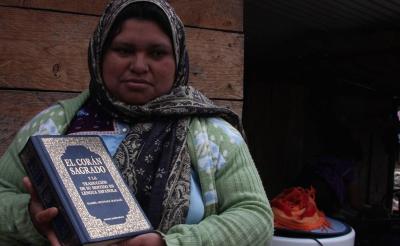
womanwithquran

Talking of decoloniality in religion and theology is today a fashionable stance that has been adopted even by the academic and political mainstream. As Latin Americans, decolonial perspectives affect us firsthandedly. For the last 500 years, our continent has nurtured resistance struggles against the racial, sexual, economic, ethnic and religious violences that emerge from the numerous process of colonization we have endured. With this in mind, in this article we contribute to the debate on decolonization of our religious phenomena.

Decolonizing is to Assume that all Religion can Operate as a Colonizing Agent

The expansion of European colonialism in Latin America transpired through all aspects of social existence and gave rise to new social and geocultural identifications (e.g. “European”, “American”, “Indian”, “African”, etc). The consequences of this domination reverberate to this day.

In this regard, we should not loose track of the fact that all abrahamic religions had their genesis within Latin America in the form of colonial presence. In other words, most of our religious expressions are the product of colonial forms of governance, which benefited from an exclusionary instrumentalization of the religious narratives as a tool to ‘dignify’ and ‘enhance’ the population as ‘colonial subjects’.

This was the case of Christianity. The mission carried out by the first European conquistadores in the Americas was characterized by the drawing of exclusionary theological lines that legitimized some, questioned others, and condemned many. Colonization thus manifested itself in part through spiritual violence on native populations. Evangelization, in this regard, was biopolitical in nature; it entailed the pushing of non-European bodies (and souls) into ‘Otherness’.

This illuminates unto why, for example, nowadays interfaith relations have become a problem, rather than a resource for many Latin American Christian congregations. It is often assumed that to establish lasting links of solidarity with religious ‘Others’ puts at risk the core elements which have been taught to enhance our population by the different metropoles that have governed and preached in our midst.

It is well established that for too long the bases of Christianity in the Americas were built upon imposed and/or conditioned conversions which constantly demanded and reminded people that in order to have ‘goodness’ reside in them, they had to be someone essentially different to who they were; they had to be Christian (Rivera Pagán 2013, 2014; Silva Gotay 1998, 2005). In this regard, long established religions such as Judaism, Islam, Spiritism, and Afro-Atlantic religions such as Santería or Palo have been relegated to inferior statuses in some still colonial contexts, such as Puerto Rico (Caraballo-Resto 2016; Román 2007).

A similar case, can be found within Islam. As mentioned in a previous article, many Muslim congregations in the Americas have done well in mirroring the colonial practices of Christianity. Despite common assumptions, some contemporary Muslim groups have come to our lands with the clear aim of Arabization and, again, through spiritual violence they categorize locals as “others” and, thus “subordinate” them as perpetual ‘underage believers’, who seem to need the Arab tutorial aid relentlessly. At times, their theologies are reminiscent of those expressed by Catholicism 500 years ago: A call to abandon local trajectories and spiritualities, in favor of adopting Middle Eastern names, language, arts and aesthetics, social manners, political causes and even diet. Only then, are us Latin American to be considered by some of these communities as “Noble Savages”.

Although some scholars linked to decolonial studies within Islam have difficulty accepting this, Islam has historically been instrumentalized as a colonizing agent in the Middle East, West Africa, Asia and the Indian Subcontinent.

If we talk about Islam and decoloniality in the same sentence, there should be honesty on these facts.

Colonization occurs not only through the sword and war, also through trade, culture and social discourses that become hegemonic and religion. In this regard, the ‘jihad of the soul’ is seldom devoid of politics. The absence of blood is not tantamount to a lessening of colonial violence. There are many and different ways to curtail, cancel and oppress a people without resorting to their physical extermination.

Religion and the Heterosexual Regime

Colonial religions in Latin America have been characterized by an hegemonic discourse based on heterosexuality as a compulsory scheme, androcentrism, ableism and speciesism. Historically, this has entailed the exercise of a new religious taxonomy (eg. ‘Moro’, ‘Marranos’, ‘noble souls’, etc.). Yet, this also corresponded to an encompassing system of power that intersected all control of collective authority, labor, racial relations, the production of knowledge, as well as sexual access and meaning.

It is well known that many indigenous peoples of the Americas were matriarchal, recognized more than two genders, recognized homosexuality and “third” gendering positively and understood gender in much more problematized terms rather than in the binary terms of subordination monotheistic system imposed.

Such dichotomy not only found its way in Latin America. It also transpired in parts of Africa, which were later linked to our Latin-American contexts by way of slavery. This has been dealt at lengths by Nigerian feminist scholar Oyéronké Oyewùmí, in her work The Invention of Women (1997). In it she states that gender was not an organizing principle in Yoruba society prior to European colonization (idem: 31). Instead, she argues that gender has “become important in Yoruba studies not as an artifact of Yoruba life but because Yoruba life, past and present, has been translated into English to fit the Western pattern of body-reasoning” (idem: 30).

So, it becomes all the more important to consider the changes that religious colonizers have brought, as well as the lip service we’ve paid to it, in order to understand the scope of our Latin American organizations of sex and gender under colonialism.

Theology of Dissent in Response to Religious Heteropatriarchy

A decolonial theology must be one of dissidence if it is to have any liberating character. ‘Dissidence’, here, is not used as a mere label of disagreement, but rather as a situational stance from which the very bases of our legitimization as colonial subjects are constantly contested. And just as the expansion of religious colonialism in Latin America transpired through all aspects of social existence and gave rise to new social and geocultural identifications, a decolonial theology of dissidence must do the same—starting from our own gendered bodies.

In sexual terms, Latin American women and non-heterosexual people have been historically defined in relation to heterosexual men as the norm. In other words, women are those who do not have a penis, and non-heterosexual men are those who do not use their penis according to the norm (Lugones 2003). From a decolonial theology of dissidence this must be contested—placed in a situation of uncomfortable political transactions perennially.

From this point of view, a decolonial theology of dissent is much more than a body of intellectual writings. It is a daily practice—a quotidian mode of resistance—that involves people at the grassroots where the challenges of exclusion are negotiated. Yet, something is to be said for the epistemological zones of privilege where colonialism is also instantiated. There is no decoloniality without resistance, and there can be no resistance against the traditional hegemonic enclaves where colonialism is legitimized, as long as the centers where knowledge is produced conceive people in resistance as “objects of study”, rather than “fellows in knowledge-building”.

Up to this day, ‘Otherness’ is one of the most deeply rooted archaeological legacies left by our colonial religiosities. Upon its finding, some people of faith in Latin America are now left to determine how best to deal with religion(s) in an inclusive, liberating and welcoming way, so that our social contexts become ones where religious, gendered, ethnic, linguistic, racial, and able diversities are not thought of as problems, but a resources to strengthen ties. Only then can we help truly shift this time of instability for our region.

Decolonizing religion in Latin America entails understanding that the religious question is always political, and as such must be contested. If there is any liberating potential in the religious phenomena, this is due to a lucid dissidence that eludes colonial privilege and embraces an ethical compromise beyond religious labels.


Vanessa Rivera de la Fuente is a social communicator, writer, mentor in digital activism and community educator in gender and capacity development. She has led initiatives for grass roots female leaders’s empowerment in Latin America and Africa. She is an intersectional latin muslim feminist in the crossroads between Religion, Power and Sexuality. Her academic work addresses Feminist Hermeneutics in Islam, Muslim Women Representations, Queer Identities and Movement Building. Vanessa is the founder of Mezquita de Mujeres (A Mosque for Women), a social media and educational project based in ICT that aims to explore the links between feminism, knowledge and activism and highlights the voices and perspectives of women from the global south as change makers in their communities.

Juan F. Caraballo Resto is professor of Sociology and Anthropology of University of Puerto Rico Reinto Cayey. PhD in Social Anthropology from University of Aberdeen, Scotland.

Featured Image: Indigenous woman in Chiapas, Mexico, part of the Islamic mission of Dawa in the area, wearing a hiyab and showing a Qur’an in Spanish,

Gender Jihad and Epistemic Justice by Vanessa Rivera de la Fuente

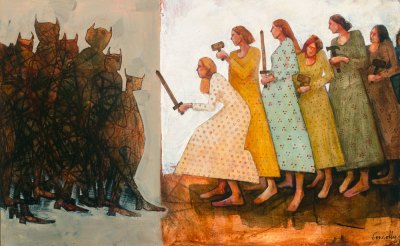
women-fighting-demons_web

In previous articles I have developed my personal perspective on Islamic feminism as a third narrative pathway that responds to the two traditional hegemonic discourses that exist on Muslim women, which I call “idealization of inequality” and “demonization of Islam

The search for gender justice within the framework of Islam has been called Gender Jihad is focused on installing a legal and social equality for Muslim women and groups or identities in the otherness, in line with the equality of divine origin established in the Qur’an. I think this socio-political equality begins with unpacking the epistemic violence prevailing in religious narratives that affects the representations and validation of women and persons in the otherness as equals, ie, like people, like men, the discursive and biopolitics referent of what is “Humankind”.

Islamic feminism is a narrative that provides answers to the epistemic violence represented by the speeches of idealization and demonization. As Gayatri Spiviak said, such epistemic violence is an orchestrated, widespread and heterogeneous project to constitute the colonial subject, as other. Women in religion are colonized subjects. Epistemic violence leads to epistemic injustice that results in unfair practices such as, for example, considering that the testimony of some people is less credible because they belong to certain gender, based on a distorted image of the other, which dehumanizes the individuals who are giving testimony.

The Gender Jihad posed by Islamic Feminisms seeks to establish a declaratory place that is an authentic expression of the agencies women and people in the otherness in relation to a hegemony with a strong colonial bias, represented for the narratives of idealization and demonization. Gender Jihad is the building of an episteme, understanding the right of Muslim women to enunciate and interpret a reality that challenges them, for and by themselves since, as Amina Wadud says “defining religion is to have power over it.”

This discursive possibility is possible thanks to the Tawhidic paradigm developed by Amina Wadud in the early 90s and  in her book “Qur’an and Woman,” a methodology that can decolonize fields of  knowledge, bodies and representational policies of the mainstream narrative about Muslim women and Others.

The merit of her paradigm, among many, is to systematize existing concepts in the Muslim cosmogony, in a way that provides a frame for gender analysis from Islamic theology and promoting the empowerment of women through it. Recognizing, on the one hand, the inherent equality of women as human beings, it gives theological support to a legal equality that for centuries have been at the discretion of Muslim scholars. On the other, it enables women, through rescuing Ijtihad, in our enunciation and narrative capacity as religious subjects. If humans are equal before God, then Women and Others are, by divine right, equally able to read, decipher, interpret and convey their perspective on religious matters.

There cannot be any political transformation, without having an equal right to speak, equal freedom to express thoughts, equal entitlement of movement of the body and ideas, equal agency to occupy material and symbolic spaces, without restrictions.

There can be no Gender Jihad without appropriating the  readings and discourses on gender, religion and jihad.

Gender Jihad begins with the recovery of the right to say and represent, therefore, is a struggle that could have as a prior aim the acquiring of epistemic justice.

This is relevant because “Who can speak” will mark simultaneously “on what terms that person talk.” What concepts and meanings can be used within the framework of the construction of a particular view of reality? What terms become the lens for discerning reality: development, democracy, gender equality, civil society, religion, social agency, etc. Only and exclusively from the enunciation (the power to speak) and from the ability to define the context in which speaking occurs, can one have a voice, that is, be a subject.

This framework for a new reality, based on the epistemic justice, will allow Muslim women to define their own place and have a voice to counteract epistemic injustice. Wadud offers a system of hermeneutic model that enables a “who can speak” and “on what terms” from an interpretation of the Quran from a gender perspective, which recognizes Muslim women agency to define and interpret religion, to build a speech based in empowerment and to rise as “political individuals of faith,” establishing a mapping for the construction of a reality in which they position themselves as people, beyond stereotypes and myths.

Image: Women Fighting Demons – Caitlin Conolly

Vanessa Rivera de la Fuente is a social communicator, writer, mentor in digital activism and community educator in gender and capacity development. She has led initiatives for grass roots female leaders’s empowerment in Latin America and Africa. She is an intersectional feminist interested in the crossroads between Religion, Power and Sexuality. Her academic work adresses Feminist Hermeneutics in Islam, Muslim Women Representations, Queer Identities and Movement Building. Vanessa is the founder of Mezquita de Mujeres (A Mosque for Women), a social media and educational project based in ICT that aims to explore the links between feminism, knowledge and activism and highlights the voices and perspectives of women from the global south as change makers in their communities.

Caring as Resistance and Sisterhood by Vanessa Rivera de la Fuente

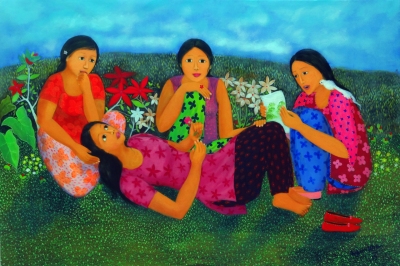
sisterhood

Every week, the women participating in my workshops easily share their experiences in the social, political or community world. However, it is difficult for them to talk about themselves. Several of them face complex situations: A divorce or a long layoff, illness of a relative whom they are caretakers, raising a disabled child. They are ashamed to speak up about how they feel; this should not be so. We women have the right and the duty to speak openly about what ails us in our private lives. The idea that the personal is political has to be a perfect circle.

Bisi Adeleye-Fayemi says that the lack of attention to physical, emotional and spiritual needs of women has become one of the weak points in the work of feminists. In our own social and institutional spheres where we work, the combined effects of the strong reactions against women’s movements, harassment on social networks, cultural and religious fundamentalisms, the pressures for leadership and the challenge of finding a balance between multiple spheres of life make it difficult to conserve energy.

While activisms mean resistance to the hegemonic system, some dynamics could reproduce patriarchal control’s devices on women’s emotions and impact us negatively: The expectation of renunciation and silent sacrifice as supreme feminine virtue. Sadness, illness or emotional distress are political issues and a way to control us with them is through the imposing or adopted silence about. Continue reading “Caring as Resistance and Sisterhood by Vanessa Rivera de la Fuente”

Have You Seen These Muslim Women? by Vanessa Rivera de la Fuente

Shia Women AshuraThe photo that accompanies this article, or others similar, have been posted, shared and commented through social networks as expression of the inherent misogyny of Islam, with descriptions such as “DAESH taking women to sell in the concubine’s market” or “Muslim women being carried to forced marriages”. I’ve also seen this picture being used by some feminists in academic conferences to illustrate their presentations on the “Status of Women in Islam.”

This photo has been misused. This image is taken from a religious event which is celebrated for Shiite Muslims to describe the terrible events that took place in Karbala 1,200 years ago. This act recalls the occasion when the family of the Prophet Muhammad, formed mostly by women, was taken prisoner, including children and forced to walk chained. History records and praises the courage of women who bear this painful pilgrimage instead of submit themselves to their captors.

 “Muslim Women” is a Hoax Continue reading “Have You Seen These Muslim Women? by Vanessa Rivera de la Fuente”