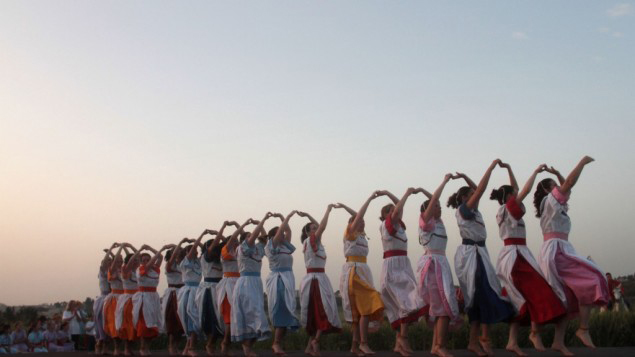
What, Together, We Are by Annelinde Metzner

Kibbutz

It seems that the hearts of the whole world, and especially the hearts of women, are grieving now, as war and warmongering take over more and more of the Earth.  Patriarchy rages on, like a monster in its death throes, and we wonder, “will they take us all down with them?”  It is my hope that these poems will help us to keep on keeping on, keep on loving Her.

My grief, my love for the world                                        

I watch the dancer, one arm framing her face,
one hip drawing upward in the belly’s rhythm.
The dance of mature women, Raqs Sharqi
born of the sensuous music of the Middle East.
Her hips pull us into infinity,
an inward-outward shout of beauty and desire.

Continue reading “What, Together, We Are by Annelinde Metzner”

War, War and More War – Can Goddess Wisdom Offer a Path to Peace? by Judith Shaw

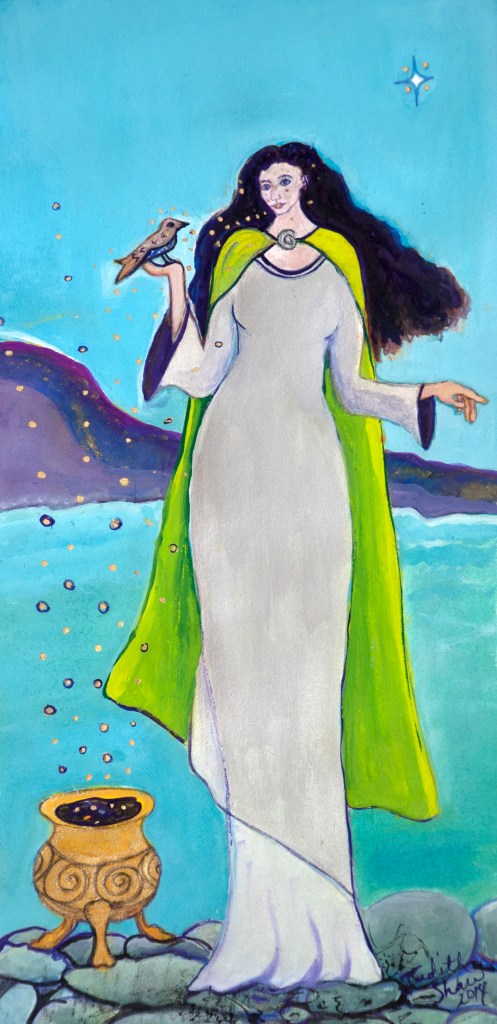
Branwen, Celtic Goddess painting my Judith Shaw

I was on my way home from a wonderful morning spent with my son when I heard the news of the horrific attack by Hamas on Israeli citizens. We had risen early to witness the mass ascension of balloons at the Albuquerque Balloon Fiesta, joining tens of thousands of people from around the world. For 10 days, a diverse crowd gathers on a vast field, experiencing childlike wonder as they watch brightly colored balloons ascend into the early morning sky. It was a joyful morning.

But then, after all that wonder, the car radio delivered the shocking news of the Hamas attack. My joy was shattered. 

Continue reading “War, War and More War – Can Goddess Wisdom Offer a Path to Peace? by Judith Shaw”

The Legacy of Carol P. Christ: Sappho Chose Love Not War, What Will You Choose?

This was originally posted on November 12, 2012

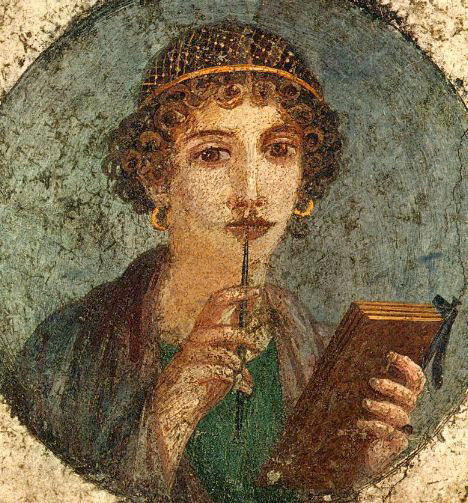
We have been taught to speak of war and the heroes of war in hushed tones. We have been told that evil Helen’s choice was the cause of the Trojan war.  2600 years ago Sappho, known as the greatest lyric poet of ancient Greece, spoke truth to power and unmasked the lies told at the beginning of western tradition.

*

In a poem addressed to Anactoria, Sappho writes:

            Some say a cavalry corps
            some say infantry, some, again,
            will maintain that the swift oars
            of our fleet are the finest
            sight on dark earth …

Here, Sappho invokes the heroic tradition celebrated in the epic poems of Homer that shaped the values of ancient Greek culture and all the cultures that followed it, including our own.  This tradition tells us that to serve in a war and to be remembered as a hero is the highest goal to which a man can aspire.  Sappho does not agree:

             …but I say
             that whatever one loves, is.

Continue reading “The Legacy of Carol P. Christ: Sappho Chose Love Not War, What Will You Choose?”

Patriotism Reconsidered by Carol P. Christ

Originally published on July 8, 2013 on FAR under the title “What Is Patriotism?,” this blog asks questions that seem even more important today, when tanks have been paraded in front of the Lincoln Memorial and children are held in appalling conditions at our borders because their parents dared to seek asylum in the United States.

July 4, American Independence Day, has come and gone. Perhaps now is as good a time as any to reflect on patriotism. What is it? What does it mean from a feminist perspective?  What is the relationship between patriotism and militarism?  Can one be a patriot and oppose war?  Can one be a patriot and deny that “America is the greatest country in the world,” the foundation of  the doctrine of American exceptionalism?

In a recent blog, Caroline Kline called attention to the use of patriarchal God language in the patriotic hymns her child was asked to sing in the 1st grade.  She wondered if this God language could be changed to female positive or gender neutral.  Her post prompted me to ask if changing pronouns would be enough and to revisit the question of patriotism and nationalism. Continue reading “Patriotism Reconsidered by Carol P. Christ”

Seared by Vietnam by Carol P. Christ

Warning: This post discusses and includes images of the violence of war. 

Recently I have been binge-watching the American comedy-drama series This Is Us. I am of the same generation as Jack and Rebecca, the parents of the triplets, but I didn’t think much about that connection during the first two seasons. The middle class father works-mother stays home family and the “father knows best” story line seemed like a throwback to the generation of my parents. Though everyone was supposed to have loved him, I didn’t like Jack, and I didn’t identify with Rebecca. The children’s lives seemed much more interesting to me, and I resented it when the flashbacks to the parents’ lives began to take over the script.

When the plot turned to Jack’s experiences in Vietnam, I fast-forwarded. “Been there, done that,” I said to myself, “I don’t need to see it again.” But eventually I realized I had to watch some of the scenes of the Vietnam War or I would not be able to follow the plot. Continue reading “Seared by Vietnam by Carol P. Christ”

Troubling Our Souls: Selling Arms to Saudi Arabia, the War in Yemen, and the US Military Industrial Complex by Carol P. Christ

There is a very big elephant in the room. Apparently it is invisible because even the left is not discussing it. This elephant is the civil war in Yemen to which Saudi Arabia has contributed 19,000 (19,000!) deadly (deadly!) air strikes that have been alleged to have caused 60,000 (60,000!) civilian (civilian!) deaths (deaths!). These air strikes have been carried out with arms purchased from the US and its allies. The UN estimates that 22.2 million Yemeni civilians are in need of immediate humanitarian aid and that 13 million are at the risk of starvation. Yet a Saudi-led blockade is preventing food and other supplies from entering the country.

In the wake of the disappearance of legal American resident and Saudi journalist Jamal Khashoggi, the left castigates Saudi Arabia for a vicious murder. The US President warns congress not to cut off arms deals with Saudia Arabia because to do so would threaten more than half a million US jobs in the military industrial complex. Continue reading “Troubling Our Souls: Selling Arms to Saudi Arabia, the War in Yemen, and the US Military Industrial Complex by Carol P. Christ”

Can You Imagine a Society of Peace? by Carol P. Christ

Carol Molivos by Andrea Sarris 2As war and the fruits of war, including hatred and the desire for vengeance, threaten our human community, I take this opportunity republish a vision of a Society of Peace. If we cannot imagine a Society of Peace, we will never be able to create one. Can you imagine that:

As a child, you would not have to fight with your sisters or brothers for your father’s or your mother’s attention. You would not have one mother but many as you would be raised in a large extended family. Both girls and boys would be equally loved and cherished by their mothers and grandmothers and by their uncles and great-uncles. Both girls and boys would know that they would always have a place in the maternal clan. As a boy or a girl you would never have to “separate from” or “reject” your mother in order to “prove yourself as an individual” or in order to “grow up.” You could grow up without severing the bond with the ones who first loved you and first cared for you.

You would be raised in a large family with sisters and brothers and cousins, all of whom you would consider your siblings. You would never feel lonely. You would not be taught to compete with your siblings. You would never be hit by or hit others, because violent behaviors would not be considered appropriate in families. Continue reading “Can You Imagine a Society of Peace? by Carol P. Christ”

Sappho Chose Love Not War, What Will You Choose? by Carol P. Christ

*

We have been taught to speak of war and the heroes of war in hushed tones. We have been told that evil Helen’s choice was the cause of the Trojan war.  2600 years ago Sappho, known as the greatest lyric poet of ancient Greece, spoke truth to power and unmasked the lies told at the beginning of western tradition.

*

In a poem addressed to Anactoria, Sappho writes:

            Some say a cavalry corps

            some say infantry, some, again,

            will maintain that the swift oars

            of our fleet are the finest

            sight on dark earth …

Here, Sappho invokes the heroic tradition celebrated in the epic poems of Homer that shaped the values of ancient Greek culture and all the cultures that followed it, including our own.  This tradition tells us that to serve in a war and to be remembered as a hero is the highest goal to which a man can aspire.  Sappho does not agree:

             …but I say

             that whatever one loves, is.

Continue reading “Sappho Chose Love Not War, What Will You Choose? by Carol P. Christ”