Moderator’s Note: We here at FAR have been so fortunate to work along side Carol Christ for many years. She died in July this year from cancer. To honor her legacy as well as allow as many people as possible to read her thought-provoking and important blogs we are pleased to offer this new column to highlight her work. We will be picking out special blogs for reposting. This blog was originally posted December 23, 2013. You can read it long with its original comments here
A link to a video of a Crow Uses Plastic Lid to Sled Down Roof Over and Over Again on a mayonnaise-lid sled appeared on my Facebook timeline a few days ago. {moderator’s note: I believe this is the same video that Carol originally posted. The link has been updated since 2013 } For me this crow expresses the “spirit of the season” as aptly as anything I can think of. She brings a smile to my face on a grey and cold morning. She makes me want to climb up on the rooftop and slide down with her. She reminds me that we humans are not alone–we share the world with a vast multitude of other intelligent creatures. She tells me that there is nothing more sacred than the joy of life.
Moderator’s note: This marvelous FAR site has been running for 10 years and has had more than 3,600 posts in that time. There are so many treasures that have been posted in this decade that they tend to get lost in the archives. We have created this column so that we can all revisit some of these gems. Today’s blogpost was originally posted December 25, 2015. You can visit it here to see the original comments.
Marie bringing in Elen of the Ways photo by Tony Mierzwicki
One of my colleagues at Feminism and Religion recently wrote of Xmas and Feminine Wisdom. My blog, for Christmas Day continues this exploration.
Elen of the Ways is a figure primarily studied by scholar, Carolyn Wise. She wrote two core articles available on the web here and here. Wise writes that in order to “track” and find Elen of the Ways she had to peel back the layers:
…to the earliest track ways, the migratory tracks of the Reindeer and Elk. Elen moves across vast tracts of time, and land, cloaked and masked appropriately for each age.
As the Green Lady, she peers out between the trees in forests …As a British Venus… she is guardian of the underground streams that carry the sacred waters. She is the Guardian of the ancient track ways, the Leys, the Kundalini currents in nature. And as the Horned Goddess, she leads us to the first track ways, the migratory tracks of the reindeer and later, to the path of the red deer through the forests. From here she leads us to the lost Shamanism of the isles of Britain and we can follow her across Scandinavia, Russia, Mongolia, Siberia, India and beyond.
…part goddess, part dream, part saint, a green lady and a water nymph, primordial mother and patroness of deer, and guardian of the Old Straight Tracks and solar alignments. …Elen is as real as the roads named after her, as solid as the ancient paths that carry her presence.
What are these tracks? Part of the story can be explained by understanding that there are ley lines, or energy paths throughout the globe. These paths were “tracked” by shamans, pagans, and regular folk and still exert their influence today in very recognizable ways. People celebrated earlier this week on the Solstice (December 21) at Stonehenge. “One of the most important and well-known features of Stonehenge is its alignment on the midwinter sunset-midsummer sunrise solstitial axis,” a spokesperson said. “The midwinter sun sets between the two upright stones of the great trilithon.” The solsitial axis is part of the ley line network that connects sacred sites such as Newgrange in Ireland, a sacred burial mound which lights up only the morning of Solstice.
At dawn in Newgrange, on the mornings surrounding the solstice a narrow beam of light enters the 62-foot long passage and lights the floor. It moves along the ground, from the window box until it lights the rear chamber. This Neolithic light show lasts 17 minutes….Local expert Michael Fox told National Geographic, “Archaeologists have classified Newgrange as a passage tomb but it is more than that. ‘Ancient temple’ is a more fitting label: a place of astronomical, spiritual, and ceremonial importance.”
If light that travels around the world lighting up sacred sites and bringing the gift of light to all corners of the world starts to sound like Christmas, let’s extend that thought to understand the connection to flying reindeer. According to Caroline Wise,
…the only kind of female deer to have antlers are Reindeer. Not only does the female reindeer have antlers, but she is stronger than the male and does not shed her antlers in winter. It is an older female reindeer that leads the herds.
So as I like to tell my students, “the McDonald drive through version” of what we’ve heard so far is: Most likely, yes, Rudolph is a girl/female reindeer, keeping her antlers leading a herd of female reindeer keeping their antlers, traveling with Elen (Santa) throughout the sky giving the gift of light—the light of Rudolph’s red nose that keeps the sleigh on track—following the ley lines around the world, and lighting up the sacred sites, turning the sacred wheel towards spring.
Wise continues the thread of Elen and Christmas thus:
…Leys as shamanic flight paths was relevant to Elen in her guises of both Empress and the Reindeer-woman…the Father Christmas story is based on the shamans of the Sámi people. These people (and other reindeer societies) had a symbiotic relationship with the Reindeer. They would follow the herds along their migratory tracks. Their food, clothes, homes, tools, even needles and thread came from the reindeer. ..the Father Christmas story is based on the older, non-Christian Shamans of Lapland. …to aid their shamanic flights, the shamans needed the properties of the Fly Agaric mushroom, the fabulous red and white toadstool of fairy stories. Taking the mushroom can be risky, or at least unpleasant, because of toxins it contains. The Shamans noted that the reindeer ate the mushrooms, which grew around the silver birch trees, and suffered no ill effects.
The shaman lets the substance pass through the reindeer, neutralizing the toxins, and then drinks its urine. The active ingredients are unaffected, and the shaman enters his trance and begins his flight. Above the snow he can see the herds, see the predators, and gains helpful knowledge for the tribe. He gains wisdom of the plants and healing, as the Fly Agaric opens the gateways for him to be able to commune with the spirits of the land, the beasts, and the ancestors. He carries back the gifts of healing, and also news of the herds. When finishing his trance session, the shaman would enter the yurt through the smoke hole, and slide down the central silver birch pole with his bag of healing plants and his paraphernalia – Father Christmas coming down the chimney.
And Christmas trees?…the Fly Agaric is found mainly at the base of the silver birch and pine trees. It can be found beneath conifers, mostly evergreens, such as cedar, and the spruce and firs used for Christmas trees. …Reindeer Shaman spirituality was holistic within its environment, a complete cosmology including the people, the herds, the landscape, the stars…Therefore the trees that the mushrooms grew around were an an important part of the whole.
The seasons turn and again we reach the Winter Solstice – the longest night which marks the sun’s return to light in the northern hemisphere. Stag, in all his antlered majesty, symbolizes the return of the sun’s life-giving rays.
The original Night Chant involved four teams who danced twelve times each with half-hour intervals in between-a total of ten hours. The dance movements involve two lines facing each other. Each of the six male dancers takes his female partner, dances with her to the end of the line, drops her there, and moves back to his own side. The chant itself is performed without variation and has a hypnotic effect on the listeners. The only relief is provided by the rainmaker-clown named Tonenili, who sprinkles water around and engages in other playful antics.
The medicine men who supervise the Night Chant insist that everything-each dot and line in every sand painting, each verse in every song, each feather on each mask-be arranged in exactly the same way each time the curing ceremony is performed or it will not bring about the desired result. There are probably as many active Night Chant medicine men today as at any time in Navajo history, due to the general increase in the Navajo population, the popularity of the ceremony, and the central role it plays in Navajo life and health. Continue reading “Navajo Night Chant – Part 2 by Sara Wright”
With the Winter Moon waxing on nights when stars are falling from the sky and the winter solstice passage, I am much aware of the healing and dwelling place that I inhabit that also characterizes these dark months of the year.
Unfortunately, even those who acknowledge our seasonal turnings rarely honor the dark as sacred. At the winter solstice the emphasis is still on light.
I grew up with a beautiful Solstice tradition: the Blue Christmas service. Each year, on or near the darkest night, our churches would offer a ceremony to remember those who had passed that year and hold space for the specific pain of holidays without loved ones we so sorely miss. Christmas itself named a broader pain, of injustice, of our many earthly wounds, and it offered a word of hope, of healing: a vision and promise of justpeace for all Creation. But Blue Christmas was different.
Blue Christmas said, sure – there is much work to do. If we really want to be vessels of a mighty Spirit of Love, we’ve got to roll up our sleeves and get to work! But… not tonight. Tonight, our work is to pause. To look away from the holy preparations of Advent, from the festive and the merry, and from the coming cruciform Birth. To be still. To turn toward pain we do not want to face. To allow ourselves to rest a moment, in Mighty Arms of Love. And to light a candle.
The Winter Solstice awakens in us a sense of awe as we witness the majesty of the crisp, cold night sky spread across the heavens – whispering songs of mystery and meaning – songs meant to awaken the need for the quiet dark and to dispel the fear that arises in the dark.
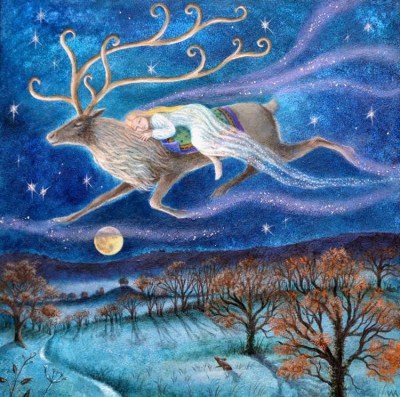
Songs of the evergreen tree decorated and lit to ensure the renewal of life. Songs of the Reindeer Goddess as she flies through the night
The days are slowly winding down toward Winter Solstice in the northern hemisphere, the longest night of the year. Today the sun rose at 7:20 and will set at 5:08 in Crete. In Sweden, the sun will rise at 9:25 and set at 2:12. Though I light candles in the darkness of morning and have lights on my tree, I am not celebrating the “return of the light,” but rather welcoming the restful dark.
In The Spiral Dance, Starhawk writes that Winter Solstice is about the rebirth of the sun. This interpretation has taken hold. For most pagans, Summer Solstice also is a celebration of the sun on the longest day. Few are those mark it as the time of the dying of the sun or the rebirth of night.
In our culture we have learned to celebrate the light and to avoid and disparage the darkness. We have inherited this habit of mind from the Indo-Europeans who, as Marija Gimbutas wrote, celebrated the shining light of the sun as reflected in their shining bronze weapons. When the Indo-Europeans rewrote the myths of the land that came to be called Greece, they placed the “Olympian” deities on Mount Olympus while relegating many of the oldest female deities to the underworld, which became a fearful place. New Age spiritualities follow this pattern, celebrating “light and love.” This habit of mind reinforces racism. Continue reading “Winter Solstice: Can We Celebrate the Restful, Welcoming Darkness?”
All sentient creatures are negatively affected by the deaths of one species.
And still people refuse to see.
As I wrote about the loss of trees and woodpeckers old tree memories surfaced without warning. Resolutely, I faced my past…
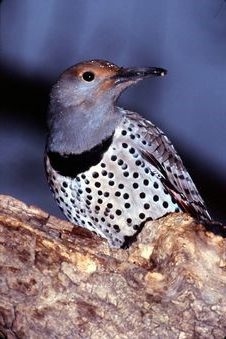
Thirty five years ago I left the coast of Maine because trees were being slaughtered and their insides ground up so million dollar homes could be built. Initially, I believed that I escaped tree carnage by moving to the edge of the wilderness in the western hills only to discover that whole mountains were being strip logged around me. The stench of pitch nauseated me. I wept, helpless in the face of such violence. Continue reading “Flicker’s New Year Gift – Part 2 of 2 by Sara Wright”
For most of my life I dreaded both the approach of winter and winter itself. Having grown up in the semi-tropics of New Orleans I had little tolerance for the cold. Living further north as an adult, the shortening days seemed to contradict the joy I found during the blooming of spring and the abundance of summer. Though I certainly appreciated the crisp, clear, golden days of fall they also caused feelings of trepidation as the days continued to shorten.





 The days are slowly winding down toward Winter Solstice in the northern hemisphere, the longest night of the year. Today the sun rose at 7:20 and will set at 5:08 in Crete. In Sweden, the sun will rise at 9:25 and set at 2:12. Though I light candles in the darkness of morning and have lights on my tree, I am not celebrating the “return of the light,” but rather welcoming the restful dark.
 [
[ Feminism and Religion