

What then is my repentance?
If not, by rote this repetition?
“Godde is.”
“Godde is.”
“Godde is.”
“Love.”
And my face tastes
The beating heart
Of the sun’s call
For reclamation of
SHE Who Is.
SHE Who Is: knows me.
She, who also, is.
©Margot Van Sluytman
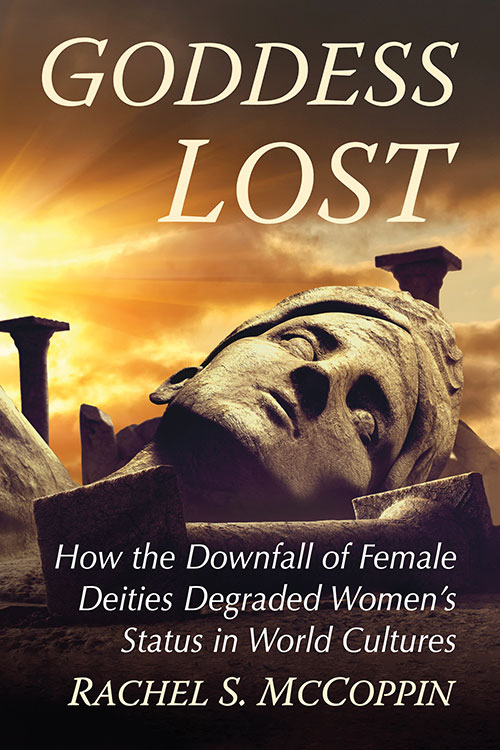
From the moment I saw the title, Goddess Lost: How the Downfall of Female Deities Degraded Women’s Status in World Cultures, by Rachel S. McCoppin, I knew I would have to read it. When it arrived in my mailbox and I saw the cover, I was imbued with inspiration. Then I read two sentences in the Preface, which articulate what for me, and for many, is one of the most vital, powerful, and, as yet, under-addressed, facts.
With precision, clarity, and brevity, these sentences explicate a foundational truth with which, for which, and into which we will continue to walk, as we shake free from the bondage of limited and limiting understandings of our shared-humanity contoured in the poverty of systemic patriarchal hegemony.
Contemporary education curriculum often teaches primarily about patriarchal historical civilization. This is a disservice to both our daughters and our sons. I would like my own children to know that belief systems existed all over the world that revered women as sacred capable and strong. (p.1)
What a crucial and vital insight, one that is addressed in each chapter of this book as Rachel takes us on a journey around the globe into the realm wherein female wisdom, authority, and political savvy was not only valued and highly respected; but was, as well, an essential element in each of the societies in which we journey via her writing. Europe, India, Asia, Africa, the Middle East, the Mediterranean, and the Americas our destinations.
What shook me profoundly in this work, is the chapter about Asia, in which Rachel delineates how with the arrival of Confucianism, Buddhism, and Christianity, a slow and steady erosion of matrilineal, feminine, and matriarchal deities, replaced by patriarchal ideologies and agendas, wherein backlash and discrimination against womyn, started to proliferate not only threatening, but eradicating womyn’s voices. Womyn’s knowings. Womyn’s teachings.
Womyn were barred from becoming monks and priests for fear that they would corrupt men; hence, society at large. An idea that was not lived prior to a shift in who had the power and pride of place in formally structured religious systems, and what they were permitted to and allowed to do and why. Rachel shows the slow and systematic dismantling of Goddess worship, as it was replaced by patriarchal mores. Even so, it becomes evident in this book, that small and committed communities of womyn practiced Goddess worship and ritual. Even into today, as can be noted by our own rich community herein, via Feminism and Religion, a light is shone on this occurrence. Womyn gather still. Womyn will always gather. Goddess, as Rachel addresses, may be hidden, may be less visible, yet is alive and not only worthy of our attention and honour, but speaks through us in our writings, paintings, and gentle and generous rituals.
Addressing how colonialism played a significant and detrimental, as well as a destructive role in the dismantling of the Goddess, is another critical, crucial, and well-argued aspect of this book. Underscoring how gender inequality and violence against womyn continues in a rampant manner due to the introduction and savage indoctrination of monotheism, with monotheism meaning a male God, demonstrates the doing away with the many faceted faces of Goddess; hence demonizing inclusivity, diversity, and relegating nature and the natural world to other. Other to be used and abused in the service of patriarchy, as opposed to being valued, cared-for, understood as one and the same as us.
Empowerment is key to the essence of the why and the how of the inarguable wisdom of female spirituality. That womyn do not need a specific spiritual path, do not need to belong to a faith system in order to embrace and know the strength, the beauty, and the wisdom of Goddess, points to the fact that spirituality in the feminine can and does include, in fact thrives, in the natural world where binary, dualistic, limited, and limiting conceptions of ritual and worship are not necessary, are not kin.
I started this book review with my poem, She Who Knows, for it situates the content of this life-infused book in the crucible of care, care becoming once again more deeply conscious of how Goddess means and matters not only for the female gender, but for all genders. Journeying with Rachel’s wisdom is a rich invitation to enter into deep relationship with sisters in spirit, in the spirit remembering what was ‘lost’, was, is, and will ever be with us, as we gather around literal and figurative fires of, with, for, and because of in-forming, re-forming, trans-forming, and being trans-formed by feminism, feminine, and matrilineal ways of knowing and ways of being. Being in a continuous lineage of an ever-alive and thriving Wisdom which is and of each of us.
To read, Goddess Lost: How the Downfall of Female Deities Degraded Women’s Status in World Cultures, is to know justice, is to know joy. Is to remember and to celebrate our very own voices of wisdom. Our very own voices of unmanacled power. Life-giving power to resurrect not only our voices but the voices of all. For all. She who knows guides and consecrates this.
Available to purchase on Amazon or McFarland Publishing
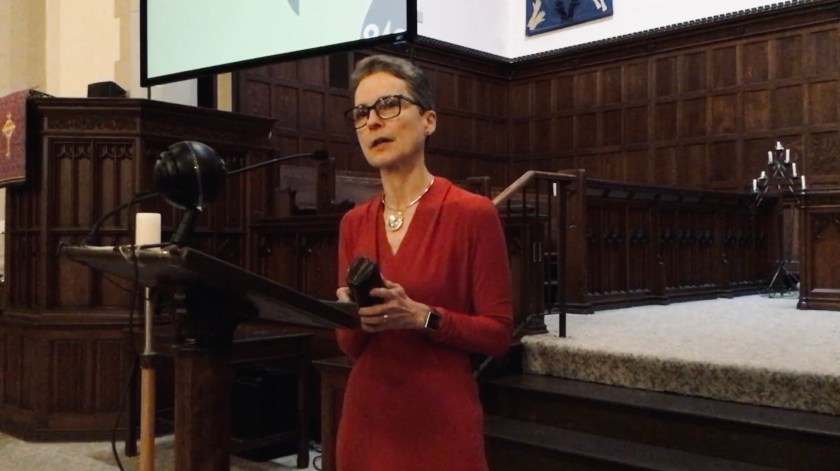
BIO: Margot Van Sluytman is an award-winning Poet and award-winning Therapeutic Writing Mentor, and Justice Activist. She teaches Global Citizenship in the framework of Sawbonna at Centennial College in Toronto, Canada. Her books include: Birthing the Celibate Soul; Sing My Spine-A Response to the Song of Songs; Dance with Your Healing-Tears Let Me Begin to Speak; Breathe Me: Why Poetry Works; Hope is: The Pandemic Poems; Wild Self Real Self: Surrender Not Control; and, How Mining Meaning Leaves its Mark. She is the Poet Laureate of Roncesvalles United Church in Toronto, Canada. She was nominated for Ontario’s First Poet Laureate. In the year 2000 Margot was gifted with the Spirit Name: Raven Speaks.
Discover more from Feminism and Religion
Subscribe to get the latest posts sent to your email.
 Feminism and Religion
2 thoughts on “Goddess Lost: How the Downfall of Female Deities Degraded Women’s Status in World Cultures by Rachel S. McCoppin; book review by Margot Van Sluytman”