


I would like to introduce this community to Gender a výzkum (in Czech) or Gender and Research (in English), a transdisciplinary, peer-reviewed journal founded in the year 2000 and dedicated to research in Feminist and Gender Studies in the Czech Republic. While the journal’s main focus is work pertaining to Central and Eastern Europe, it is open to a wide range of geographical locations and topics. The journal, which publishes articles in Czech and English, often puts out calls for individuals or groups of people to edit monothematic issues. Past monothematic issues include feminist reflections on Covid, an issue on the use of language concerning sex and gender, gender in popular culture, children, adolescence and sexuality, feminist interpretations of Islam, and postcolonial and decolonial thinking in feminist theory to name just some. If you would like to read them, the journal is available online as well as in print.
Two colleagues, Dr. Tereza Jiroutová Kynčlová and Dr. Blanka Knotková-Čapková, and I have just edited for the journal a monothematic issue on religion and spirituality entitled Gender, naboženství a spirituality or Gender, Religion and Spiritualities. This is a milestone for the intersection of feminism and religion within this country, although interest in the field from the perspective of gender, specifically in Christian Protestant circles, can be traced back to the 1990s and ThDr. Jana Opočenská (note 1). Our issue includes a memorial about ThDr. Opočenská, who recently passed away, yet whose impact in the field is truly felt here.
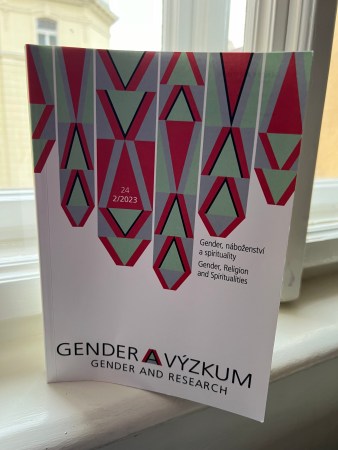
Our issue grounds feminist work in religions within the larger history of the feminist movement, both in the Czech Republic and in a global sense, and illustrates as well just how religion shapes lives, particularly the lives of women. In the issue, we not only introduce our readers to the foremothers of the field in the United States, many of whom have been involved in or beloved by our community such as Carol P. Christ, Leila Ahmed, Rosemary Radford Ruether, Judith Plaskow, Rita M. Gross, Z. Budapest, Mary Daly, and Carter Heyward, but also intertwine the work of ThDr. Opočenská and other Czech feminists who study religion into the broader discussions about religion feminists around the globe are having.
There are six articles in our issue – five in Czech and one in English (by me)- as well as an editors’ introduction that supplies the reader with the basic history of feminism and religion and how feminist critiques and reconstructions of religions and spiritual traditions have occurred. The Czech articles (note 2) examine the ecofeminist works of the Rosemary Radford Ruether, gender in the Roman Catholic Church, Czech New Age spirituality, emancipatory concepts in the works of Saba Mahmood and Judith Butler, and subversive Jewish Orthodox feminist discourses surrounding the mechitza. My article, in English, argues for a change in approach to Jewish environmental ethics from the individualistic principle-based concept of bal tashchit (do not destroy) to a communal, feminist stance in which the environment is included in the Talmudic/Torahic category of the poor.
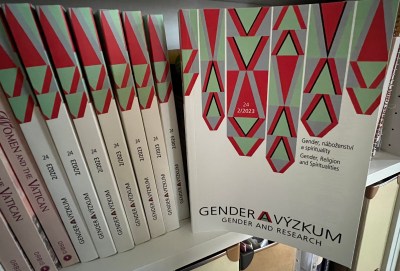
What our issue uniquely brings to the journal is the idea that there are individuals living in the Czech Republic who find religions important, thus study (and perhaps practice) them, and do so from a feminist/gender studies perspective. As the issue is directed more to academics as most academic journals are, we are, I suppose then, more interested in illustrating to feminists in the academy the following: our hope is that the issue, “offer[s] the reader a brief glimpse into a diverse field of research,… provide[s] greater access to the subject area,… and inspire[s] further reflections on the analytical potential of gender for research within religion and spirituality,” (23). In other words, within the Czech Republic, religion is an interesting and broad topic of study for further feminist inquiry. However, we as writer activists also want to reach a broader audience and make real, concrete feminist change here in the Czech Republic and in the global context to religious institutions, organisations, communities, rituals, theology, etc.
I hope you find our issue and the journal Gender a výzkum/Gender and Research a helpful resource for your feminism and gain some insight into the more academically-minded feminist discussions taking place here in Central Europe.
NOTES:
- I want to acknowledge that there has been a monothematic issue on Islam and feminism. The issue treats Islam as a religion practiced outside of the Czech Republic (even when Muslims clearly also live here). (The topic of religious diversity and acknowledging difference in the Czech Republic is a topic for another blog; I have discussed it somewhat here.) According to the introduction to the issue, Islam and feminism is a topic for study because of various Islamophobic perspectives prevalent in the Czech Republic as well as the myth that feminism and Islam are incompatible (i.e. there are no feminist Muslims). This is very important work, but it is different from what we want to do. We want to bring discussions about religion into the Czech context and the religions present here.
- I have found that google translate helps to make the articles in Czech at least relatively accessible. It is not perfect as academic writing in Czech often relies heavily on the passive voice, but you could try it if you are interested in one of the articles and do not know Czech. All of the articles also include a short abstract in English so that one can get a general sense of the article.
Discover more from Feminism and Religion
Subscribe to get the latest posts sent to your email.

 Feminism and Religion
I am impressed by the scope of the issue you edited that addresses feminist issues in a more global context. And the fact that you ground your research by including our foremothers. In my opinion, and as a former women’s studies professor, it is almost an imperative that young feminists read the works of those women some of which you mention, including of course, Carol Christ. We are fortunate at FAR to be exposed to Carol’s thinking each Monday and it distresses me to see how rarely women comment. Carol was not only an impeccable scholar but her vision of religion was grounded in Nature and the importance of the natural world to feminism and to religious expression. If feminism and religion don’t unite over the earth crisis who will? I do note that you speak to “a communal, feminist stance in which the environment is included”. This communal feminist stance towards the fate of the earth as we know it, and of course to future generations is probably the only hope we have.
LikeLike
Thank you Sara. I have always taken an ecofeminist approach to the work I do. I do not think we can solve the climate crisis without feminism and vice versa – we cannot hope to end patriarchy without reconceptualizing our relationship to nature.
LikeLiked by 1 person
Oh Ivy I fervently believe we are right – as you say – reconceptualizing our relationship to (the rest of) nature.
LikeLike