

This was originally posted on Jan. 7, 2o13
A few days ago, a German-speaking friend spoke with an Eiloff relative of mine who lives in St. Nikolaus, Saarland. My relative remembered hearing the story that Heinrich Eiloff, my 2x great-grandfather, emigrated to the United States in the mid-1800s. Since we connected, I am experiencing an incredible lightness of being.
This is the first time my two years of genealogical research have led to a “Kunta Kinte” moment, a connection with a relative in “the old country.” I have been unable to trace most of my ancestors back to the places of their birth.
My relative in St. Nikolaus was perplexed by a call from Greece from a woman claiming to represent his American relative. But when she explained that I only want to find my roots and perhaps visit relatives in St. Nikolaus, he said, “that would be very nice.” He promised to speak with other living relatives and said we should call in a month or two and he would tell us what he found.
According to my research, my 2x great-grandfather Heinrich Eiloff was born in 1820 in St. Nikolas, Saarland, in Prussia (now in Germany).
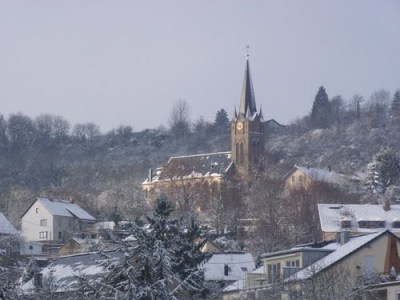
His father and grandfather were born in nearby Rosbruk, Moselle, Lorraine, now in France, and his mother in a neighboring village in Saarland.
After a brief sojourn in New York where two children were born, Heinrich and his wife Catherina Latour settled on a dairy farm in Cherry Ridge, Pennsylvania. In the United States, my 2x great-grandfather called himself Henry Iloff and told census-takers he was born in France and in Prussia in 1820 and in 1822. It took me some time on FamilySearch.org to locate his birth records, but I was pretty sure I was right, as Eiloff is an uncommon name, and this was the only birth record that seemed to fit.
I had known for at least a year that there are only about 50 Eiloffs in the German phone book, 5 of them in the small town of St. Nikolaus. I suspected these were relatives, but I had been hesitant to call to confirm my hunch.
In the meantime, I continued piecing together the family story through online records and my father’s memories. FamilySearch led me to census, birth, and marriage records that provided vital information such as ages, places of birth, addresses, occupations, and number and ages of children. Family surname groups on Ancestry.com led to connections with 3rd cousins who shared information with me. These groups can be located by typing, for example, “Iloff family surname” on a search engine.
My father remembered his grandmother, Catherine Iloff Christ Scheffling, whose first husband had died when my grandfather was a baby, leaving her with 5 children. George Christ’s death certificate, found by a 3rd cousin, confirmed that he had died at home of tuberculosis after a year-long illness, a few months after my grandfather was born. The place in Williamsburg, Brooklyn where my great-grandfather died was noted as a “tenement,” perhaps a 3 room airless apartment overlooking an internal courtyard, like the one in A Tree Grows in Brooklyn . My great-grandmother was struggling to feed 4 children during her pregnancy while her husband was lying on the living room couch coughing up blood. (This image was provided to me by a Greek friend who vividly described her father’s death.) Two of Catherine’s children would die in succeeding years. She gave birth to 2 more children with her second husband and ran a boarding house for 20 or 30 people–individuals and famiies of German, Irish, and East European descent.
As my father had never wanted to speak about the poverty in which his father and mother were brought up, I was astonished to see words like “tenement,” “malnutrition,” “diphtheria,” and “tuberculosis” on most of the family death certificates provided by my 3rd cousin. I understand why my father wanted to spare us this knowledge, but I feel stronger and more compassionate knowing what my family went through.
When I came to a dead end in my research, I contacted cousins and second cousins to see if they knew anything more about the family. One of my father’s cousins had asked his mother, my grandfather’s half sister, to write down everything she knew about her family before she died. Her notes produced the astounding information that Heinrich Eiloff had 9 children with Catherina, and another 9 with his second wife Johanna Switzer–15 of whom lived to adulthood.

Iloff family in 1880s, Henry right of center
Two 3rd cousins have recently created Iloff family Facebook groups with a total of more than 100 members, descendants of Henry Iloff and his two wives, now spread around the United States. It was through emailing the founder of one of these groups that I plucked up the courage to call St. Nikolaus.
My interest in my family’s history began when I realized that “ancestor reverence” is an important part of earth-based spirituality. We are connected through our bodies to places that have shaped our histories. We are also connected through our bodies to ancestral DNA and to our ancestors and the places where they lived. This connection is not only physical, but spiritual. We did not create ourselves. Our ancestors and specfic places in the earth made our lives possible.
All of my ancestors emigrated from Europe to the United States. Their places of origin include Ireland, France, Germany, Sweden, Scotland, and England. They were both Protestant and Roman Catholic. In the 1930s my father’s family moved from New York to San Francisco, while my mother’s family moved frequently due to her father’s work with the Railway Express. Thus, my family lost touch with people and places. Impoverished lives in New York and Kansas City were not mentioned. Farms in Michigan and Pennsylvania were invoked fondly, but not visited.
For me, finding “the place” where some of my ancestors lived and some of my relatives still live feels more profound than I have words to express. The joy I feel in my body may be one measure of all that we lost when we left home, not only in Europe, but also in the United States. As I learn my ancestral history, I free myself of the burdens of loss and loss denied. I plant myself more firmly in mother earth.
Discover more from Feminism and Religion
Subscribe to get the latest posts sent to your email.

 Feminism and Religion
Ah Carol’s words hold so much wisdom…”My interest in my family’s history began when I realized that “ancestor reverence” is an important part of earth-based spirituality. We are connected through our bodies to places that have shaped our histories. We are also connected through our bodies to ancestral DNA and to our ancestors and the places where they lived.”….. I would add that we are connected through invisible fields to those who have come before – for good or ill. In my case there is much darkness in family history so although I am aware of this field’s influence I do not wish to pursue it – what I have learned from one life -time is enough.
LikeLike