


Moderator’s Note: We are pleased to announce that we have formed a co-operation with The Nasty Women Writers Project, a site dedicated to highlighting and amplifying the voices and visions of powerful women. The site was founded by sisters Theresa and Maria Dintino. To quote Theresa, “by doing this work we are expanding our own writer’s web for nourishment and support.” This was originally posted on their site on January 5, 2021. You can see more of their posts here.
A few weeks back, I came upon a term I had not heard before, the ‘Matilda Effect’. It’s defined as: a bias against acknowledging the achievements of those women scientists whose work is attributed to their male colleagues (Wikipedia). This term was coined by science historian Margaret W. Rossiter in 1993, in her essay The Matthew Matilda Effect in Science.
The Matthew Effect, labeled in 1948 and credited to Robert K Merton, and later to Harriet Zuckerman as well, refers to the way that: eminent scientists will often get more credit than a comparatively unknown researcher, even if their work is similar; it also means that credit will usually be given to researchers who are already famous (Wikipedia).
While the Matthew in the ‘Matthew Effect’ is drawn from the biblical Gospels of Matthew (“For to every one who has will more be given, and he will have abundance; but from him who has not, even what he has will be taken” – Matthew 25:29, RSV), where did the Matilda in the ‘Matilda Effect’ come from, I wondered?
Margaret W. Rossiter, American historian of science at Cornell University, a phenom in her own right, named this particular effect on women after Matilda Joslyn Gage, a women’s suffragist, abolitionist, and Native American rights activist, who worked alongside Elizabeth Cady Stanton and Susan B. Anthony. Carolyn Gage, American playwright who took Gage’s name for her own, calls Stanton, Anthony and Gage “a triumvirate..the leaders and strategists of the [suffragist] movement.”
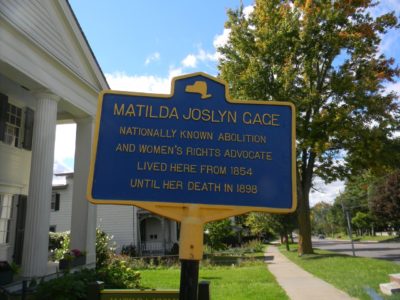
Matilda Joslyn Gage, born in in 1826 outside of Syracuse, New York, was the only child of progressive parents. Rossiter describes Gage’s father, Dr Hezekiah Joslyn, as, “a physician who was an abolitionist, a temperance advocate, a woman’s rightist and free thinker, whose house was reportedly a stop on the Underground Railroad that took escaped slaves to Canada. He taught her [Matilda] Greek as well as mathematics and physiology”(335).
Later, Matilda Joslyn Gage’s own house would also be a stop on the Underground Railroad, and she would be initiated into the Iroquois Wolf Clan with the name Karonienhawi – she who holds the sky, for her advocacy of Native American rights.
Gage, writer and editor of suffrage newspapers, also co-edited the first three volumes of the History of Women’s Suffrage with Stanton and Anthony and later worked with Stanton and others on The Woman’s Bible published in 1895, “a major Bible criticism from a radical feminist point of view”(Women of Courage).
Ultimately, Gage was more radical than the others, turning “her efforts to religion, especially to Christianity, which she thought especially downgrading to women”(Rossiter 336).
When in 1890, Susan B. Anthony arranged for the National Women’s Suffrage Association, of which Gage was a co-founder, to join forces with Women’s Christian Temperance Union, Gage broke away and formed the Women’s National Liberal Union. Anthony believed that by merging with the Women’s Christian Temperance Union, chances of gaining the vote sooner than later were better, but Gage “who championed the separation of church and state”(Dominus) was opposed to this merge.
This was the beginning of the end: “Joslyn Gage’s radical beliefs, confrontational style, and the danger she posed to patriarchy resulted in her deletion from the history to which she was so much a part”(Brammer 119).
Susan Dominus, in her article Women Were Written Out of History. It’s Margaret Rossiter’s Lifelong Mission to Fix That, says:
“It is an off wrinkle of feminist history that one of the most powerful terms [Matilda Effect] used to identify overlooked female scientists has been named after a woman diminished not by male credit-grabbers but arguably the two most influential feminists in American history. In their effort to win the vote, Stanton and Anthony made choices that bowed to traditional power structures – some of them racist, some of them based in the church, and all of them controlled by men.”
To be continued tomorrow.

BIO: Maria Dintino has worked in higher education for over thirty years. While in graduate school, Maria became enamored with the Transcendentalists, especially Henry David Thoreau. Although introduced to Margaret Fuller then, she did not comprehend her undeniable significance until another encounter many years later. It is now clear to Maria that Fuller is destined to claim her rightful place in American herstory and one of Maria’s goals is to help her do so. Maria’s first work of creative nonfiction, The Light Above: A Memoir with Margaret Fuller has been recently published and she is at work on her second book. Contact Maria at mdintino477@aol.com.
Discover more from Feminism and Religion
Subscribe to get the latest posts sent to your email.
 Feminism and Religion
Thanks for this fascinating article about Matilda Joslyn Gage. I had heard of her and of the Woman’s Bible, but I did not know much about Gage. She certainly deserve to be as well known as Susan B. Anthony and Elizabeth Cady Stanton. What a pity that they bowed to patriarchy and kudos to her for breaking away. I’m looking forward to part 2 of your post.
LikeLike