

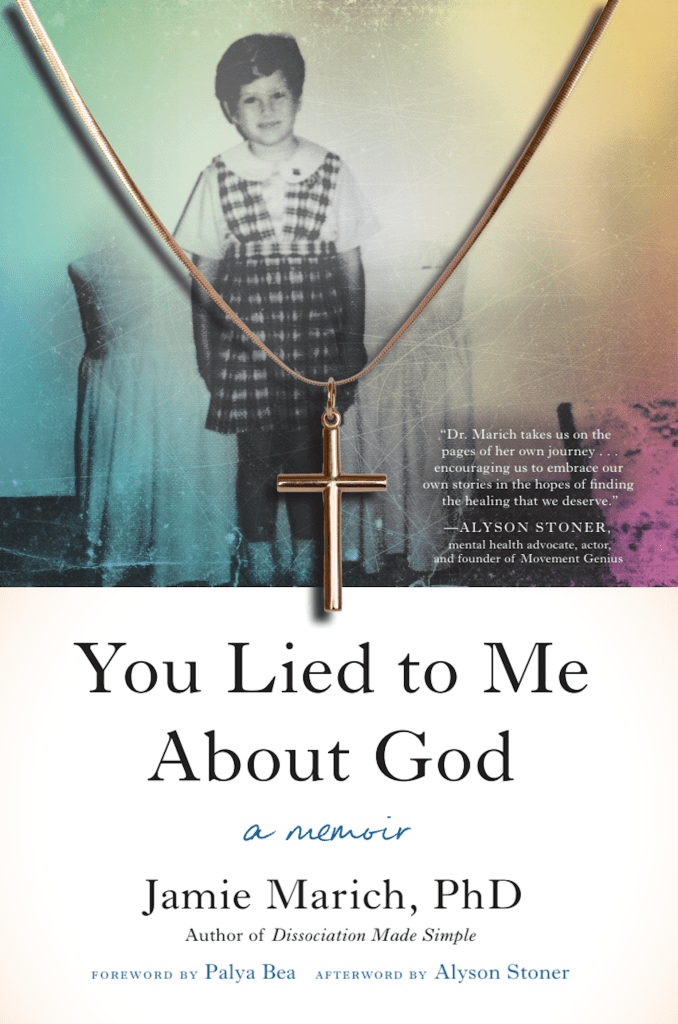
This was a hard book for me to review. Perhaps because she writes about such difficult issues and yet she does so in a compelling and at times even humous manner. I feel a responsibility and yet find it hard to capture how she manages a breezy manner while discussing heavy material. Perhaps, even though our backgrounds are vastly different, I was also relating to so much of what she said. Jamie also covers so much ground; it is hard to pick out individual aspects to discuss.
As a child Jamie Marich was caught in the web of different religious systems, Catholicism from her mother and Evangelical from her father. They were at soul-hurting odds with each other (both parents and religions). Each one proclaimed they were the one true path so there was the ever-present threat of choosing the wrong one and facing a parent’s wrath along with that of eternal damnation. She labels this spiritual trauma. It cuts to the soul of a person being trapped into a no-win situation. It’s a conflict-driven, shame-filled, guilt-ridden way to grow up.
Jamie navigates this emotional and spiritual minefield with integrity and verve as she sets off on her own quest of spirit. I originally read her book in Sept. Now reading it again with the election behind us it is fascinating, and yet even more painful to see the historical threads which weave through her story. It does explain much of why we are in the situation that we are.
She notes how she was introduced to Rush Limbaugh’s concept of a feminazi when she was 9 or 10 (43). That is downright chilling.
She talks about her Pentecostal Evangelical father who followed the same religious strain as Amy Coney Barrett which is called the Praise of People movement. (3)
As we follow her own healing journey, she has experiences both out in the “real” world and in other religious traditions. She becomes a therapist in the field of her own healing: spiritual trauma survival. She has a lot to say from both personal experience as well as a professional. This gives great depth to her writing.
At the end of each chapter, she has an “Expressive Arts Invitation” with creative suggestions so that the reader can delve into their own thoughts and feelings in relation to the narrative. In this manner, they welcome the reader to participate in various experiential ways in their own healing journey.
She describes the spiritual abuse she suffered as a child in ways that are surprisingly readable. I found it particularly sad when several people she knew and loved had died. Her father turned the causes of their deaths into her own spiritual failures as if she was a type of grim reaper and it was all her fault. Harrowing!
She turned to substance abuse and when she hit bottom she ran away and journeyed to pilgrim sites of her ancestral roots in Bosnia-Herzegovina. I just have to stop and say what courage that must have taken to leave behind everything and everyone she knew and head off into the unknown. And she did so with limited financial resources. She spent several years working in Medjugorje, Bosnia-Herzegovina which is a place for pilgrims who honor Mary, mother of Jesus.
She writes: “When all was said and done, I ended up spending over two years in Medjugorje, from December 2000-April 2003. What started as a spiritual pilgrimage to find myself truly ended up being my long-term stint in rehab.” (93)
Jamie covers a lot of ground in this book. When Roe V Wade was overturned, she notes, “I was both shocked into a trauma response and not surprised. I once again felt like, as a woman, I was nothing but a second-class citizen in my country that falsely promised freedom for all.” (57) And she goes on to describe how, in the Evangelical world, this was all part of “God’s plan.” This all hit home for me as I also experienced a trauma response at that time although for different outward reasons. I think for all of us who have experienced our bodies as sacrifices for the pleasures and philosophies of others, we learn to tremble when we see it spreading out in our world. We have experienced in our own bodies, the pain and suffering such beliefs cause and none of us want others to go through such experiences.
And it can be hard to recognize when we are in the midst of it. As Jaime writes, “When I started to heal, I noticed the horrific pattern of control, insult, abuse and terror to which I was exposed.” (112) I need to stop here again and note how hard it is to turn to the patterns of our youth and recognize them in the face of trauma and abuse and then use them as a healing springboard as Jaime has done.
In tying it all together she notes in what, for me, is probably the strongest sentence of her book, “Not only did they lie to me about god, they lied to me about me.” (74)
There is denouement which is quite satisfying. She writes how in this process, “I learned. to trust myself and the Inner Power that lives in me.” (125) And I love how she attaches her own healing to the larger picture of self-responsibility. “It’s up to us as seekers to determine how much of our power we are going to give away, or whether or not we are going to use spiritual practices to empower ourselves.” (125)
All in all, this is a gorgeous book. It is surprisingly easy to read and relate to. It weaves gracefully among society in general and personal experience. I felt personally enriched by reading it and I highly recommend it. You can purchase it here.
BIO: Dr. Jamie Marich (she/they/we), LPCC-S, REAT travels internationally teaching on topics related to trauma, EMDR therapy, expressive arts, yoga, and spiritual trauma while maintaining a private clinical practice and online education operations, the Institute for Creative Mindfulness, in her home base of Akron, OH. Marich is the author of over a dozen books and manuals in the field of trauma and expressive arts, including Dissociation Made Simple (2023), Trauma and the 12 Steps (2012/2020), and Dancing Mindfulness (2015). Her long-time publisher, North Atlantic Books, is releasing the memoir of her lived experience with spiritual abuse and religious trauma, You Lied to Me About God, scheduled for an October 2024 release. Marich grew up with one Catholic parent, one Evangelical parent, has a brother who is a Roman Catholic priest, and also survived a yoga ashram experience. Marich is on the wisdom council of Abbey of the Arts.
Discover more from Feminism and Religion
Subscribe to get the latest posts sent to your email.

 Feminism and Religion
Janet, I deeply appreciate your most excellent reviews – truly you are natural! What I perceive here in the big picture is that you are reflecting upon our current political/personal situation and that willingness seems particularly important at this time.
LikeLiked by 1 person
Thank you for calling me “a natural” Sara. I do hope that I did not obliterate Jamie Marich’s personal journey, which is remarkable on its own, by tying in too much of the political. There are both threads in this book.
LikeLiked by 1 person
You most definitely did not obliterate anything – as for the political – well – we are the political, yes? The personal is political – we cannot separate them
LikeLiked by 1 person