

Years ago while I was a student at Boston University, a student group organized a spoken-word event. There were already some among the student body who were spoken word poets, but they also brought in Edyka Chilome, a poet, and as she refers to herself, a “cultural worker, futurist, and community weaver” (who’s also written with FAR as Erica Granados de la Rosa). She was not the first to speak, but before she did, she first took a minute to light some sage, lay it in a bowl in the middle of the circle space she had opened up in front of her, she called the four directions, and then said a prayer.
I was immediately struck by several things about the moment. First, she completely changed the energy in the room; bringing in a sense of reverence that was not expected, as it was not that kind of a gathering. She also set the stage for herself, so to speak, and prepared herself in the way that she needed to in order to do the work she came to do. But she did that preparation before us, in public. Two things stayed with me in particular: first, was, how is it that she developed that degree of individuation, enough to practice something that stood in stark contrast to the setting she walked into; and the second was, does having such a practice – a spiritual practice as I understood her to be enacting – do something to strengthen her art, her work?
The whole experience of witnessing Edyka Chilome at work made me curious about what bringing that kind of spiritual grounding might do for the work any of us do, specifically as activists, artists, and writers.
More recently, this October, I attended an event put together by an artist I’m connected to at the Skirbal Cultural Center, a Jewish cultural Institution (note, not a religious Jewish institution). The event was titled “Manifestos for the Moment: An Evening of Civic Joy with Joey Soloway, Nadya Tolokonnikova, and Patrisse Cullors.”
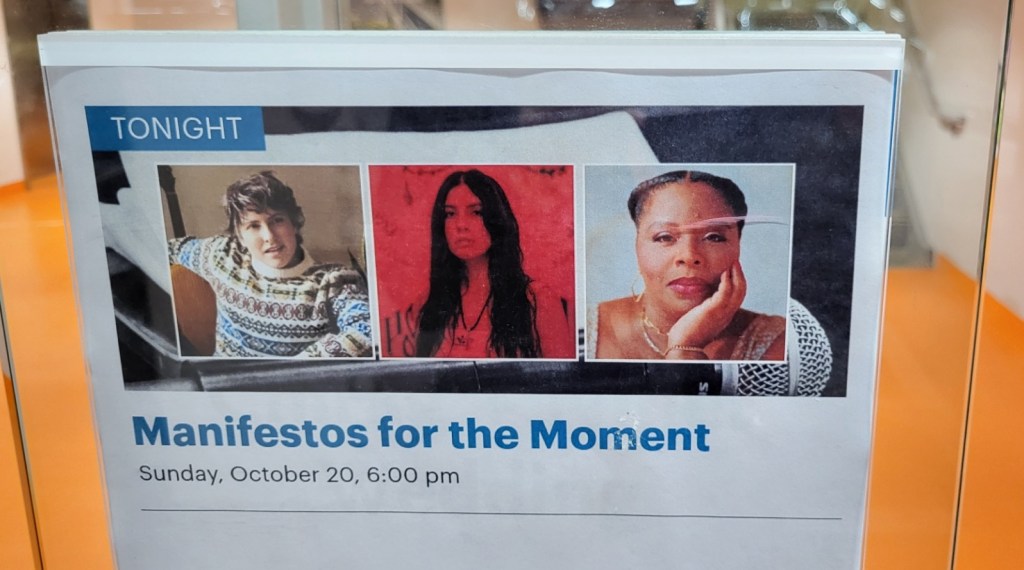
It was a public, non-religious event, focused on the work of these activist artists, with the stated aim:
How do we meet this fraught electoral moment with grace and resolve to deliver a more just America?
Who are the people that inspire activists toward action?
but the tone was very spiritual:
Walking in very slow motion into the auditorium room – dark, transcendent feeling – Patrisse Cullors (co-founder of the Movement for Black Lives) entered dressed in a regal, intergalactic outfit, and led us in story-telling, inviting us all to imagine a cosmically interconnected future.
Pussy Riot member, Nadya Tolokonnikova, read from a written statement about her experience standing up to Putin and fascism in her home country, from which she is now exiled. I captured one sentence in particular that I was able to write down: “an autocracy aims to break your body and your spirit, so that you will submit, and yet, I choose hope.”
Joey Soloway, television director and writer (known for creating and producing Transparent, the Amazon original series) had us collectively chant Amtlai 17 times, (Aaaaam(a) -T-(a)lai), the name of the mother of Abraham of the Hebrew Bible, as a way to cast a spell.
In the reception following, we were invited to consider it a celebration and to live the moment as if Kamala Harris was already our president. They had set up an altar with a countless number of goddesses, had a place for us to write out our intentions, and we sang Happy Birthday to Kamala Harris, whose birthday it happened to be.
Though these are all just anecdotal and informal reflections on my part, it highlights for me the critical role that spiritual practices play in the grounding or resourcing of self, which we all increasingly require. The grounding is individual in nature, but it feeds work that is communal and collectively carried out toward a common good.
Yara Gonzalez-Justiniano, in her book, Centering Hope as a Sustainable Decolonial Practice: Esperanza en Práctica, says that, “hope is about what is not yet actual, but about what is hoped for and lived into anyway.”
All the subsets of the progressive institutions and online communities that I am a part of, are expressing the need to “stay grounded” and to attend to their needs and keep them at the forefront in order to stay resourced for the long road ahead (the next 4 years of a Trump administration). One of my colleagues recently said, “The battle is long – I’m learning how to take care of myself as I take care of others.”
What are the ways you will carry, sustain, and enact another reality and way of being beyond that which reaches our own private life and toward a vision for collective justice-seeking — be that democracy, human rights, justice? What are the spiritual practices that are helping us live into the hope of what is not yet actual, but that we still hope for and are willing to live into nonetheless?
Discover more from Feminism and Religion
Subscribe to get the latest posts sent to your email.

 Feminism and Religion
Thank you, Xochitl. I needed this so much. You’ve given me much to ponder, and the first stirrings of hope I’ve felt in a while.
LikeLiked by 2 people
Beth, I so understand. I’m searching too. Writing definitely has helped me to think and try to access hope and inspiration. We must stay in the light.
LikeLiked by 1 person
“an autocracy aims to break your body and your spirit, so that you will submit, and yet, I choose hope.” Yes Xochitl this is exactly why we need to stay awake, self reflect, ground our bodies in what is and lean onto whatever spiritual tradition moves us for help….Here is a little prayer I wrote that I am using to help me move through these dark days when endurance seems to be all I can manage: ” I put my faith in this soil/ When I came here this was a holy place/Those roots run deep/ outliving those who would harm”. I can’t truthfully say I can really feel these words but I repeat them anyway.
LikeLiked by 3 people
Oh, I love your prayer, Sara. And that’s exactly right, we sometimes practice what we don’t feel as a way to live into that which we desire and hope for. I’m all about it!
LikeLiked by 1 person
me too – feel a bit desperate because I can’t feel those sparks but we have to keep going as best as we can – you are wonderful!
LikeLike
Hello, this was just the thing I needed to read today because it supports much of what I’ve been saying to people. This was put much better.
Thanks much and blessid be.
LikeLiked by 1 person
So glad to hear it, Patty. Thank you for reading and engaging!
LikeLike
Hello, my pleasure.
LikeLike
Thank you for the timely, timeless inspiration!
LikeLiked by 1 person
Thank you, Elizabeth!
LikeLike