

Moderator’s Note: Sara wrote this in 2019. This is its first publication and has grown all the more pertinent now.
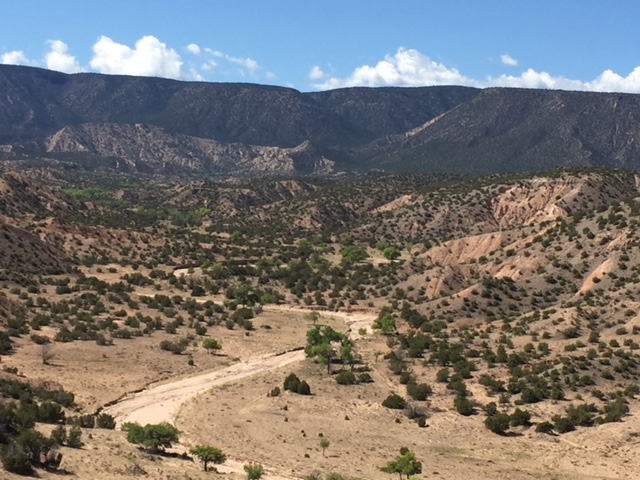
Sapawe is an ancestral Tewa Pueblo located outside of El Rito. Until this weekend I had never been to the ruin. I didn’t know, for example, that it was the largest ruin in New Mexico, and perhaps the entire Southwest or that during the period it was built and occupied (1300- 1500’s) that ten thousand people lived there. Estimates suggest that there were at least 1,800 ground rooms and twenty – three kivas. Walking around the huge compound is something I have yet to do. It was too hot for me to do more than take in the astonishing view or traverse a small part of the plateau, briefly. I did note that there were artifacts and planned to come back another time – soon.
Early yesterday morning I met with four other people to see the shrine that was located outside the pueblo. This was the place that secret ceremonies were held on behalf of all the people in the pueblo. On the surface all that could be seen was a large raised stone circle, but there was a sense of presencethere that felt both powerful and peaceful probably because few people knew about this shrine and the natural power of place had not had a chance to dissipate. After having explored a couple of other Tewa ruins, I learned that it was very important to allow place to speak in its own time, and to allow that to happen I had to return again and again with an open heart, eyes that could see beyond the obvious, and an active inner ear … The land speaks to those that can listen.
When the leader, a kind local man pointed out an almost juniper hidden standing stone as the East entrance marker to the shrine, another man, who turned out to be Tewa, said quietly, “there is only one way in and one way out of the circle and it is marked by the stone which is always placed in the east.” Immediately, awareness struck – he knows what transpired here – I felt him “reading” the land as we walked. I watched carefully as he picked up an artifact. “This was probably a stone that held paint” he said, turning the oblong hollowed out stone over in his hands before placing it back on the ground.
Little by little the others dropped away as the man began to talk… I listened, dropping deeper and deeper into my body with each word. Although he had never been to Sapawe before he told me that he knew how the people lived here because the Tewa still lived. “Archeologists speak of us as if we are dead but we are here, and we have the stories, and our ceremonies are the same.” He told me that he had come to the conference because it was important for the Tewa to work with the archeologists. So he was a cultural bridge -builder, like me. He said he had to use sociologist terms like “values” to discuss the spiritual aspects of the material world, which for him, as for me, were one. “There is no separation, and archeologists don’t understand this… this is why I farm, because our spiritual lives are tied directly to the land. Our spirit is the land.” He laughed then, saying that he was out in his field spraying Neem oil on his squash plants at 1:30 in the morning the night before! I nodded. He was talking to a plant woman… we were on the same wavelength and we both knew it.
His next words upset me, “the Tewa live now but the old ways are dying. The young people are not following the elders. They are too impatient. They want money and don’t want to work the land, and they are too young to feel that the spirit of the land is alive, and living through them.”
“Are you sure, I asked him. The Tewa still have their stories, the dances that acknowledge every turn on the agricultural wheel…” my words faded away as I experienced the sudden paralyzing fear of loss because the Tewa are part of the reason I came here, and certainly one of the primary reasons why I am staying. I am a woman with Indigenous roots that has no tribe. The Passamaquoddy/Maliseet have been wiped out as have most tribes in the northeast. All my life I have been disconnected from a people whose ways were my own and it has been very lonely. Moving onto land that belongs to the Tewa has allowed me to feel supported by invisible threads. To lose that connection now would be devastating to me. I belong to the land; I am the land and these Tewa ceremonies have been my own, although I didn’t know it until I came here.
He continued, “I was talking to an elder who told me that it was the young people’s choice to leave the old ways behind and that there was little to be done to stop it. The Spanish tried to destroy us, the Mexican’s did too and now the United States is succeeding.” I felt an involuntary chill.
“But what will happen then” I asked, not sure I wanted to hear what he had to say.
“The young people will become confused and when all is finally lost then the Creator will return to restore not just the Tewa but all tribal peoples to the land.”
Part 2 tomorrow.
Discover more from Feminism and Religion
Subscribe to get the latest posts sent to your email.

 Feminism and Religion