


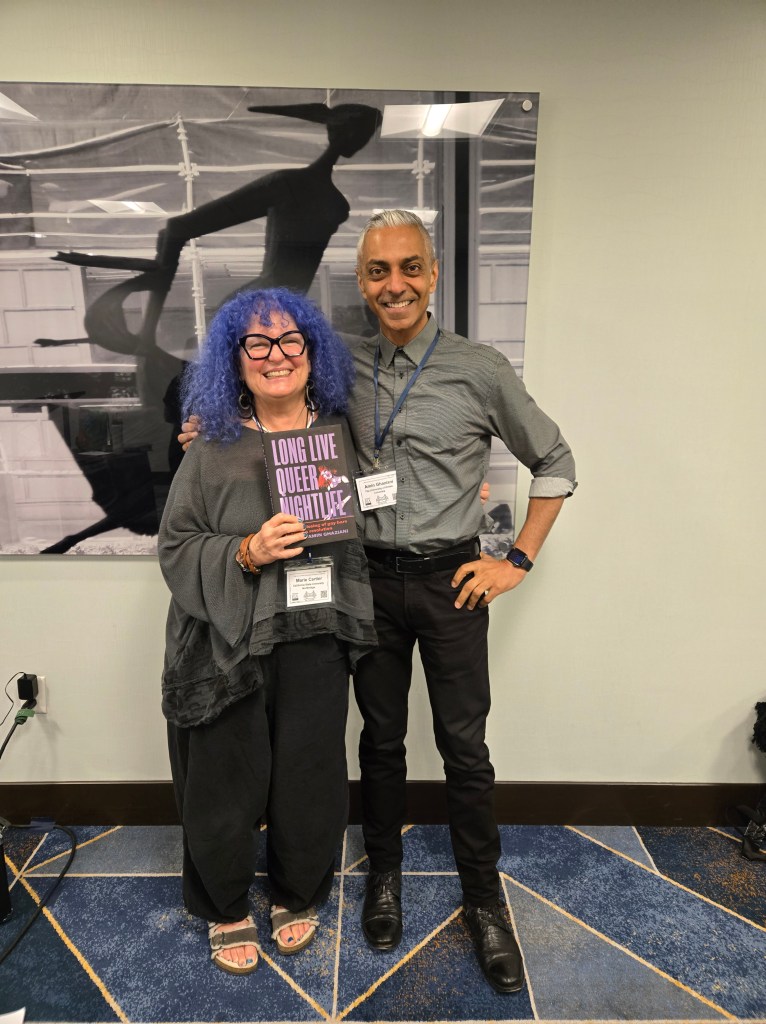
I was invited to be on a panel for the Pacific Sociological Association (PSA) in San Francisco this past March for a new book by Amin Ghaziani, Long Live Queer Night life (Princeton University Press, 2024).
Since I wrote Baby, You Are My Religion – Women, Gay Bars, and Theology Before Stonewall and have discussed aspects of this work here I thought the FAR family would also enjoy this conversation on where queer nightlife is now.
The book is interspersed with visits to club nights, something Ghaziani says helps widen the possibilities for communities—different communities can have their own nights and these chapters where he visits these various hot spots are exciting and first person.
I found this book so – luscious. I wanted to go to all of the clubs and places that Amin went to – and especially to Femmetopia—a femme inspired night! I found the work immersive I could pretty much even smell those spaces…and the yearning that queer folk have to inhabit those kinds of fantasy worlds made real—Buttmizvah—a night specifically Jewish inspired!
One of the big questions threaded throughout the book is, “What is the purpose of the gay bar? Do we still need them?” For my work, Baby, You Are My Religion I interviewed 102 people who identified gay feelings and acted on them mostly prior to Stonewall, but did include informants up to the millennium. All of the informants, but one, said the gay bar was “the only space,” and most of them said it was “home.” I think that is a bigger question and I think Long Live Queer Night Life is looking to also answer that—do we still need a “home” away from where we live? Can queer nights give us that? While the gay bar may not be the only place – especially for urban queer folk—it certainly remains the only place for many rural people who still travel to get to a place where they can “be.” Small Town Gay Bar, a documentary film made in 2006 showed that: a gay couple in front of a small town gay bar, one in drag and the boyfriend says, “Out here he is Randy, but in there he is Miss Judy! And we’ll go as far as we have to, to make that happen.” They had driven three hours.

It stands true today—if you can even still find that special, sacred place–the gay bar within driving distance.
Los Angeles is home to queer nights – for women of “older” age there is Hot Flash -a lesbian queer event for women over 30, also Hotter for women over 40. These are monthly parties. Hotter Flash advertises that is a place to “reclaim joy in a space where folks might otherwise feel underrepresented. In LA, we had two lesbian bars—The Rubyfruit, open for only a few years and closed due to the January fires and promising to re-open soon! But so far—no date. And Honey’s—a young crowd, burlesque type club. In Long Beach we also have Watch Me! a women’s sports bar and women’s sports bars are having a definite mark on the nightlife scene. NBC says they are expected to quadruple in 2025.
A boom for lesbians is there were 3 NATIONALLY and 14 are expected to open this year–nationally. Watch Me! has a definite gay vibe—will the rest of them? That also remains to be seen.
We hear a lot about the need to reclaim or just discover “queer joy”—and certainly the gay bar has been that for me and I believe a strong thesis for Long Live Queer Night Life is that queer joy will rise, like cream, and find its place—even when other places are closed.
I remember dancing until dawn with gay male friends in San Franciso under a disco ball and then walking in early morning fog to the center of the Golden Gate Bridge and watching the sun rise. That was one night and I have always remembered the joy I felt standing on that bridge after dancing all night.
“Where do new joys await?” asks Ghaziana.
Is it enough to have a night? Inferno! —a wild art inspired night documented in the book. Or as I had that one night of dancing till dawn—or do we need a place to call “home”?
One of the things I found in researching gay bars was the democracy of them. One did not need to be “in the know” or go to a specific college, be employed in a specific place or even know the geography that well. One could show up in a city, during the period I researched and ask a cab driver or as my informants said follow a butch woman. But the assumption that there would be a gay bar somewhere in any mid-size to large city was correct. That is not correct today. So, what concerns me are the questions that were posed in Ghaziana’s chapter “When Capitalism Crushes” — referring to the need for “permanent physical structures that we can exist in 24/7 and not just the last Tuesday of the month” (106).
In 2016 I presented at ALMS—the GLBT International Conference for Archivists, Libraries and Museum Specialists in London and I went to Duckie’s as part of the Conference. I ran into a friend of mine from the states who had relocated to the UK. Otherwise, I was one of the only attendees who went to the party. I was alone, but not alone—I had a great time—would I have had a better time if I had known more people? I’m not sure. My friend from the US, then UK, was with his wife and we chatted but he was off to his own thing. I stayed to the end and it was fabulous but of course yes, I think it would have been better if I had known more people. If it been “open” the following night I would have gone and continued going—but of course Duckie’s was one night, as far as I knew.
I also want to bring up the economics of being able to create jobs within a permanent structure—one of the magic parts of the interviews I did for my book was folks who were able to make a living in what was described as “heaven”—or an accepting place for queer folk.
What kind of living can be made from club nights? Who gets to make that living? These are really good questions that are explored in our author’s text and deserve consideration.
So, yes, long live queer nightlife! Yes. But has the closing of gay bars sparked a revolution in the states? Perhaps it is very lesbian/sapphic of me to want to have a “home” a space where “everybody knows your name” where you can flirt for a while before you hook up…is it? I’m not sure. I know we must take fun seriously—we must take joy seriously. It is a core concept of our current leadership in the queer studies program in which I now teach—find queer joy. Is it so rare that we must make sure we find it? Perhaps it is.
I’ll end with a quote on page 148 from the book, “Taking care of yourself is a radical act.”
I loved this book and its questions and its call to action for queer joy. How do we take care of ourselves? Can we do that in our different permutations under the rainbow as club nights? Do we need gay bars? And if we can’t get them will club nights suffice?
We do need places of respite. We need joy. We need community. We need connection. So, I raise my glass. May we figure out how to find—for a night. For a lifetime.
Cheers, everybody!
Discover more from Feminism and Religion
Subscribe to get the latest posts sent to your email.
 Feminism and Religion
Thank you Marie for this post. The book sounds great. And, I would love to go to a women’s sports bar. That sounds like an amazing experience. I am glad that they are growing in popularity.
LikeLike
My time playing women’s rugby really immersed me in the wonderful subculture of lesbianism and sport, and I have been forever changed by how liberating it was. The singing, the fun, the camaraderie, and the close knit nature of the global culture of women’s rugby. Thanks for sharing this.
LikeLike