


This post was originally published on Jan 13th, 2014.
In a provocative essay and heart-breaking painting, Angela Yarber asked us to consider who Jephthah’s daughter is in our time. Angela reminded us that Jephthah was a heroic warrior in the Hebrew Bible who swore in the heat of battle that if his people won, he would sacrifice the first person he would see on returning home. That person turned out to be his unnamed daughter.
Reading Angela’s post and looking at her holy woman icon of Jephthah’s daughter, my mind turned to the story of Agamemnon’s daughter. In this case, the daughter is named: Iphigenia. Agamemnon had gathered his troops to sail to Troy, but lack of wind prevented them from setting off. According to the myth, Agamemnon was told by the Goddess Artemis that he must sacrifice his daughter if the ships were to sail. He did.
In his powerful rewriting of the myth of the sacrifice of Iphigenia, Daniel Cohen questions whether the Goddess requires human sacrifice. In his version of the story, the Goddess Artemis tells Agamemnon that he must sacrifice his daughter if he wants the ships to sail. He does.
Cohen adds a postscript that makes my skin tingle every time I read it:
[The tellers and hearers of the tale] do not see that Artemis demanded no sacrifice. She simply gave Agamemnon a warning, that his acts would have consequences. The goddess tried to make him understand that the cost of his glory and fame was the death of many daughters and mothers, sons and fathers. That is why she asked if he was prepared to bring death to his own daughter.
The Greek dramatists intended to evoke “pity and fear” in their audiences when they retold the story of Iphigenia. But I don’t think they ever intended to question the necessity for war. The classical Greek “democracy” in which they wrote and produced their plays was based on war and led by the heroes of wars. “War is hell,” my father often said. But he did not question the necessity of war in human life.
My friend Judith Plaskow and I have often debated whether the “texts of terror” in the Bible should be read in church or synagogue or excised from liturgies. While I would prefer that stories like that of Jephthah’s daughter never be read again, Judith has insisted that it is important to read these stories which are considered “sacred texts” and then to question the “message” that is usually derived from them. Judith is invoking the time-honored Jewish tradition of midrash, from which the Christian homily or sermon on a text derives.
Here is my suggestion for coda, postscript, or midrash to be added whenever the story of Jeptheh’s daughter is read.
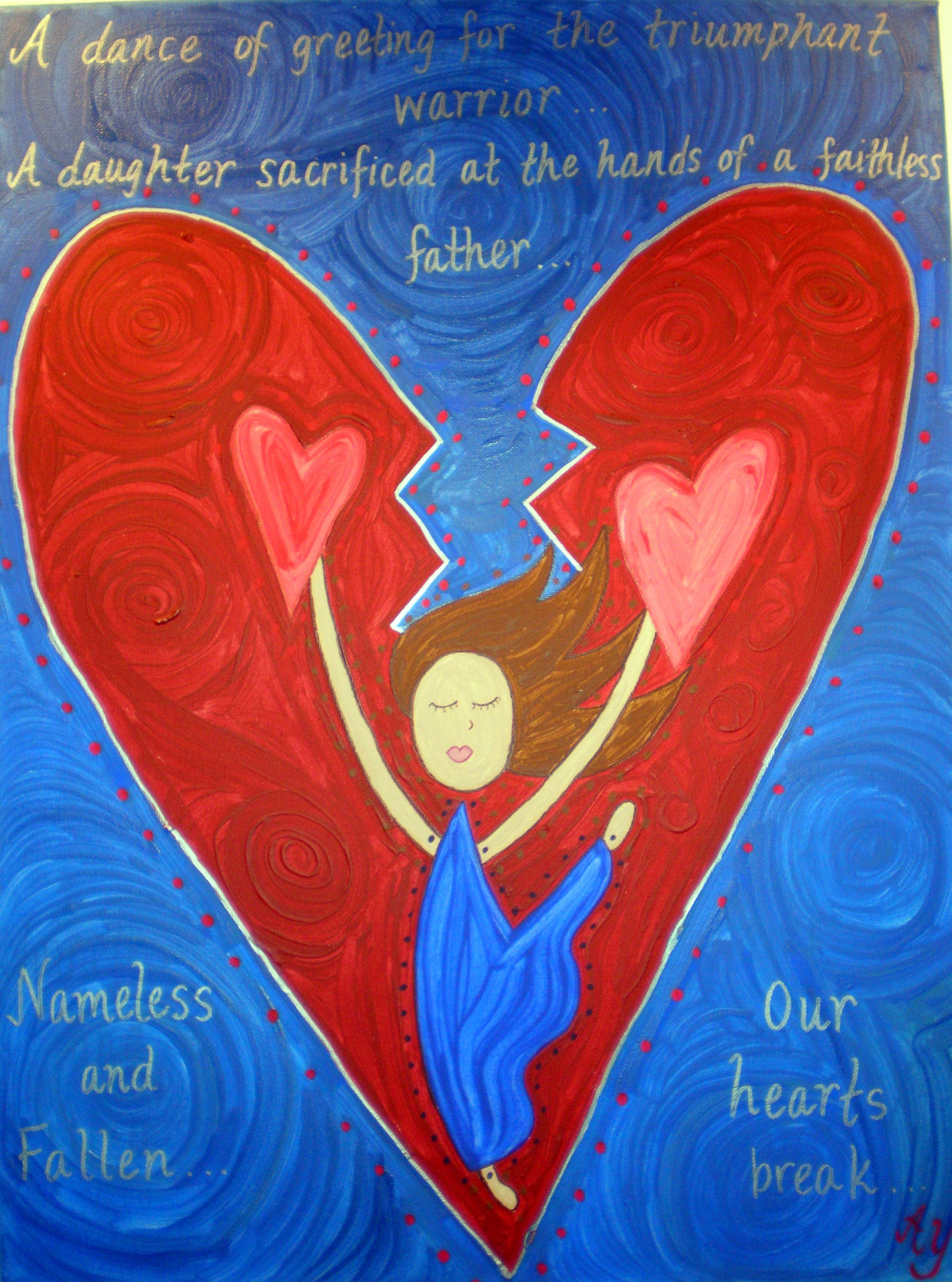 We read this story not to celebrate Jeptheh’s terrible act, but to remind ourselves that every father or mother who goes to war or condones war is signifying his or her willingness to sacrifice not one but many beloved daughters, not one, but many beloved sons.
And I would add that an appropriate hymn to be sung following the reading would be Willie Dixon’s “Ain’t Gonna Study War No More,” with feeling. It’s refrain is:
Ain’t gonna study, study war no more
Ain’t gonna think, think war no more
Ain’t gonna fight, fight war no more
We’re givin’ it up, we gonna let it go
We’re givin’ it up, we gonna let it go
As the Greeks say: makari, would that it were so!
Discover more from Feminism and Religion
Subscribe to get the latest posts sent to your email.

 Feminism and Religion
I am struck by how many cultural stories require the SACRIFICE of the daughter…. this indicates that a PATTERN of sacrifice is written into western culture (this is the meaning of archetypal – it repeats intergenerationally) and until we become aware of this aspect of woman sacrifice how in hell can we stop it?
LikeLiked by 2 people