

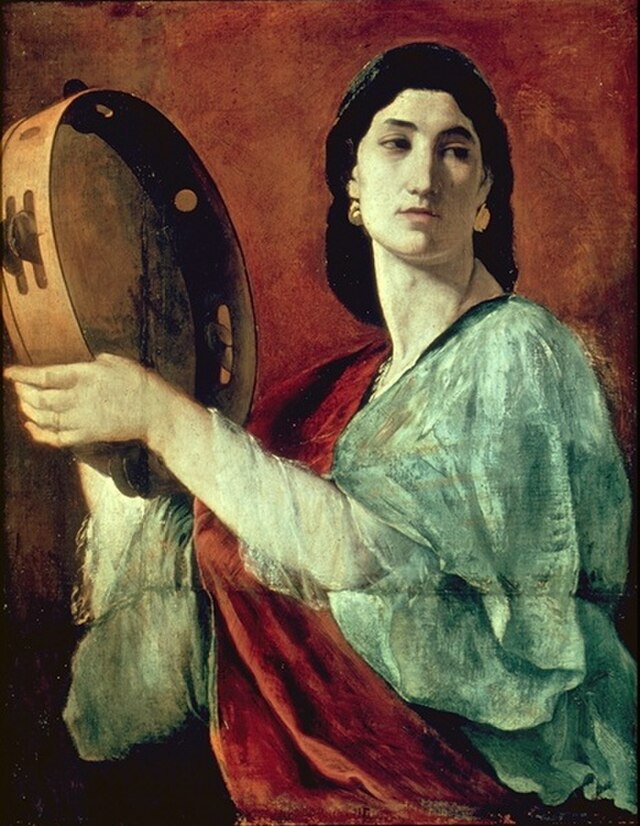
When you hear “Jezebel” do you think of a bold queen, co-regent with the king? Does “Delilah” evoke a businesswoman concerned about securing a comfortable retirement? Does “Miriam” call to mind a community leader who speaks truth to power?
You don’t have to believe in, or even read, the Hebrew bible[1] to be aware of, and perpetuate, its misogynistic portrayal of women as either promiscuous or passive, subservient to their husbands and longing for sons.
Honouring and (re)discovering our spiritual lineage is an important part Feminism and Religion. In this, and future blogs, I will reframe the stories of Biblical women to examine their legacy as unconventional foremothers. Let’s uncover their contributions which have been swallowed by the patriarchal focus that discounts or appropriates the contributions of women.
Depictions of women from the Hebrew Bible in art, literature, music and theology are so familiar that they run in the Western cultural background. While some have been passed down as role models, their popular image may not be fully authentic. Miriam, Sarah, Rachel, and Judith are examples.
Other images, such as Eve, Delilah, and Jezebel, are clearly negative. And many self-reliant women in the Hebrew Bible, including Tamar, Zipporah and the Necromancer/ Witch of Endor, have been ignored or forgotten altogether.
In a culture that provided few roles for them, these women took charge of their lives, using tools that were available to them. While we may not agree with their actions, can we identify with their aspirations?
All of these women, in one way or another, transgress societal norms, then and perhaps even now. Can we see them as strong independent women who take steps to control their own destiny?
As feminists searching for role models, let’s reclaim/ reframe their contributions and recognize their relevance in the 21st century.
Were any of these women historical figures? It doesn’t matter. They are powerful archetypes. Whether or not the Biblical stories happened in some distant time and place, their archetypal energies are present right here and now.
These women know what they want and go after it. All of them exhibit agency by taking control of a situation. Some commit a transgressive act, for which they get bad press by the Biblical writers/ redactor(s) and by later interpreters and commentators. For each woman’s story, there is another explanation that puts her in a better light.
However, while they may in some ways be role models, these women are, above all, human, with strengths and weaknesses. Their gift to the future is taking matters into their own hands, which moves the story forward. Sometimes laudable, sometimes negative, even despicable, they actively deal with a problem or situation rather than rely on others to do so. They take charge, in the face of adversity.
Women who are economically secure
Few women in the Hebrew Bible are able to pursue their lifestyle in economic security on their own terms. Here are the stories of two of them.
Miriam and Judith are community leaders in their own right, without husband or sons. However, unlike most women of their time, they need not struggle to maintain themselves. Although this is not the focus of either story, both have, however, come down to us as admirable.
Miriam the Prophet
Exod 15 Num 12, 20, 26; Deut 24:9; 1 Chr 6:3; Mic 6:4; Exod 2:1-10 (unnamed)
Miriam’s life, chronicled from early childhood to death, identifies her as daughter (of Amram Jochebed) and sister (or Aaron and Moses), but, in the Hebrew Bible itself, never as wife or mother[2].
Miriam is outspoken and speaks truth to power. In an ancient commentary, as a child she opposes her father’s decree that Hebrew men should divorce their wives so as not to have babies to be killed under Pharaoh’s decree. She asserts that Pharaoh’s order to kill Hebrew children applies only to males while his will affect females as well; that Pharaoh’s decree kills children in this world while her father’s would affect babies in all the worlds; and besides, Pharaoh is evil and no one listens to him, while her father is respected and obeyed. Her father relents, re-marries his wife, and Moses is born.
Miriam’s diplomacy is next apparent when, in the well-known story, after Pharaoh’s daughter finds infant Moses on the river, Miriam (unnamed in the biblical story) steps forward and offers their mother as a wetnurse[3]. Later, after the Israelites cross the Sea of Reeds[4], Miriam, identified as a prophet, takes her drum and leads the women in singing and dancing.
Still later, in Numbers 12, Miriam and Aaron “talk against” or “criticize” Moses because of his Cushite wife. This has been interpreted as racist, as Cush is considered to be in Africa. But it is consistent with the Hebrew text that Moses’s unnamed wife (Zipporah or another), in distress because Moses is spending all his time with God and neglecting his family, asks her sister-in-law to tell Moses his family needs his presence. In other words, she speaks to Moses in support of, not in opposition to, the Cushite. At the same time Miriam asks Aaron “Why does God speak only through Moses? Why not through us?” God rebukes her firmly and she turns white[5] as punishment. She is exiled from the community. The (nomadic) people refuse to move until Miriam returns. Aaron is not similarly punished.
In a final Biblical story, Miriam dies and is buried when the community camps at Kadesh in the wilderness of Zin. The next sentence asserts that there was no water for the community. Identifying water as the symbol of life, spiritual sustenance, and prophecy, Jewish tradition attributes Miriam with a miraculous well that accompanies the Israelites through the desert and dries up with her death.[6]
Judith
Judith, exceptionally, is uniformly presented in a positive light. However, her actual story takes up less than half of the Book of Judith, which did not make it into the Hebrew Bible; it is considered Apocrypha/ Deuterocanonic. Widowed young, Judith lives simply, managing her late husband’s estate. When her city, Bethulia, is besieged by an enemy army, she persuades the terrified, reluctant (male) city officials to trust her to save them. She dresses in festive finery and, with her maid, enters the army camp, telling them that she is a Hebrew who will show them how to take the region with no casualties (in effect, that she will betray her people) because they have acted badly. Strategically, she has brought food, and asks to leave at night to pray. When, in an attempt to seduce her, General Holofernes drinks too much wine and passes out, she takes his sword, cuts off his head and hands it to her maid to carry. No-one stops them from leaving, as they had done every evening. Without their leader, the army disperses. Having (literally) taken matters into her own hands and prevailed, Judith returns to her simple life and refuses many offers of marriage. When she died, she had arranged to free her enslaved peoples and distribute her property.
In future blogs, I will explore the stories of other Biblical women and what they have to teach us for today’s world.
[1] More or less the same as the Christian Old Testament
[2] Later Rabbis found unrelated men in the Biblical text and linked them with her.
[3] Miriam, her mother, two midwives, Pharaoh’s daughter, and her servants, women of diverse ages, ethnic backgrounds, and economic circumstances, unite to save one child.
[4] Mistranslated as Red Sea
[5] Usually interpreted as leprosy
[6] Was she, perhaps, a dowser?
BIO: Judith Maeryam Wouk is a long-time follower of FAR who is thrilled to be on this side of the computer screen. She is an ordained Kohenet Hebrew Priestess whose current research focus is reframing Biblical women.
Discover more from Feminism and Religion
Subscribe to get the latest posts sent to your email.
 Feminism and Religion
Your piece of writing HERe, Judith Maeryam is both affirmation and confirmation of womyn. Our voices. Our choices. That you have written about humanity and human-ness, the real-ness of womyn, I applaud and celebrate. Miriam inspires me, has inspired me. Reminding me/us via your writing, that to stay the course of our calls to live fully and to choose to eschew self-immolation due to the un-kindred, if almost automatic notions of guilt and shame, is what will remain with me. And yet again, remain with me.
Sawbonna, Margot/Raven Speaks. Heyoka.
LikeLiked by 1 person
Thanks, Margot. That means a lot to me. I actually wrote it for a different publisher, who turned it down as irrelevant to women in the 21st century. I love your phrase “the real-ness of womyn”.
LikeLiked by 1 person
How can any woman’s story be irrelevant to us during these times?????
LikeLiked by 1 person
Dear Judith! How exciting to see your writing here with FAR at last! I read this inspiring piece with great interest and I’m looking forward to reading future work from you here as well. ❤️👏
LikeLike