

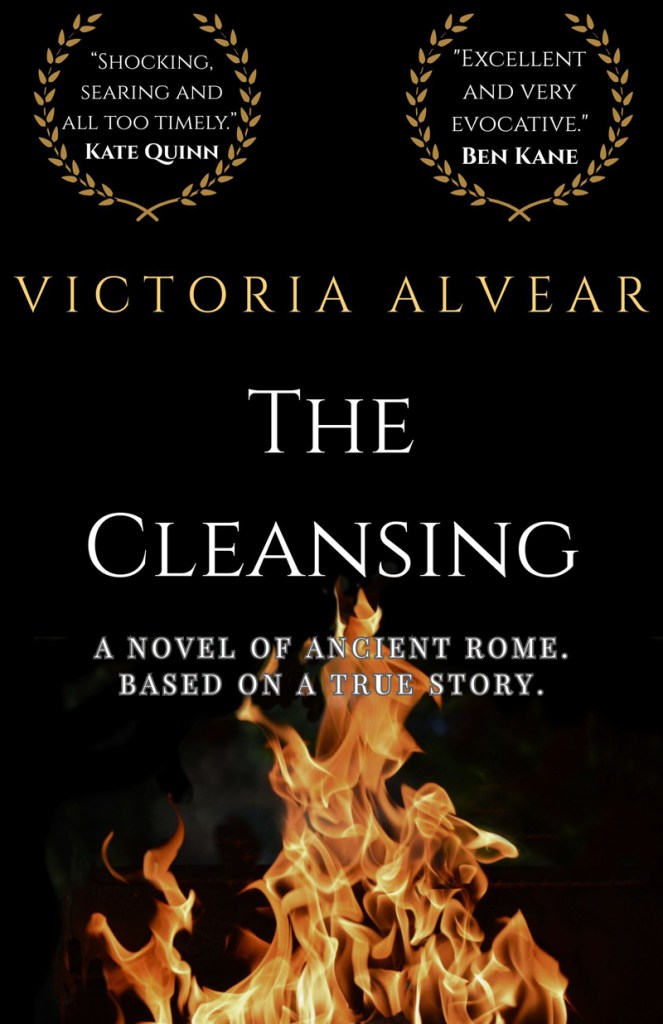
Writing a novel about the persecution of a Vestal Virgin priestess in ancient Rome really brought home for me just how deep the religious roots of misogyny and purity culture go. In my novel, The Cleansing I focused on the true story of a Vestal accused of having sex and being blamed for the massacre of 50,000 men in one battle.
Two hundred years before Christianity, Rome’s religious leaders claimed only a “crime” of that magnitude—of one of their sacred virgins breaking their vows—could have “disgusted” the gods enough to cause them to turn their backs on Rome. The Vestal faced a death sentence—being buried alive—for this so-called “crime.”
Meanwhile, the general who made a massive strategic error in battle, the man responsible for marching tens of thousands of soldiers into a trap, walked away scot-free.
It seemed unbelievable to me that they truly believed a woman’s sexual conduct could have that much influence and power. And yet they did, as evidenced by the fact that the Romans buried alive two dozen Vestal Virgin priestesses (that we know of) during Rome’s existence. When a tragedy occurred—war, famine, pestilence—the head priest of Rome, the pontifex Maximus, and the Collegium of priests often claimed that one or more of their six Vestal priestesses “had” to have had sex to explain away the tragedy.
But ancient history isn’t so ancient—today, evangelists regularly claim that natural disasters or mass tragedies are caused by “feminists and the gays and the lesbians,” as Jerry Falwell claimed after 9/11. Evangelical leaders continue to blame women’s sexuality and the LGBTQ community for God sending hurricanes or floods. And not just in America. In Iran, an earthquake that killed thousands was blamed on women dressing immodestly. All around the world, patriarchal, high-control religions consistently blame women and LGBTQ populations for “causing” God to “smite” whole cities or nations because their behavior “disgusts God.”
The belief that “god gets mad if certain people are having sex” is central to rape culture. It gives divine permission to punish and kill anyone who steps outside the lines of proscribed behavior. It lives on in today’s honor killings, which are rampant around the globe. Interestingly, the foundational myths of ancient Rome themselves reinforce and strengthen the basic tenets of rape culture.
First is the story of the mother of Romulus and Remus, the twin founders of Rome. Rhea was the first Vestal Virgin. After stealing the throne, her uncle locked her in a temple to make sure her bloodline did not continue. But Mars, the god of war, “came” to her in the sacred fire of the locked temple and impregnated her. We can presume consent was not a consideration. Rhea gave birth to the twins but then was banished to the woods to die for the crime of breaking her vow of chastity. Mars, of course, got a pass. This story of the first virgin birth predates Christianity by about seven hundred years.
Another foundational Roman event was the “Rape of the Sabines,” where Romulus and his men stole women of childbearing age from the Sabines, an ancient tribe of southern Italy. They “excused” the theft of these women by saying they needed them to breed so that Rome could survive. This mass stealing of women is disconcertingly celebrated in both sculpture and painting throughout the ages.
The Rape of the Sabines was reenacted in a highly ritualized selection process for new Vestal Virgin priestesses. Vestal Virgins were obligated to serve thirty years after being selected at ages between six and ten. Since virginity was required and considered sacred, this ensured that they would never bear children. As mentioned previously, if a woman broke her vow of chastity or allowed the eternal fire of Vesta to go out, she was buried alive. A consecrated Vestal was considered “married” to Rome. And her purity had a direct correlation to Rome’s safety.
In the “Rite of Captio”—the selection process for new Vestals—young girls of eligible age were rounded up in the Forum. The pontifex selected a new priestess by lot. He then made it official by stealing the child from her father’s lap, just as the Sabine women were ripped out of the arms of family members in the early days of the creation of Rome. The father had to pretend-fight the pontiff to keep the child with him, but eventually the priest wrested the girl away from the father and carried her into the House of Vestals. In other words, every new Vestal selection was a reenactment of mass rape.
Vestals did enjoy some privileges—they were paid for their services by the state, and they could invest that money in land. Many accrued significant wealth after thirty years. They were also able to speak in a court of law, unlike the average Roman woman, who had no voice.
But to earn those rights, they had to stay “pure” and sacrifice their autonomy for thirty years. So why were they regularly blamed for mass tragedies? Because Rome claimed that “as our Virgins go, so does Rome.” If their paragons of purity were defiled—willingly or unwillingly—it meant something bad was going to happen or had already occurred to Rome. They insisted that the purity of a Vestal’s body had a direct causal link to mass tragedy. Just as honor cultures place the honor of a family in the bodies and behaviors of its women, Rome put the safety of the entire nation into the bodies of its Vestal priestesses. If tragedy struck, it “had” to mean one of their six Vestals had misbehaved.
Scholars call the punishment Vestals experienced “ritual murder” and not technically “human sacrifice,” but I disagree. After all, human sacrifices were meant to appease the gods or to cleanse the community’s pollution (or sin in Christian terms). Once a Vestal Virgin was removed by death, Roman religious leaders claimed the city had been cleansed and the gods appeased.
Tying a family or nation’s honor and safety into the sexual behaviors of women or vulnerable people needs to be tossed into the bins of history, just as we left behind the medical practice of using leeches to bleed out bad humors. Without our conscious excavation of these ancient, often unconscious beliefs, powerful politicians and religious leaders will continue blaming and scapegoating women and the vulnerable for natural disasters or mass tragedies to enforce even greater control. Understanding the way a culture embeds these beliefs into the community and into the minds of the victimized is what drove me to write about the stories of the lost priestesses of ancient Rome. Because thousands of years later, high-control religions are pressing hard to perpetuate these false narratives.
You can buy the book here: Amazon

BIO: Victoria Alvear is a novelist specializing in historical fiction set in the ancient world. Her latest novel, The Cleansing: Based on a True Story, is the tale of a Roman Vestal Virgin facing a death sentence for the crime of having sex and being blamed for a loss in battle. Her other novels include Cleopatra’s Moon, and A Year of Ravens: A Novel of Boudicca. Alvear has served as a docent for the Carlos Museum of Antiquities at Emory University in Atlanta for 20 years.
Discover more from Feminism and Religion
Subscribe to get the latest posts sent to your email.
 Feminism and Religion
It truly is disgusting
LikeLike
Thanks for this. It’s so important to know about our fore-mothers.
LikeLike
We have been a woman culture for so many thousands of years now that the threads of monstrosity invade us whether we know it or not – – as for woman and sex – well I turn to Carol – she nailed it.
LikeLike
Book ordered!
LikeLike