


I played Dolores Huerta in an adaptation of Antigone Too: Rights of Love and Defiance, at the feminist theater in Minneapolis, At the Foot of the Mountain, in 1983. When the theater closed in 1991, it was the longest continuously operating women’s theater in the United States. For Antigone Too, they brought, I think, twenty- five actresses from around the country to play twenty-five significant women who stood up for social justice. We had parts illustrating our histories, interspersed throughout the traditional script of Antigone.
I got the part of Dolores Huerta—championing the cause of social justice for farm workers.
I loved the character and I was deeply honored to become her. (Today I question why I, a woman with white skin privilege, but native heritage, was chosen for this role—but at the time I was just intensely grateful.)

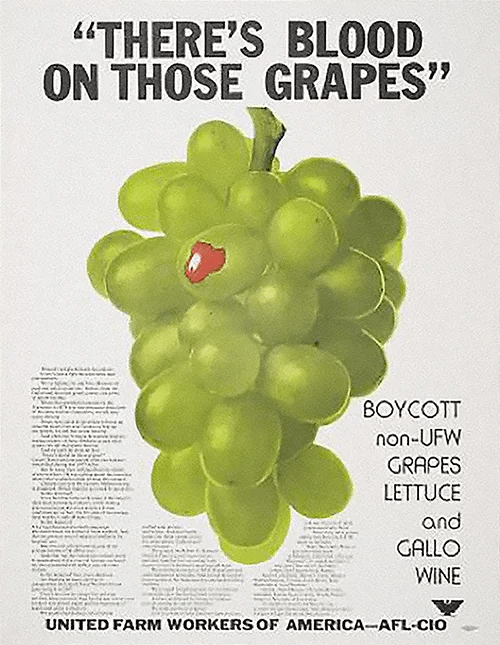
I did not eat grapes for years. My mother was an intense defender of Cesar Chavez and the grape boycott. We boycotted grapes the entire time of the boycott, from 1965-1970. This was from the time that I was nine years old to when I was fourteen. It was such a formative part of my upbringings in New Hampshire that if I was at a friend’s house and they were eating grapes I thought—are they watching the news? Don’t they know what is going on?
I remember clearly around age fifteen when grapes were brought back into my house. It felt like a victory for everyone.
In my mind, and there may have been other reasons, but the grape boycott, and the plight of the farmworkers, radicalized my mother. My parents were DEMOCRATS. My Dad wore the straw hat that proudly said “Kennedy,” even after the election. The one with “Kennedy” over a red, white and blue ribbon. We are Irish Catholic and Canadian.
So…we did not eat grapes. My mother was so proud to have been part of it.
Since then, I have met Dolores Huerta several times in my role as a college professor in the field of Gender and Women’s Studies in a university that is fifty-seven percent Latinx/Hispanic. When I met her the first time in the late 1990s, I told her about me playing that role, of her, in an adaptation of Antigone—my part celebrating her fight for social justice, her civil disobedience. She was so pleased. I was so proud.
And this week, we heard her tell how she kept a secret locked away – for decades. Why? To protect the farm worker movement. Which she did. Which succeeded. Farm workers today are farm workers. With rights. They have rights—like all workers have rights (or should). It was an incredibly brave struggle. And Huerta was an integral voice within it. Perhaps the most important voice. She saw the future.
The face of the movement however was Cesar Chavez. And now we find out he coerced her, later he raped her. He sexually assaulted minors…he assaulted other women who were part of the movement.
Sigh. He was a hero to my nine-year-old self, my fifteen-year-old self, my twenty-seven-year-old self playing the woman who stood with him in the movement.
The school where I teach today has a huge mural featuring Chavez. I’m not sure yet what will happen to that—but I know many California schools are removing them, painting over them, covering them. Our mural is under Plexiglas to protect it. I walk by it every time I teach almost—and I have always been grateful that it is there. That the not-eating-grapes thing worked, that the farmworkers’ struggle worked, that the students get to see that, as well, on their commutes to their various classes.
Whether they take him out of the mural, cover the mural, paint over him—is not up to me, of course. And I know it is so disappointing …I am grieving for a movement that felt to my naïve nine yar old mind untarnished. It felt pure.
It is quick—this dismantling of Chavez’s legacy. Turning the Cesar Chavez holiday into Farmworker’s Day. Do I think it is because he was brown? Mexican? Yes. I also think it is because he is dead. Do I think it is because the cause he championed was that of immigrants—a group being depicted as the evilest by the current administration? Yes, as well. It’s convenient for the administration to do away with heroes who are not useful to them.
I am an abuse survivor—of long-lasting abuse. Do I agree with Dolores’ choice to keep the secret? I believe that what we do as survivors to survive- is the right thing. I honor her bravery to come forward now. I honor her decision to keep the movement for farmworker rights intact—it is horrific what women must do. What we are told— “If you tell– your father will die.” “If you tell–NAACP will be destroyed.” “If you tell–the movie will never be made.” “If you tell…”
Deepak Chopra. David Copperfield. Harvey Weinstein. Kevin Spacy. Ghandi. Almost the entirety of the Trump administration. The Epstein files. And now—Cesar Chavez.
Chavez was a childhood god to me, to my mother, to those of us from low income, and working-class backgrounds. He represented caring about those who needed care, who needed lifting up. And now we find out—he, like so many of our heroes, had more than clay feet…and is accused of exploiting his fame and getting away with assaulting women, and children.
I mean, why did they do it? Why do they still do i? I think the simple answer is truly terrifying in its simplicity – because they could. Because women’s lives, and children’s lives, are not considered as important as powerful men’s desires. Their desires—no matter how fleeting –are considered justification for agency. Children’s lives in a patriarchal culture are not worth protecting—it is a toss-up if you get protected. Maybe you do, maybe you don’t.
I’m so saddened by Chavez’s crimes…it adds so much more pain to the already incredibly battered community of immigrants in the U.S. at this time. Immigrants are already fighting for their lives, for Constitutional protection…the families suffering and …now this?
I am writing this a week before what would have been the proud holiday of Cesar Chavez birthday. When I would have had lesson plans devoted to his life and service.
I’m assuming we will still get the day off.
I think about alternative lesson plans. Now– farm workers day.
Farm. Workers. Day. The struggle. The boycott.
The grapes we did not eat.
–Marie Cartier
In These United States, March 2026
Discover more from Feminism and Religion
Subscribe to get the latest posts sent to your email.
 Feminism and Religion