Legacy of Carol P. Christ: Of Human Life*

This post was originally published on July 2nd, 2012like many of Carol’s other posts, it is eerily poignant for today.

Watching the last episode of the Australian series Brides of Christ in which Catherine leaves the sisterhood of the convent because of her disagreement with Humanae Vitae brought me right back to the Yale Roman Catholic chapel and the folk mass I attended regularly.  In 1968 just after the publication of Humanae Vitae, priest and co-graduate student Bob Imbelli preached a sermon on the doctrine of conscience, arguing that though it was incumbent on Catholics to think carefully about the papal encyclical on birth control, it was also the responsibility of every Catholic to follow her or his conscience on the matter.  In the episode, Sister Catherine encourages a Roman Catholic mother of six who has already self-induced more than one abortion to take the pill, but the woman decides she cannot go against the church’s teachings.  Catherine allows an editorial against Humanae Vitae to be published in the school newspaper even though she knows it will probably lead to the expulsion of one of her favorite students.

Continue reading “Legacy of Carol P. Christ: Of Human Life*”
Legacy of Carol P. Christ: Football as a Ritual Re-enacting Male Domination Through Force and Violence

This was originally posted on November 18, 2011

The other day when Paula McGee asked on this blog how Penn State students could rally in support of Sandusky, I was also reading a student paper quoting Rianne Eisler’s opinion that peace and environmental justice cannot be achieved in dominator cultures. Xochitl Alvizo commented that we should not be surprised by the reactions of the students as we live in a “rape” culture.  I would add that we must examine the culture of male domination through force that is “football,” one of the “sacred cows” of American patriarchy, just as we need to examine the culture of hierarchical male domination of the Vatican in the context of child-rape by priests.

Continue reading “Legacy of Carol P. Christ: Football as a Ritual Re-enacting Male Domination Through Force and Violence”

Legacy of Carol P. Christ: Let Us Give Thanks for Feminism and Religion Dot Com

This was originally posted January 6, 2014

Feminism and Religion was founded in the late spring of 2011. Throughout the summer Gina Messina-Dysert hounded me about submitting a blog while I ignored her emails because I didn’t think I wanted to take on a new project.  Gina was persistent nonetheless. Finally I decided that it would be easier to take an excerpt from a book review I had recently written than to explain why I didn’t want to write something for the blog, and so “Exciting New Research on Matriarchal Societies” became my first contribution.

Continue reading “Legacy of Carol P. Christ: Let Us Give Thanks for Feminism and Religion Dot Com”

Legacy of Carol P. Christ: Thinking About Thanksgiving

This was originally posted on December 3, 2012

Thanksgiving evokes deep memory and raises questions about what we are celebrating, now that we know the stories we were told about the Pilgrims and the Indians are not the whole truth about America’s early history.  I thought about all of this as I prepared for Thanksgiving this year and cleaned up for days afterwards.

Although I do not live in America, I have celebrated Thanksgiving with a group of friends in my home in Greece many times during the past twenty years.

Continue reading “Legacy of Carol P. Christ: Thinking About Thanksgiving”

Legacy of Carol P. Christ: Gender, Friendship, Collaboration, and Unacknowledged Authorship

This was originally posted on April 20, 2015 and was updated by Carol on August 23, 2019

In recent weeks Judith Plaskow and I have been revising the manuscript of our new book Goddess and God in the World in preparation for sending it to the publisher. Yes, we have a publisher. We signed a contract with Fortress Press a short time ago. The book should be out in 2016.

We have been hard—and I mean very hard—at work revising the four chapters in the book that are jointly written. The versions have been going back and forth and forth and back as we revision what we want to say and revise each other’s revisions of the drafts we have. We both want the final manuscript to say things just right and it is very hard not to make one more set of (alleged) improvements.

In the process we have realized that while we often disagree on words and wording, we have come to think alike on a wide variety of issues to the point that it becomes hard to say who had the ideas first. In addition we have both become so familiar with each other’s positions that we can each easily articulate both sides of our dialogue on the issues on which we disagree.

Continue reading “Legacy of Carol P. Christ: Gender, Friendship, Collaboration, and Unacknowledged Authorship”

Legacy of Carol P. Christ: Can We Celebrate the Dark? Can We Sleep?

This was originally posted on December 19, 2019

According to Marija Gimbutas, the religion of Old Europe celebrated the Goddess as the power of birth, death, and regeneration in all of life. Agricultural peoples understand that seeds must be kept in a cold dark place during the winter if they are to sprout when planted in the spring. People who work hard during the long days that begin in spring, peak at midsummer, and continue through the fall, are grateful for the dark times of the year when they can rest their weary bones on long winters’ nights. Long winters’ nights are a time for dreams, a time when people gather around the hearth fire to share songs and stories that express their understanding of the meaning of the cycles of life.

The Indo-Europeans were not an agricultural people. Herders, nomads, and horseback riders, they celebrated the shining Gods of the Sky whose power was reflected in their shining bronze armor and shining bronze weapons. When the Indo-European speaking peoples entered into a Europe, they married their Sun and Sky Gods to the Earth Mother Goddesses of the people they conquered. These were unequal marriages in which the Sun was viewed as superior to the Earth. The unhappy marriage of Hera and Zeus reflects this pattern, as do the many rapes of Goddesses and nymphs recorded in Greek and Roman mythology.

Continue reading “Legacy of Carol P. Christ: Can We Celebrate the Dark? Can We Sleep?”

The Legacy of Carol P. Christ: Dance of the Bees: Reading the Language of the Goddess

This blog was originally posted on December 1, 2014

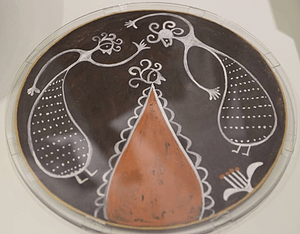
The image from an ancient Cretan bowl (c.1700 BCE) from the Sacred Center of Phaistos pictured here has often been interpreted as an early depiction of Persephone’s descent or rising. But are clues from later Greek mythology pointing in the right direction in this case?

Recently, my colleague Mika Scott posted the Phaistos bowl image on our Goddess Pilgrimage Facebook site in conjunction with the bee pendant from Mallia. This juxtaposition led me to think again about the importance of bees and pollination in agricultural societies and to offer an alternative reading of the symbolism on the bowl.

Continue reading “The Legacy of Carol P. Christ: Dance of the Bees: Reading the Language of the Goddess”

The Legacy of Carol P. Christ: Weaving and Spinning Women: Witches and Pagans by Max Dashu A Review

Moderator’s Note: This was originally posted on September 19, 2016

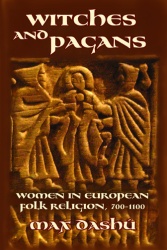
Max Dashu’s  Witches and Pagans: Women in European Folk Religion 700-1000 challenges the assumption that Europe was fully Christianized within a few short centuries as traditional historians tell us. Most of us were taught not only that Europe became Christian very rapidly, but also that Europeans were more than willing to adopt a new religion that was “superior” to “paganism” in every way. Careful readers of Dashu’s important new work will be challenged to revise their views. When the full 15 volumes of the projected series are in print, historians may be forced to hang their heads in shame. This of course assumes that scholars will read Dashu’s work. More likely they will ignore or dismiss it, but sooner or later–I dare to hope–the truth will out.

witches-and-pagans-cover

History has been written by the victors—in the case of Europe by elite Christian men. These men may have wanted to believe that their views were widely held, but Dashu suggests that they were not. Combing artistic and archaeological records, Dashu finds (to give one example) that images of Mother Earth nursing a snake are far from uncommon and can even be found as illustrations in Christian documents and on Christian monuments. Clerics rage against people—particularly women–who continue to visit holy wells and sacred trees and to practice divination and healing rituals invoking pagan powers. To paraphrase Shakespeare: “Methinks the cleric doth protest too much.” Were these things not happening and happening often, there would have been no need to condemn them.  Using these clues, Dashu provides intriguing new readings of the Poetic Edda and Norse sagas.

Continue reading “The Legacy of Carol P. Christ: Weaving and Spinning Women: Witches and Pagans by Max Dashu A Review”

The Legacy of Carol P. Christ: June 25th or “June Unteenth”: A Sad Day For All Americans

This was originally posted on July 1, 2013

Kelly Brown Douglas wrote recently on Feminism and Religion about the celebrations in black communities on Juneteeth when the emancipation of slaves became a reality in the formerly Confederate states.  Sadly, on June 25th 2013 the Supreme Court announced its decision striking down section 4 of the Voting Rights act of 1965, the most important Civil Rights legislation of the 20th century.  The Supreme Court gave a “green light” to states with previous and on-going records of introducing laws with the effect of preventing minority voters from voting to “proceed straight ahead.”  I name this day June Unteenth and call on all Americans to mourn it in sackcloth and ashes.

For every American concerned with Civil Rights this indeed is a sad day. It means states and municipalities—particularly those in the former Confederacy—will in the days following the decision be introducing new legislation which will have the effect of disenfranchising black voters.  Those of us who consider the right to vote fundamental in a democracy must rise up, with time, with money, and if necessary with our bodies in peaceful protest.

Continue reading “The Legacy of Carol P. Christ: June 25th or “June Unteenth”: A Sad Day For All Americans”

The Legacy of Carol P. Christ: WHEN THE OLYMPICS CELEBRATED THE STRENGTH OF GIRLS AND THE RENEWAL OF LIFE

This was originally posted on July 30, 2012

The first “Olympics” were races of girls of various age-groups around a 500 foot stadium in ancient Olympia. The races of girls were held every four years on the new moon of the month of Parthenios (September/October). They were dedicated to Hera Parthenos who renewed her virginity in the river Parthenias. The winners of the races wore olive crowns and feasted on the flesh of Hera’s sacred cow.

These “Olympics” for Hera and for girls came before the more celebrated Olympics for men that were dedicated to Olympian Zeus. The temple of Hera at Olympia is older than the temple for Zeus and the girls’ Olympics were tied to the more ancient lunar calendar.

Continue reading “The Legacy of Carol P. Christ: WHEN THE OLYMPICS CELEBRATED THE STRENGTH OF GIRLS AND THE RENEWAL OF LIFE”