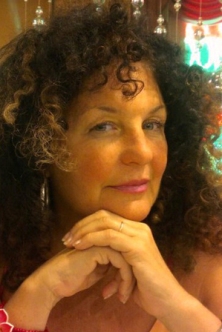
Walking in Moonlight Before the Pandemic by Marie Cartier and Kimberly Esslinger

photo by Kimberly Esslinger

For this month’s blog my wife, the poet Kimberly Esslinger, and I have written a joint poem—


Walking in Moonlight Before the Pandemic


and what is done to the least of these….

Where is the god of woman. Of cats. Of dead cats?

Of wives. Of midnight walks with dogs and the normalcy of silence.

And day becoming more like night in this stillness.  All the crowded spaces. Open.

Empty. A bag floats down at night. A grocery bag. Onto the hood of a

speeding hatchback. Not a bag. But now a cat. Someone’s cat.  Dead.

Just like that.  A hatchback. And yes, here I was, with my dogs, wanting to believe

it was alive. I start to call her, she. Did she just move? Did you see her move?

My wife has gloves. A box. A plan. But I push her away.

I believe in god. And she could heal this cat.

She would. She would if I would wait long enough. Continue reading “Walking in Moonlight Before the Pandemic by Marie Cartier and Kimberly Esslinger”

Poem: In These United States is a Woman Electable? by Marie Cartier


In these United States we are wondering
if a woman is electable.
Is she likeable enough?

I donate to a woman candidate and I have put a sign
on my front lawn with a woman’s name on it.
I’m a woman. My wife is a woman.
Over half of my students are women. I teach over two hundred
students a semester. I see that women can.
We do and we can. But…

Can a woman lead? A headline asks.
Is she likeable enough to get elected? Another asks.
I was born from a woman.
All of us get here through the legs of a woman.
Women hold up half the sky. Continue reading “Poem: In These United States is a Woman Electable? by Marie Cartier”

2020 Women’s March by Marie Cartier

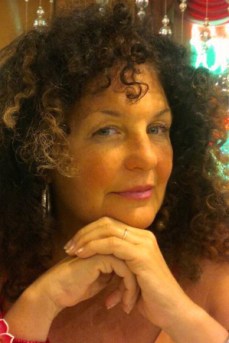
Picture of author, Marie Cartier and her partner, Kimberly.
Photo of the author (left) and her wife Kimberly Esslinger

Here we are at the fourth now annual Women’s March. I have done a photo essay of the March every year for Feminism and Religion (FAR), the first two from the Los Angeles March, and the last two from Orange County.

I’m taking a break this month from the series “In These United States” poems I have been delivering to FAR (back with more poems next month) to showcase some of the activism, commitment, humor, and courage that showed up at the March I attended in Santa Ana in Orange County, California, January 18, 2020.

In this part of these United States the marchers chanted, danced, laughed, and were very serious. Santa Ana is a densely populated city where almost 62% of the population is Mexican. This evidenced itself in the March where for the first time I saw ballet folkloric by a company dressed in traditional folkloric costumes, in suffrage colors. Continue reading “2020 Women’s March by Marie Cartier”

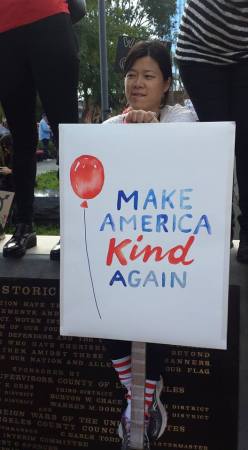
Poem: Make America Kind Again by Marie Cartier

Photo by Marie Cartier

Make America Kind Again was my favorite poster slogan of every Women’s March.

We’ve had three and will have a fourth soon, January 18. I’ll be there and hope I see this sign again.

It’s a sign that maybe it will happen –America will be kind again.

It will be a place where we don’t put kids in cages

Or gouge people’s health care

Or ban Muslims from entering our country

Or kick transgender people out of the military

Or threaten voting rights for Blacks

Or remove registered voters from the polls

Or… fill in the blank


Continue reading “Poem: Make America Kind Again by Marie Cartier”

Poem: She Works Hard for the Money and a Working Class Dream by Marie Cartier

My neighbor gets up at 2 a.m. and is at work by 3:30 a.m.
Six days a week.
She works hard for the money*

She works at a grocery store. She has two dogs and I have two dogs.
Our dogs like each other and we talk about going to the dog beach
together, but who can plan that? We’re lucky to run into each other in our own neighborhood.
“Hey, how are you?” “Tired. You know.”
So hard for the money

I do know. I teach six classes at two universities. My wife works freelance for an overseas company
in artificial Intelligence designing for humans to be obsolescent.
In the meantime, she has no time to sleep.
My neighborhood is all plumbing trucks, gardening trucks and vehicles that go to work.
People leave in the morning to make the world turn. And they come home late at night.

So hard for it honey. Continue reading “Poem: She Works Hard for the Money and a Working Class Dream by Marie Cartier”

Prose Poem – Rape is Robbery and We Want All of Our Stuff Back by Marie Cartier

We protect ourselves by saying it wasn’t that bad.
It only happened once, twice, when I was little, when I was older, when I was drunk, when I was the only one not drinking, when I was alone, when I was out with friends, when I was in the break room at work, when I was in the military, when I was unemployed, when I asked for a raise, when I was silent, when I…

When you can’t change it, you change yourself. Because it’s better than thinking you can’t change anything. It’s epidemic, people say. So it’s better than thinking it’s epidemic—the abuse of women.

So, you think, if I blame myself, maybe there’s hope.

That things will get better. Because I can change—me. Continue reading “Prose Poem – Rape is Robbery and We Want All of Our Stuff Back by Marie Cartier”

The Maiden Tale of “It’s Happening”* by Marie Cartier

Photo by Kimberly Esslinger

*with thanks to Margaret Atwood, The Handmaid’s Tale

In The Handmaid’s Tale women don’t
have their own names anymore.
They whisper them to each other
in order to re-member who they are:
June, Moira… maybe even Lydia
Their bodies aren’t their own.
If you are fertile, you are used to breed.
If you are infertile, but clever, you can be a Martha
and cook or clean for men, and their families.
Women don’t have families; they are part of a man’s family.
Or they could be an Aunt, someone who trains
the other women to be docile. To be afraid. To give in. To give up.
Not everyone will get the message, or be able to follow it:
Don’t let the bastards get you down.

The author, Margaret Atwood, made the choice
to not include anything in the novel that had
not happened in real life. Most especially Continue reading “The Maiden Tale of “It’s Happening”* by Marie Cartier”

#GunControlNow: While We Still Have Now by Marie Cartier

If you are somewhere:
a movie theater, festival, mosque,
temple or church, bar (especially a gay one although it could be any bar –cheers),
concert, elementary to college classroom, or any other public space in America…and
someone starts shooting,
shooting so fast the bullets spray like
a hose of water —
spray so fast you can’t know where to duck.
if you are somewhere and that happens…
Re-member yourself as a hero:
hide the children, if there are children
cover the babies, if there are babies
lock the doors, if there are doors.
Try to make it out alive.

Continue reading “#GunControlNow: While We Still Have Now by Marie Cartier”

Poem:  “How to Survive a Four Letter Word” by Marie Cartier

What is taken from a woman?

When someone breaks her open and fills her with nothing of herself,

and then leaves?

She has to find all the pieces of herself.

That’s why they call it—recovery.


You have to recover.

It doesn’t always happen. You’re not put back together

exactly the same. The pieces were broken.

Still are, just glued back together.

It’s a four letter word:  rape.

Continue reading “Poem:  “How to Survive a Four Letter Word” by Marie Cartier”

The Berlin Wall—what did the US learn? by Marie Cartier

I am writing this from Berlin. I am here for two weeks for the ALMS conference entitled, “Queering Memory.” Berlin is a city of such memory. You walk the streets and there are small brass plaques in the sidewalk in front of you memorializing Jews that were deported who lived in the residence. Everywhere there is memory of war, and hope.
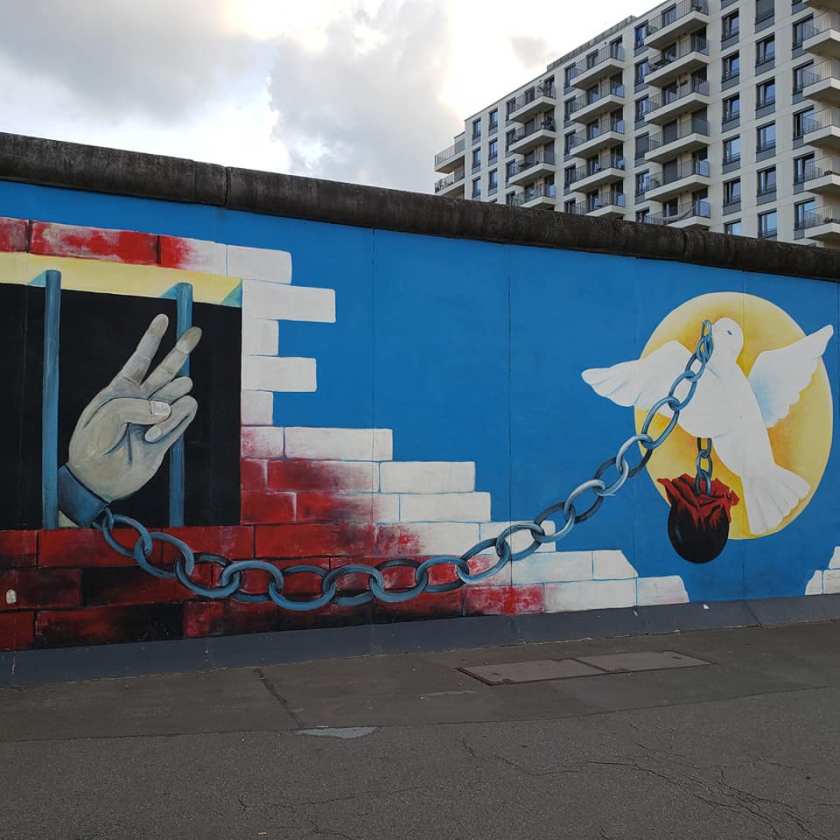
For me, perhaps the most visible symbol is the wall. The Berlin wall was in place from 1961-1989. When it fell, the East Side which had been closed off for decades, burst into freedom, as evidenced by the images on the east side of the wall, at the East Side Gallery – an open air mural gallery painted directly on that side of the wall.

Continue reading “The Berlin Wall—what did the US learn? by Marie Cartier”