This tree lives in a park, surrounded by other trees. There’s a lake in the distance, and the tree has plenty of space to spread its leaves to the sun. In the summer, its leaves are lush and green, and in the winter, its bare branches shake in the wind.
Now imagine this tree saying to itself, when its leaves turn brown in the fall, “I am so ugly—the other trees won’t like me.” Imagine the tree next to it thinking, “I am the smart tree,” or “I am mom’s favorite tree,” or “I’m a failure–I will never be a good enough tree” or “I’m going to be the richest and most successful tree.”
It doesn’t seem likely. Yet as humans, we have these kinds of thoughts all the time. They’re called identifications, and every practice of yoga, despite all the incredible diversity of lineages and traditions, is designed to teach us how to let them go. No matter what school of yoga you study, this is the goal: liberation from our identification with the impermanent, changing, and ultimately unsatisfying temporary self, so that we can reunite with the true Self beneath.
Welcome, dear reader. It seems you have found yourself at the Witch’s hearth. Imagine–if you can–a cozy cottage, a comfortable rocking chair, a steaming mug of something to drink, and a conversation between two witches who have journeyed together in sisterhood and collaboration over the past year. They are the founders of Witch Workshops, a year-long, community program designed to uplift personal and collective witch wisdom. I hope you’ll stay a while and listen as they reflect, interview-style, on what they’ve learned, what they’ve taught, and what they hope for the future.
Can you give us a sneak peek into one of the workshops?
Amie: Okay, let’s travel back to December 2025… The candles are lit, our bodies are present, we’ve shared reflections around the fire, and it’s time to practice. We unearth and honor the forgotten mothers. I introduce the Cailleachan, and Freia welcomes Skadi to our circle–two ancestral guides from both respective lineages. During our practice, we’ll invite, materialize, and initiate a release. Later this month, our community will share who may be guiding them through this dark side of the year. The monthly challenge will be to rest and rest some more. Last, we’ll offer an intentional closing before the next month begins.
I am not fond of Christmas and these holidays are very difficult for me to deal with. This has nothing to do with me being a Muslim. I have been a Grinch before this. I do not like excessive noise or crowds of people. It bothers me especially the excess, the lack of meaning and loud claims for kindness and mercy to decorate our lives for few days. This year is proving particularly hard for me.
Experiences of 2015 have forced me to question the paradigms under which I had lived until now. Life is suing me for an extra effort of introspective, growth and openness and that can be painful at times. A few weeks ago, I was venting my sorrows and doubts to my mother. I told her that the last thing I wanted to do was install a Xmas tree. She looked at her own Xmas tree full of golden balls and said:
“You know why I like Christmas trees? You were born a week before Pinochet’s coup. That year, the Dictatorship forbade people to buy, sell or cut pines trees under punishment, which ruined our Xmas, since plastic ones were very expensive. I built a tree for you at home, made of brass and wood. The center was a broomstick and the branches of wire. I cut leaves from empty cans of milk. I lost a child before you came to my life. And you were born in a country that suddenly lost freedom. I could not deny you hope. The Christmas tree has been my way to convey hope. That was my present.”
Listening to my mother, Christmas took on new meaning for me, a sacred dimension. I understand the sacred as those things, memories and spaces that are vital for us, all of what gives our lives meaning, purpose, reason and inspiration. I come from a family of women where husbands, brothers and male cousins are scarce. Joy, mourning, religion, knowledge or strength have been developed and shared from womb to womb. Continue reading “From the Archives: Xmas and Feminine Wisdom by Vanessa Rivera de la Fuente”
Only in November 2025, the following murders were reported:
Mobina Zare, age 20, in Islamshahr (a city southwest of Tehran), was killed by her former fiancé. After murdering her, he burned her body in an aluminum-melting furnace at his father’s workshop. Her family searched for her for ten days before finding her half-burned body.
Mobina Zare was burned in analuminum melting furnace
Leila Aliramaii, age 40, in Marivan (in Kurdistan Province, western Iran), was killed with a Kalashnikov rifle because she refused the vile demands of a member of the Revolutionary Guard Corps (IRGC). Leila was married and the mother of a young daughter and son.
Leila Aliramaii, the mother of two young children
Sarina Rostami, age 16, in Sarpol-e-Zahab (in Kermanshah Province, western Iran), was killed by a male relative because she refused accept a forcible marriage.
Sarina Rostami, 16, victim of forced marriage
A 40-year-old woman in Pakdasht (Tehran Province) was suffocated with a blanket by her husband.
Reyhaneh Dorzadeh, age 23, in Nikshahr (Sistan and Baluchestan Province, southeastern Iran), was suffocated by her husband because she opposed his desire to take a second wife.
A 29-year-old woman identified as J.D. was murdered by her father, who then dismembered her body and set it on fire.
Sakineh, age 80, in Tehran, was killed by her son using an iron rod.
Zahra Ghaemi, a women’s rights activist and member of the Women’s Study Group at the University of Tehran, was suffocated by her husband.
Zahra Ghaemi, a member of the Women’s Study Group at the University of Tehran
Shahla Karimani, age 38, mother of two, in Mahabad (Kurdistan Province), was strangled with a scarf by her husband and brother-in-law.
Sajedeh Sand-Kazehi, in Khash (Sistan and Baluchestan Province), was killed with a hunting rifle because her father-in-law wanted to forcefully take a gas regulator that belonged to her. Sajedeh was the mother of two young children.
Raheleh Siavoshi, age 26, in Nahavand, a town in Hamedan Province in western Iran, was fatally stabbed by her husband after participating in a sports camp. She died in the hospital two days later.
Raheleh Siavoshi, a national wushu champion and coach
Justice Has Lost Its Meaning
While women are sentenced to long prison terms for “removing their hijab” or protesting discrimination, men who murder their wives typically receive only a few years in prison. In many cases, they can pay money to buy their way out and return to their lives.
In notorious cases such as Romina Ashrafi and Mona Heydari, the murderers received only two to eight years in prison. Even state-run media sometimes acknowledge this “inverted justice”: “The punishment for beheading one’s wife: 8 years in prison; The punishment for removing one’s hijab: 10 years in prison!”
According to the regime’s laws, the father, who is also the “male guardian and blood-owner (vali-ye-dam),” is exempt from retributive punishment for killing his own child.
Zahra Eftekharezadeh, founder of one of Tehran’s safe shelters, said regarding the absence of deterrent laws: “When the law does not impose a punishment proportionate to the crime, perpetrators realize there is no serious consequence waiting for them. In many cases, the sentences issued by the judiciary are not only non-deterrent but encourage the offender. Romina Ashrafi’s father is an example. He openly said that if he killed his daughter, he would receive at most ten years in prison.” (Shargh newspaper – October 11, 2025)
Atrocities Rooted in Law and Politics
Under Iran’s misogynistic clerical laws, a woman is not recognized as an independent individual but as “subordinate” to a man. Without legal or structural protection, women are forced to endure domestic violence, and each day adds new names to the list of women murdered.
Article 1105 of Iran’s Civil Code assigns family leadership exclusively to men.
Article 1108 makes a woman’s right to financial support conditional on her “obedience.”
Article 1114 gives the husband the right to determine the wife’s place of residence.
In such a system, women seeking divorce must prove their lives are in danger, and their testimony is worth only half that of a man. Judges routinely force women who have been beaten or threatened back into the homes of their abusers.
Through its laws, media, and judiciary, the clerical regime perpetuates these crimes. Violence extends from home to the school, from the street to the courtroom, widening its reach every day.
But beyond the laws, today’s social tragedies in Iran stem from political roots. The misogynistic clerical regime is founded on the subjugation of women. The horrific killings of women are not isolated acts of personal fanaticism; they are the product of a system that authorizes violence against women.
The rising number of honor killings must therefore be understood as the direct result of the regime’s anti-woman policies and the patriarchal culture embedded within its structure. The Iranian people blame not society but the regime itself, an oppressive, misogynistic establishment that preserves its power through the suppression and elimination of women.
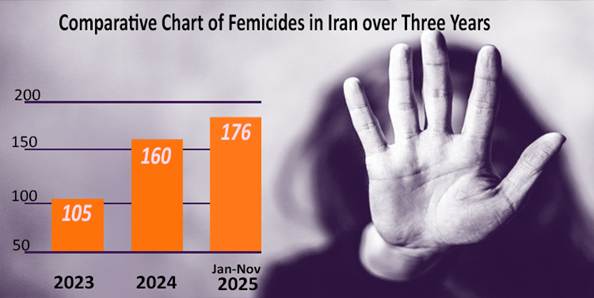
Data compiled over the past three years by the NCRI Women’s Committee shows a sharp upward trend in the number of women murdered under the misogynistic rule of the clerical regime. These figures are drawn entirely from documented and published reports by state-run media and other available sources. They therefore represent a minimum estimate, as the regime deliberately obscures such information, and many families, fearing the perpetrators, avoid publicizing the killings of their daughters and female relatives.
According to these findings, at least 105 women were murdered in 2023, 160 in 2024, and during just the first eleven months of 2025, no fewer than 175 women have been killed in Iran.
INFO: NCRI The NCRI Women’s Committee works extensively with Iranian women outside the country and maintains permanent contact with women inside Iran. The Women’s Committee is actively involved with many women’s rights organizations, NGOs, and the Iranian diaspora.
The NCRI Women’s Committee is a major source of much of the information received from inside Iran with regard to women. Attending meetings of the UN Women, the UN Commission on the Status of Women (CSW), the Human Rights Council, and other international or regional conferences on women’s issues, and engaging in a relentless battle against the Iranian regime’s misogyny are parts of the activities of members and associates of the NCRI Women’s Committee.
The NCRI Women’s Committee is one of the 25 committees of the National Council of Resistance of Iran.
Moderator’s Note: This post has been brought to you in cooperation with the NCRI women’s committee. NCRI stands for the National Council of Resistance of Iran. You can learn more information as well as see this original article by clicking this link. A description of their Council can be found at the end of this post.
Women Are Killed in Iran with Complete Impunity
November 2025 Report: Under the Clerical Regime, Nowhere Is Safe for Women in Iran
Under the rule of Iran’s misogynistic clerical regime, Iranian women, from childhood to old age, are unsafe in all spaces and circumstances. If they manage to escape the brutality of security forces in the streets, they may still fall victim in their homes to so-called “honor suspicions,” resisting forced marriage, requesting a divorce, or even attempting to defend their own rights. Many of these killings take place in front of children or other family members, feeding a cycle of violence across generations. Among the victims are pregnant women or mothers killed alongside their children.
Beatings and torture of women in prisons, firing pellets into the eyes of protesting women, sexual assault in detention centers, and the attacks by morality police patrols enforcing compulsory hijab in public all legitimize and encourage violence against women inside the home and within families.
As I prepare for the Hanukah celebration this year, the word that resonates with me is “enough.” I will light candles for eight nights, recalling that in the beginning, there was not enough oil to rededicate the temple after the victory of the Maccabees over the Syrian Greeks, but then there was enough.
How much is enough? The dictionary tells us that enough means having as much or as many of something as required.
During the government shutdown when SNAP was at risk, we learned that one in eight Americans qualify for the program, revealing how many people are food-insecure in our country. The one in eight includes the working poor, disabled, and children. Their issue is quantitative: the amount of food they can afford does not provide adequate nourishment. On the spectrum of enough, they are on the shortage end. Just as the temple needed more oil to be rededicated, they need more food to sustain themselves.
Here the reader further witnesses how young Tom treats his little sisters which is consistently cruel-hearted. Tom continues to describe how he will harm the helpless birds while Agnes desperately works to persuade him otherwise:
“But you shall see me fettle ’em off. My word, but I will wallop ’em? See if I don’t now. By gum! but there’s rare sport for me in that nest.”
“But, Tom,” said I, “I shall not allow you to torture those birds. They must either be killed at once or carried back to the place you took them from, that the old birds may continue to feed them.”
“But you don’t know where that is, Madam: it’s only me and uncle Robson that knows that.”
“But if you don’t tell me, I shall kill them myself—much as I hate it.”
“You daren’t. You daren’t touch them for your life! because you know papa and mamma, and uncle Robson, would be angry. Ha, ha! I’ve caught you there, Miss!”
“I shall do what I think right in a case of this sort without consulting any one. If your papa and mamma don’t happen to approve of it, I shall be sorry to offend them; but your uncle Robson’s opinions, of course, are nothing to me.”
This young charge of Agnes’s is threatening and manipulating her as he and the other children do often. Tom doesn’t realize he has hit a nerve with Agnes, where the brutal treatment of the most vulnerable is unbearable. This situation is indicative of the overall treatment she receives as a governess, as one less-worthy-than and stripped of power, yet blamed for the misbehavior of her charges.
“So saying—urged by a sense of duty—at the risk of both making myself sick and incurring the wrath of my employers—I got a large flat stone, that had been reared up for a mouse-trap by the gardener; then, having once more vainly endeavoured to persuade the little tyrant to let the birds be carried back, I asked what he intended to do with them. With fiendish glee he commenced a list of torments; and while he was busied in the relation, I dropped the stone upon his intended victims and crushed them flat beneath it. Loud were the outcries, terrible the execrations, consequent upon this daring outrage; uncle Robson had been coming up the walk with his gun, and was just then pausing to kick his dog.
“Tom flew towards him, vowing he would make him kick me instead of Juno. Mr. Robson leant upon his gun, and laughed excessively at the violence of his nephew’s passion, and the bitter maledictions and opprobrious epithets he heaped upon me. “Well, you are a good ’un!” exclaimed he, at length, taking up his weapon and proceeding towards the house. “Damme, but the lad has some spunk in him, too. Curse me, if ever I saw a nobler little scoundrel than that. He’s beyond petticoat government already: by God! he defies mother, granny, governess, and all! Ha, ha, ha! Never mind, Tom, I’ll get you another brood to-morrow.”
Uncle Robson’s appalling show of support and praise for Tom’s egregious behavior toward his governess underscores a deeply engrained and condoned misogyny. But here our usual grin-and-bear-it Agnes will not back down or be silenced.
“If you do, Mr. Robson, I shall kill them too,” said I.
“Humph!” replied he, and having honoured me with a broad stare—which, contrary to his expectations, I sustained without flinching—he turned away with an air of supreme contempt, and stalked into the house. Tom next went to tell his mamma.”
Agnes has risked her position in defense of her values, but Uncle Robson, who it is noted never pays his nieces any heed, has instilled and upholds his nephew’s cruel ways, no doubt leading him to become a person who will kick his dogs and treat all creatures deemed lesser, including girls and women, with disdain. Little Tom is “beyond petticoat government already,” encouraged and rewarded for not listening to any of the women in his life. Following the example of his father, uncle, and many of the other men in his life, Tom has already learned to disregard what women have to say.
And Tom’s mother, Mrs. Bloomfield, buys into the dysfunction wholeheartedly. The passage continues with an interaction between Agnes and lady of the house, with her defending the violent behavior of her son and blaming Agnes for interfering with his fun and games.
“It was not her [Mrs. Bloomfield’s] way to say much on any subject; but, when she next saw me, her aspect and demeanour were doubly dark and chilled. After some casual remark about the weather, she observed—“I am sorry, Miss Grey, you should think it necessary to interfere with Master Bloomfield’s amusements; he was very much distressed about your destroying the birds.”
“When Master Bloomfield’s amusements consist in injuring sentient creatures,” I answered, “I think it my duty to interfere.”
“You seemed to have forgotten,” said she, calmly, “that the creatures were all created for our convenience.”
I thought that doctrine admitted some doubt, but merely replied—“If they were, we have no right to torment them for our amusement.”
“I think,” said she, “a child’s amusement is scarcely to be weighed against the welfare of a soulless brute.”
“But, for the child’s own sake, it ought not to be encouraged to have such amusements,” answered I, as meekly as I could, to make up for such unusual pertinacity. “‘Blessed are the merciful, for they shall obtain mercy.’”
“Oh! of course; but that refers to our conduct towards each other.”
“‘The merciful man shows mercy to his beast,’” I ventured to add.
“I think you have not shown much mercy,” replied she, with a short, bitter laugh; “killing the poor birds by wholesale in that shocking manner, and putting the dear boy to such misery for a mere whim.”
“I judged it prudent to say no more. This was the nearest approach to a quarrel I ever had with Mrs. Bloomfield; as well as the greatest number of words I ever exchanged with her at one time, since the day of my first arrival.”
Agnes knows her place and if she wants to maintain her position to both assist her family and to prove she can handle the role, she must monitor herself and bite her tongue around her employers and their children. In both Agnes’s positions, the parents are portrayed as overly indulgent and uninvolved, allowing the children to misbehave and manipulate at every turn. The parents consistently take their children’s side and refuse to see any fault in them, lest it cast blame on their parenting. This creates an especially impossible arrangement for the governess to have any influence on the children, let alone get them to care about and complete their lessons.
Anne’s resting place at St. Mary’s Church in the seaside town of Scarborough, North Yorkshire.
At a certain point in the story it becomes quite clear how all will unfold, yet one cannot stop reading!
In the end, Agnes is rewarded with the love of one she has admired for some time. The icing on this happy-ending cake is that she is also reunited with the neglected dog, Snap, that one of the young women in her charge had given away, breaking Agnes’s heart. This delightful reunion takes place on the beach, a setting Anne Brontë herself cherished.
If one cannot bear the truth, don’t read Anne Brontë’s novels. Yet, it’s worth keeping in mind that if the ugly truth is kept undercover, it’s less likely to be addressed.
Moderator’s Note: This piece is in co-operation with The Nasty Women Writers Project, a site dedicated to highlighting and amplifying the voices and visions of powerful women. The site was founded by sisters Theresa and Maria Dintino. To quote Theresa, “by doing this work we are expanding our own writer’s web for nourishment and support.” This was originally posted on their site on November 19, 2024. You can see more of their posts here.
Anne, the youngest of the Brontë sisters, penned two novels in her short life. The first was Agnes Grey (1847), then The Tenant of Wildfell Hall (1848).
A sketch of Anne by her sister Charlotte.
It’s probably safe to say that Agnes Grey is the least read and appreciated of all the Brontë novels, of which there are seven. Emily’s Wuthering Heights and Charlotte’s Jane Eyre garner the most praise and attention. But Anne’s The Tenant of Wildfell Hall is not far behind, and by some accounts leads the pack.
Interestingly, all the sisters’ first novels were released in the same year, under their pen names Currer, Ellis, and Acton Bell. First was Jane Eyre in October 1847 and then Wuthering Heights and Agnes Grey together as a ‘triple decker’ in December 1847, with Wuthering Heights making up the first two parts, and Agnes Grey the third.
Moderator’s Note: This post has been brought to you in cooperation with the NCRI women’s committee. NCRI stands for the National Council of Resistance of Iran. You can learn more information as well as see this original article by clicking this link. A description of their Council can be found at the end of this post.
The water crisis in Iran has moved far beyond a simple environmental issue — it has become a humanitarian, ecological, and economic disaster.
While at first the problem seemed to be the result of drought and declining rainfall, its true causes ran much deeper: entrenched corruption and mismanagement at the heart of the ruling establishment. Until these systemic roots are addressed and removed, Iran’s present — and its future — will only become more precarious.
A significant number of researchers and international observers emphasize that 70 to 80 percent of the current crisis stems from mismanagement, unsustainable policies, lack of transparency, and corruption. As one report notes, “Iran’s water crisis is not a crisis of resources; it is a crisis of decisions—decisions that have made the land thirstier and the future darker. This crisis, alongside the erosion of public trust in governance, is a symptom of structural and managerial failure.” (Newsweek, August 1, 2025; The Times, December 8, 2022; Reuters, April 27, 2021)
Moderator’s Note: This piece is in co-operation with The Nasty Women Writers Project, a site dedicated to highlighting and amplifying the voices and visions of powerful women. The site was founded by sisters Theresa and Maria Dintino. To quote Theresa, “by doing this work we are expanding our own writer’s web for nourishment and support.” This was originally posted on their site on November 19, 2024. You can see more of their posts here.
As the Thanksgiving holiday rolls around, I am reminded of Margaret Fuller’s Thanksgiving revelation, one she later wrote about in her journal. This revelation resonates annually for its gentle reminder of the value of being willingly and patiently engaged, of releasing resistance in the face of what cannot readily be altered.
Joy Harjo, American poet, musician, playwright, and author. She served as 23rd US Poet Laureate, the first Native American to hold that honor. (Wikipedia) Learn more at joyharjo.com.
As I re-read Fuller’s account, I think about something former US Poet Laureate Joy Harjo said when she joined us a few years back at Flagler College in St Augustine, Florida for a virtual event. I don’t remember the exact question one of the listeners asked, but I’ll never forget Harjo’s response. She answered, “Every job is a service job.”
The truth in this statement struck me. I’d never considered my many jobs over the years, both inside and outside the home, as service jobs, but indeed they were.












 Feminism and Religion