Two recent posts, Community Immunity by Natalie Weaver on May 6, and Carol Christ’s May 11 essay, Women Invented Agriculture, Potter, and Weaving…, have spurred me to focus and finally share something that I’ve meant to for a long time. For 30 years I helped my husband realize his dream of a small farm, while I continued working as an artist. We both came from urban backgrounds and both (separately) charged out into the wild world at age 17, inventing as we went along. That fearless approach continued with the farming many years later.
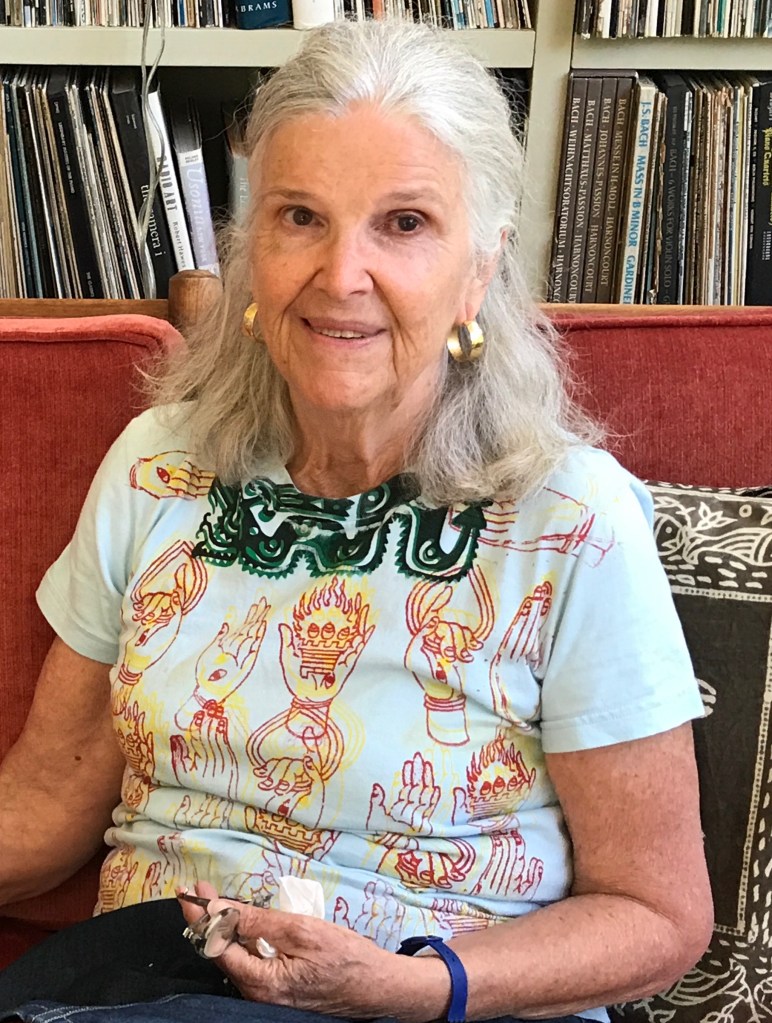
We started with sheep and cows but soon turned to focussing on goats. We wanted to farm organically from the start (1988) and that, combined with a lack of childhood indoctrination into Big Ag Culture had us devouring all the information we could while carefully observing the animals and applying our shared humanistic approach to daily life to the care of goats. I say this last part so no one imagines a slavelike situation as is often seen in images of dairy farms. Continue reading “Caprine Community by Laurie Goodhart”

Today, I bring you an old old story from Scotland. It explains how and why winter became spring.
In a recent interview about my current published paper and my life’s-work, Sawbonna, which is a model of both social and restorative justice, I was struck by how being locked down due to this global pandemic not only rips us to the core of our fears and forebodings; but, as well, invites us, if challenges us, to witness with and for each other, as we come to see the depth of resilience that has been a kindred companion throughout the ages. From time immemorial, Gaia delights by firing our hearts of justice with creativity. With love.
My ancestors built great circles of stones that represented their perception of real time and space, and enabled them to tell time: the
Amongst Celtic peoples, the capacity to speak poetically was a divine attribute, regarded as a transformative power of the Deity, who was named by those peoples as the Great Goddess Brigid: She was a poet, a Matron of Poetry (along with her capacities of smithcraft and healing). And at Delphi in Greece, the oracular priestesses delivered their prophecies in poetic form: Phemonoe invented the poetic meter, the hexameter. And from Sumeria, humans have the first Western written records of literature, which is poetry written by the High Priestess of Inanna, Enheduanna in approximately 2300 B.C.E.. Poetry has been recognised as a powerful modality: Barbara Mor and Monica Sjoo described “poetic thinking” as an wholistic mode, wherein “paradox and ambiguity … can be felt and synthesized. The most ancient becomes the most modern; for in the holographic universe, each ‘subjective’ part contains the ‘objective’ whole, and chronological time is just one aspect of a simultaneous universe” (
Brother Francesco, known to the world as Saint Francis of Assisi, left us many sweet and lovely poems and songs. In “The Canticle of the Sun,” he wrote about the gifts of nature. Brother Sun, his light and radiance.
The term ‘PaGaian’, which became the title of my work, was conceived in at least two places on the planet and in the opposite hemispheres within a year of each other, without either inventor being aware of the other’s new expression. It was some time before they found each other … one party in Australia, myself having published a book with 
I began to follow Kimberlé Crenshaw a little more than five years ago when I first learned of her theory of intersectionality as a more concise description of oppressions stemming from race, age, gender, sex/sexual orientation, religion and socio-economic status.
I am a priestess of the divine feminine, ordained in the Fellowship of Isis. So how did I end up becoming ordained for a second time in the Christian