Priestesses at the Parliament by Rae Abileah, Bekah Starr & Chaplain Elizabeth Berger

During the first week of November 2018, 12 graduates and current students of the Kohenet Hebrew Priestess Institute attended the Parliament of the World’s Religions in Toronto, Canada. The Parliament is a conference with a 125-year-old history that has grown to an estimated 10,000 participants representing more than 200 spiritual traditions. To share a Jewish feminist perspective with the Parliament’s attendees, we sought to create moving experiences and  intimate spaces through a variety of invited and informal initiatives.

Priestessing Panels

Many of us were slated to speak at the Parliament, and rather than just show up and give an academic presentation on a panel, we brought the feminist spirit of Kohenet into our sessions, moving rows of chairs to create a circle, guiding participants through embodied practices rather than giving speeches, and crafting ritual. Continue reading “Priestesses at the Parliament by Rae Abileah, Bekah Starr & Chaplain Elizabeth Berger”

A Moment of Change in Our Church by Janice Poss

On September 12, 2018, Roman Catholic Bishop David O’Connell helped move the Episcopate into a new day. A healing Mass at Our Lady of the Assumption Church in Claremont, California was celebrated for the victims of clergy sex abuse. They were humanized, spoken about reverently, prayed about to heal, to sacredly be acknowledged in their pain, to be known how priests and bishops were guilty and had their direct part in the hurtful abuse of children. This Mass was said in the hope of healing our collective wounds, I believe it has helped turn a new chapter in our church.
The service did not stop at the end of the mass: Bishop O’Donnell had an open Q&A with the people in the pews who came, many attending had been abused, not all by priests, but others. Among them were a man abused by a woman when he was four years old, a woman whose sister was abused by a priest, a woman abused from six years old until twelve by a male.  The victims were all a part of the prayers said for this healing mass dedicated to the victims of clergy sexual abuse, particularly from the recent revelations of sex abuse by the Grand Jury in the Pennsylvania dioceses. Continue reading “A Moment of Change in Our Church by Janice Poss”

Clerical Male Mess! by Janice L. Poss

“I am sorry!” “I am guilty of sex abuse” “I have hurt many young children!” “I have ruined lives!” “We are sorry for hiding sex abuse in the Church!” “We are criminals!” “We want to make amends!” We, in the pews, have yet to hear true contrition, instead we hear how the Church needs healing. True, but where is remorse from those who perpetrated and covered-up the crimes? To heal, we must hear from them.

Remorse, a contrite heart, admitting grave sin, deceitfulness, criminal behavior, the global Catholic Church has not yet confessed this loud enough. Why? Why is male clerical privilege so deeply ingrained in the construct of In Persona Christi that none of these guilty perpetrators of crime are able to directly tell Catholics worldwide that they truly, in their hearts grieve for our church and grieve for what they have done to our children? Where is their sensitivity for children? Continue reading “Clerical Male Mess! by Janice L. Poss”

Hear Me by Winifred Nathan

image1.png

I found the confirmation hearings of now Justice Kavanaugh deeply disturbing. I have ideas for preventing a replay.

First, secret keeping doesn’t work. For too long girls/women have suffered in silence with their secret while boys/men move along often without any sense of guilt about  their “fun”. When the victim/survivor keeps her secret, the perpetrator remains in control.  An important  step for the victim to regain control is to tell her story.  Then the next step … she needs to be heard.   Dr. Blasey Ford spoke, but her distracters did not hear her.  They questioned her credibility. She was criticized for her years of silence, and her lack of memory of details.  What I learned from this is that the victim/survivor must be prepared to speak, and that this preparation must start well before it occurs.

Continue reading “Hear Me by Winifred Nathan”

What Part of “No!” Don’t You Understand??: Morality at Center of Mid-Term Election by Elizabeth Fresee

As my late and dearly missed Professor, Dr. Otto Maduro, put it, “One mile from the courthouse, it’s complicated. One hundred feet from the courthouse, it’s not.” In that spirit, with just a couple of weeks until Nov 6, I submit that the mid-term election of 2018 is a referendum on morality – not a particular moral issue, but the entire principle of moral limits as a crucial element in a functional society. We are answering the question “Is morality itself still a thing?” Vote Republican, you are answering “No;” vote Democrat, you are answering “Yes.”

I must first clarify what I mean by “morality.” For some, it is about a traditional, hierarchical social order. The Almighty Father lays down the law and “No!” here means “No, you may not do anything I forbid, according to my will, regardless of your needs, including walking away from my authority and demands.” For most others, myself included, morality is about egalitarian, mutual concern for the well-being of all and a social contract obligating members of society to: a) not be mean jerks to one another and b) ensure those in need are basically cared for. “No!” here means “No, you may not trespass upon the integrity of others, nor may you walk away from your responsibility to them.” While many world religions have elements of the former version of morality, even the patriarchs generally have some obligation to social responsibility. The real heart of religiosity, though, is the mutual social contract, aka “The Golden Rule.” Continue reading “What Part of “No!” Don’t You Understand??: Morality at Center of Mid-Term Election by Elizabeth Fresee”

Refrigerator Poetry by Kay Bee

I am at such a loss over the state of things these days. What’s left for me seems to be a process of assessing where I have agency at this exact moment and of taking refuge in small things.
After a terrible drought year and an awful fire season, it is raining once again in the mountains. This morning, I look out my kitchen window – thankful I have a kitchen – and gaze lost in thought at wet aspen leaves, kelly green at their centers and ringed with autumn gold. What do I want to convey today?  Continue reading “Refrigerator Poetry by Kay Bee”

You Can Make Your Own Rose BOOK REVIEW by Lila Moore

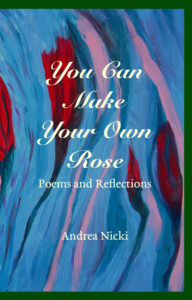
You Can Make Your Own Rose by Andrea Nicki is a collection of poems infused with the spirit of feminist sensibility, social justice and activism. The poems offer more than mere therapeutic comfort while depicting shamanic-inspired healing rituals and magical encounters. They are trauma-free in the sense that Nicki doesn’t ask for our sympathy nor does Nicki simply wish to share traumatic memories. On the contrary, she utilizes somewhat analytical and educational language, interlaced with subtle picturesque and lyrical details alongside a severe social critique, to depict the emotional, intellectual, and social landscape of her reflections on incest and other gender-related forms of abuse.

Continue reading “You Can Make Your Own Rose BOOK REVIEW by Lila Moore”

Playing Safe: BDSM & The Ethics of Justice and Care By Angelina Duell

From the archives – 9/23/11 – our first FAR year! 

This post is written in conjunction with the Feminist Ethics Course Dialogue project sponsored by Claremont School of Theology in the Claremont Lincoln University Consortium,  Claremont Graduate University, and directed by Grace Yia-Hei Kao.

It is Wednesday night and I am alone in the house. It’s dark; the only light is from my computer screen. A bead of sweat rolls from my brow as I delicately tap the keys of my keyboard until two words stare back at me, “BDSM feminism.” With bated breath, I press enter.

Just kidding.  Continue reading “Playing Safe: BDSM & The Ethics of Justice and Care By Angelina Duell”

Sex is a Feminist Issue: An Interview with Rev. Dr. Beverly Dale by Jera Brown

Sex is a feminist issue. Harmful perspectives on sex and our physical bodies have been used to disempower and invalidate the sexuality of women, LGBTQIA folks, and people of color. It runs through our theology and cultural traditions within the church.

I run a personal blog which speaks positively about sex and queerness. And when folks find it, frequently, their first questions to me is what other resources are out there that teach a better Christian perspective? I often tell them to start with The Incarnation Institute for Sex and Faith.

IISF offers “inclusive, science-friendly, sex-positive” educational programming for church leaders and lay people. Founder Rev. Dr. Beverly Dale, affectionately known as “Rev Bev,” is ordained through the Christian Church (Disciples of Christ) and currently teaches courses on sexuality and religion at Lancaster Theological Seminary.

The institute recently released a four-part web series, Reading the Bible with Sex-Positive Eyes, which includes the topics: “Introduction to Christian Sex Negativity: The Beginnings,” “Discerning Truth, Discerning Culture,” “Sex in the Bible: The Good, The Bad & the Ugly,” and “Sex: Whether, When, and How.”

I interviewed Rev Bev about the new series.

Continue reading “Sex is a Feminist Issue: An Interview with Rev. Dr. Beverly Dale by Jera Brown”

The Exclusion and Embrace of Trans-women within Feminist Spirituality by Kelly Palmer

Women-only circles have long existed within the Goddess movement, the Red Tent movement for example exists as an inter-faith, grass-roots movement for women only to come together to claim safe and sacred space. But too often ‘women-only’ in fact means ‘cis women only’. Trans women are not allowed. This has been the topic of much heated debate in recent years, culminating last year in the publication of ‘Female Erasure’ an anthology of essays on gender politics and feminist spirituality that has led to calls for the editor Ruth Barrett to be expelled from her thealogical seminary on grounds of transphobia. Barrett and many of her contemporaries openly call for the exclusion of transwomen from women-only Goddess circles and respond to criticism by saying that asking for ‘women born women only’ space is not meant to be antitrans but simply carving out a space for people with similar life experience – in the same way that people of specific ethnic minorities may gather, or LGBTQ people. Surely, they may say, the answer is for trans women to create their own spaces?

There are two problems with this. Firstly, trans women are in a significant minority, making access to groups of other trans women practicing Goddess spirituality difficult. If a local woman’s circle is their only means to practicing their religion with others, and they are excluded by this on the basis of their genitalia, this exclusion is incredibly hurtful and undermines not just one’s ability to practice a faith but one’s very identity and esteem. Secondly, it is not just local, personal groups that are practicing this exclusion, but large and public gatherings, making very public pronouncements that trans women are not welcome. They have been excluded from womens rituals at PantheaCon in 2011 and Michigan Womyns Music Festival has a policy of excluding trans women from the entire event.

Continue reading “The Exclusion and Embrace of Trans-women within Feminist Spirituality by Kelly Palmer”