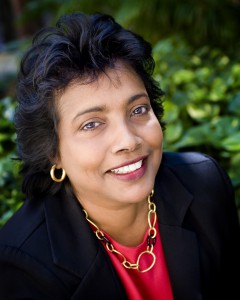
 Ivy Helman’s recent commentary (((Israel))) criticizes what she sees as “a new form of anti-Semitism” from organizations such as Jewish Voices for Peace in their advocacy of the Boycott, Divest and Sanction (BDS) movement. So I begin this account of a recent visit by two Palestinian students to Hawaii with a reminder that the BDS movement is simply using the tools of nonviolent resistance to pressure Israel into giving Arab-Palestinians what Israel insists on for itself: equality, freedom, peace, justice and access to their homes and properties as stipulated by UN Resolution 194. Israel’s continuing land grabs speak to Israel’s sense of impunity. The two Birzeit University students provided a first hand account of what life under Israeli control means to them and their families. It was the kind of opportunity “to share and learn” that Helman says is necessary. And it only reinforced the importance of the BDS effort.
Mai Hasan and Noor Daghlas, students participating in Birzeit University’s Right to Education (R2E) Tour of American universities have stories to tell that are chilling. Stories that make you wonder why you are still in your seat, instead of running out screaming for someone to do something. To stop the madness that is the Israeli occupation of Palestine. Yet both students speak of their experiences with the matter-of-fact intensity of activists who have come to terms with the fact that their journey is long, and that they have survived, while many have not.
“I am here, not to speak about myself, but to speak for those who are no longer with us,” said Mai Hasan when asked whether she herself might face “administrative detention” after the tour. Since the year 2000, the Israeli government has imprisoned over 7,000 Palestinian youth, many for asserting their right to education. Mai, who graduated shortly after her return home, said without hesitation: “If I am arrested because of the truths I tell about the occupation, I will accept it proudly.”
Both students bear witness to the truth that Freedom is a Constant Struggle, the title of Angela Davis’ latest book. They were at the University of Hawaiʻi at Mānoa recently, with the renowned scholar at the same table, speaking to a packed room. The panel discussion took place just a few hours before Davis delivered her keynote address as the spring 2016 Dan and Maggie Inouye Distinguished Chair in Democratic Ideals to an overflow crowd at the Kennedy Theater. The two young Palestinian undergraduates talking about their life under siege in their own homeland, in conversation with the lifelong activist in front of an audience in Hawaiʻi, one of the places made American by occupation, was a statement of what Davis calls the “intersectionality of struggles.” As Cynthia Franklin, professor in the English department at UH Mānoa and organizer of the visit, said in introducing the panel, the event could be viewed through the lens of Davis’ own words that “It is in collectivities that we find reservoirs of hope and optimism.” Continue reading “Education as Resistance by Dawn Morais Webster”


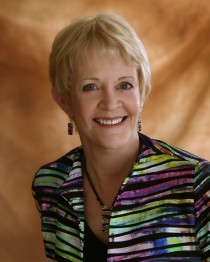 If you knew about me, you might ask, “Why does a former executive decide to abandon retirement and devote herself to writing a book about women leaving religion?” Of course if you knew me well, you would understand that I must have a worthwhile project. Idleness is not in my nature. But the path that led me to the publication of
  Acknowledging and responding to feminine divine energy is an inherently radical, feminist act. With age my feminism and spiritual path have become inexorably intertwined and I have become more comfortable and confident in my identity as a daughter of the goddess, a priestess, and as a feminist. My feminism is continually being shaped by a call to serve the goddess in a variety of ways, particularly in response to an activating third element in my feminist goddess path (no surprise for fellow triad lovers who practice a Celtic spiritual path). This third activating element is my relationship with my body and my work to reclaim
  In the winter of 2013, I went on pilgrimage to Kathmandu, Nepal. While there, I visited the Khachoe Ghakyil Ling (Pure Land of Bliss) Tibetan Buddhist nunnery, the largest in Nepal with about 400 nuns. It’s affiliated with the nearby Kopan monastery where I stayed in the retreat housing. The nuns gave a group of us a tour of the gompa (meditation room), classrooms, workshops, and kitchen. The studies at the nunnery include math, science, and English, Nepali, and Tibetan languages, as well as meditation, debate, ritual arts, and chanting, the same education that the monks receive at the monastery. When not engaged in prayer and education, the nuns produce herbal incense renowned for its healing properties, which clear and uplift the mind. Not surprisingly for their ambitious program, a nun’s average day is 14 hours long.
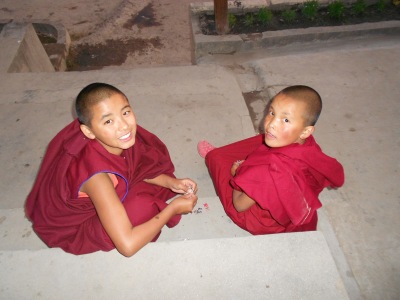 Since I am averse to crowds and rebellious by nature, I ducked out of much of the sight-seeing and instead spent my time engaging with the novitiates, the young nuns who were milling about before dinner because they had completed their classes, daytime prayers, and other duties. We asked each other questions like “What’s your name?” and “Where are you from?” Then I was treated to “Watch me do this!” and “Can you do this?” because the language of children is universal. Yet, what was special about these girls was that they were being given food, shelter, and an education — opportunities that many their ages, especially girls, would never know.
  History offers few instances of women helping create scripture. Hinduism’s sacred Rigveda may have been partly composed by women, and scholars believe the biblical Book of Ruth was possibly written by a woman, but the evidence for each is wanting. And while Muhammad’s widow was entrusted with the manuscript that would become the Quran, its scribe was a man named Zayd ibn Thabit. The only clear exception to this is the Book of Mormon, which Joseph Smith partially dictated to his wife Emma. The central role of Mormon women in the church was therefore fixed from the start.
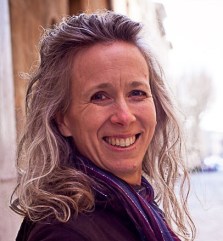 Working alongside my dad on the family farm, I grew up learning how to operate and maintain machinery: tractors, balers, and a double-shift 10-wheeler. We worked outdoors in weather with temperatures ranging from minus 10 to plus 110 degrees Fahrenheit. You could say, I developed a thick skin. Snide comments about me being a girl, doing a man’s job, rolled off.
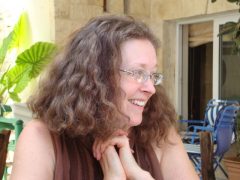 My book club recently read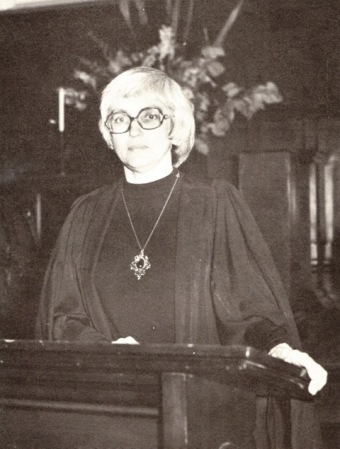
 There is no shortage of men in power. No shortage of men who are ready to issue warnings and threaten punishment for straying from the party line. No shortage of men ready to hold forth in front of cameras. And yet, and yet….It took a woman with a lot of guts, a lawyer, and a person of faith to champion healthcare for all. It took a woman to criss-cross the country, standing in solidarity with those in need, ministering to those with “broken hearts” who stand on the margins.
 Feminism and Religion