 On CNN’s State of the Union, Donald Trump reiterated his call to bar Muslim immigration to the U.S. and predicted that his fellow presidential candidates would soon come around to his position.
This prompts me to declare a theological state of emergency. And I urge religious first responders to step forward.
His anti-Muslim rhetoric has caused Muslims to fear for their lives and well being—and it runs counter to the American Constitution on matters religious, although that does not seem to deter its adherents.
Because the content of these statements is focused on a specific world religion, I believe that scholars and activists of many religions need to step forward in concrete, educational ways.
Theologians must be among the first responders on this one. And we need to start at the beginning since Mr. Trump’s ignorance of the Muslim faith mirrors that of many Americans. “Islam” has become a code word for terrorism. In fact, it is the name of a monotheistic faith tradition based on the Qur’an which is practiced by more than 1.6 billion people, nearly a quarter of the world. Its practitioners are referred to as Muslims.
So our popular pedagogy must begin in order to right the wrongs of misinformation and demagoguery. Just as Christianity and Judaism have many expressions, so too with Islam. It is for Muslims to sort out their internal matters—but it is incumbent on global citizens to inform ourselves so as not to be cowed by the likes of Trump.
For example, a group of Muslims, including feminist journalist Asra Nomani, is calling for a new movement:
“We are Muslims who live in the 21st century. We stand for a respectful, merciful and inclusive interpretation of Islam. We are in a battle for the soul of Islam, and an Islamic renewal must defeat the ideology of Islamism, or politicized Islam, which seeks to create Islamic states, as well as an Islamic caliphate. We seek to reclaim the progressive spirit with which Islam was born in the 7th century to fast forward it into the 21st century. We support the Universal Declaration of Human Rights, which was adopted by United Nations member states in 1948.
We reject interpretations of Islam that call for any violence, social injustice and politicized Islam. Facing the threat of terrorism, intolerance, and social injustice in the name of Islam, we have reflected on how we can transform our communities based on three principles: peace, human rights and secular governance. We are announcing today the formation of an international initiative: the Muslim Reform Movement.”
Do Mr. Trump and the sector of the American public that agrees with him have any such information? I doubt it. Nor do they apparently have much experience with Muslim neighbors who live and work peacefully in virtually every part of the country.
Ignorance of religion is an acute problem in the United States. We have a lack of basic education about religion. Few school districts venture into the topic with their students. So it is not until tertiary education that most American young people have any formal instruction, if then, about religions other than their own. There must be a better way.
I propose that religious professionals, whether educators, pastoral people, or activists, become part of the solution by engaging in a massive, differentiated educational campaign to counter the negative narratives about Islam. This does not mean that anyone need convert to Islam. It is simply that in a democracy we owe one another a fair rendering of our faith traditions. That Mr. Trump’s remarks about Islam have caused such damage already, and could give license for more violence, add urgency to this task.
It is time for community forums where the basics of Islam can be explained in every part of the country. Radio shows, teleconferences, videos, social media posts, religious education classes, community group meetings might usefully focus on the basics of Islam. Simply to demystify the terms and show how ordinary Muslims go about their ordinary law-abiding lives would go a long way toward stemming the current tide.
I do not expect Muslims to educate the rest of us. But those who want to collaborate with other religious first responders are more than welcome. Among feminist colleagues, plans are afoot to launch some modest efforts, but we recognize and respect the need for safety and security for those who have been put in harm’s way by ignorant rhetoric and unconstitutional proposals.
It is non-Muslims who must bear the burden of this education about religion.
Not since the Nazi period has the specter of religiously-based oppression taken on such a heightened profile, with the potential for such devastating results. I believe it is a true emergency for which strong and constructive countermeasures are necessary.
“The following is reprinted with permission from Religion Dispatches. Follow RD on Facebook or Twitter for daily updates.”


 Standing as a stark and graceful contrast to the corruptions of freedom of religion, expression, and human rights we hear about every day, there was a grand display of feminine empowerment and beauty at the most recent Burning Man festival, an event in Black Rock City, Nevada. It was a magnificent temple created for Mazu—the Chinese Goddess of the Sea. Her temple and its towering lotus flower were built, and soon thereafter ritualistically burnt, in the simplistic beauty of the desert.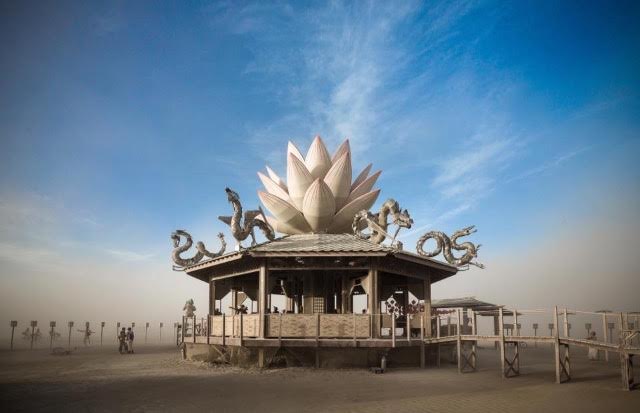
 If you follow your heart, you’re going to find that it is often extremely inconvenient.” -Acharya Pema Chödrön
 I wrote this piece in response to an e-mail from a friend that said: “Yes, women’s circles may help you with your headaches that you have every 3 to 7 days (or whatever else ails you.)”
 As I write yet another email apologizing in advance that I will miss a deadline, I debate whether to provide a reason. Should I write that I am struggling with sometimes crippling anxiety, that I have physical symptoms related to that anxiety and to depression? Or should I stick with “some health issues”? Or is even that too much information? Is it better not to provide a reason at all?
 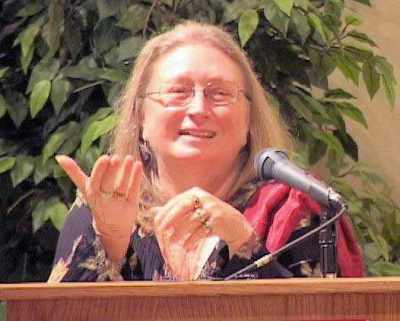 Feminist foremother in the field of women and religion and Buddhist feminist theologian Rita Gross died on November 11, 2015 in her beautiful home in Eau Claire, Wisconsin, surrounded by symbols of Buddhist art and the loving presence of her cats.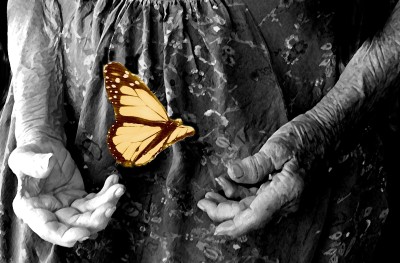
 At times, being ignored, erased, and made invisible, is more hurtful than open debate and disagreement. Such silencing and marginalization render the energy, activism, and work of so many people mute and, ultimately, they do not serve the communities and society we are attempting to change. In what follows I insist on uplifting and naming some of the radical Muslim activists and advocates for gender justice I saw ignored in a recent Muslim community event.
 During the summer I had the opportunity to interview Edwina Sandys, the creator of the sculpture, Christa. Initially, I was drawn to this sculpture during a seminary class with Whitney Bodman – “Jesus and His Interpreters.”
 On June 22, 2015 Carol Christ translated
  Feminism and Religion
