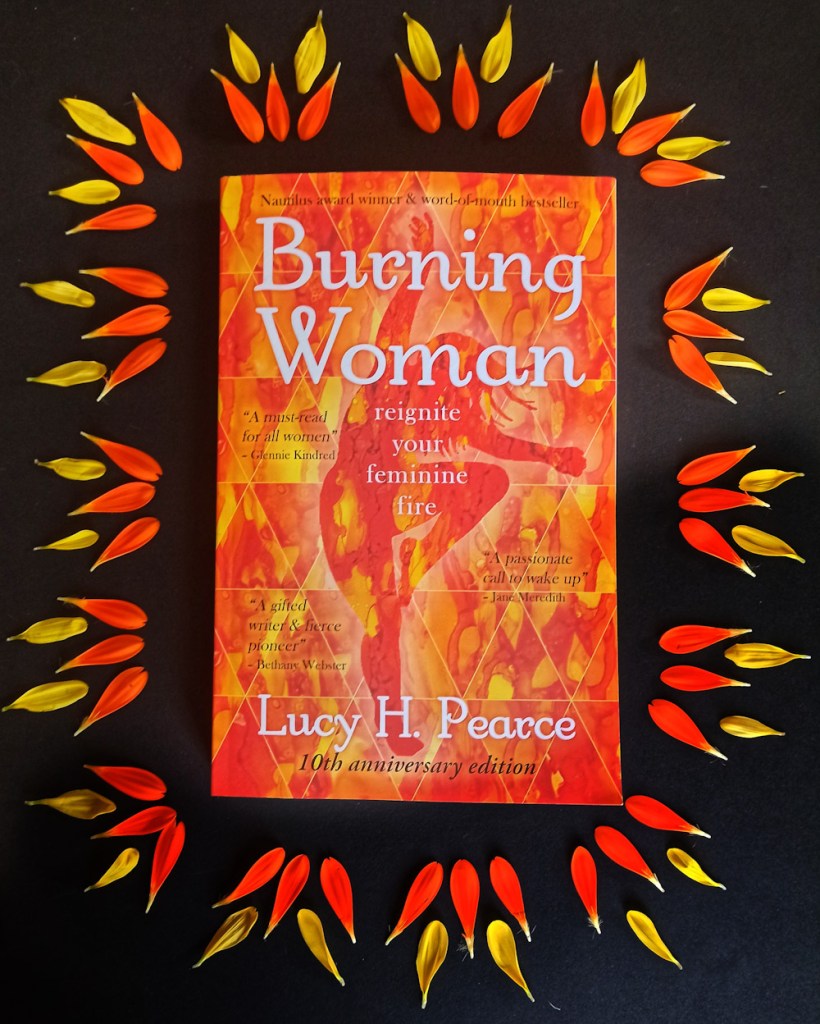
As someone who came into feminism in the late 1970s early 1980s, reading Lucy Pearce’s Burning Woman was re-entering the power and promise of women-centered feminism – the heyday of Adrienne Rich, Audre Lorde, Mary Daly, Clarissa Pinkola Estes, Andrea Dworkin, Charlotte Bunch, China Galland, Riane Eisler, Carol Christ, Gloria Anzaldúa, Susan Griffin, Starhawk, Sara Ruddick.[i] It was the era of reclaiming the Feminine from its patriarchal definitions and women defining themselves outside of patriarchy – celebrating women’s spirituality, art, music, language, bodies, sexuality, birthing, voices, and power – when feminism was about transforming patriarchy rather than fitting into it — when Meg Christian proudly sang Betsy Rose’s “Glad to Be a Woman.”
And then everything changed. Just as women were coming into our own beyond patriarchy, women-centered feminism came to a halt due to pressures both from within feminism and without – with a whole school of deconstructionist feminists[ii] now critiquing women-defined women as “essentialists,” and moving back to minimizing rather than maximizing the differences between the sexes,[iii] with an emphasis on abolishing the gender binary, welcoming trans and non-binary folk, and questioning the whole concept of “women.” Indeed, one of my Women’s Studies, now Gender Studies, students asked me privately if it was okay to call herself a “woman” because the term had become so forbidden among many of the students. At this time, feminist theorist Nancy Hartsock raised the important question, “Why is that just at the moment when so many of us who have been silenced begin to demand the right to name ourselves, to act as subjects rather than objects of history, that just then the concept of subjecthood becomes problematic?”[iv]
Continue reading “Burning Woman, by Lucy H. Pearce, 10th Anniversary Edition, Book Review by Beth Bartlett” Standing as a stark and graceful contrast to the corruptions of freedom of religion, expression, and human rights we hear about every day, there was a grand display of feminine empowerment and beauty at the most recent