 As a child, I learned all about my religion from my grandmother, in her small and remote Romanian village. She told me many Bible stories from our Christian Orthodox tradition, often disguised as bedtime fairytales, but it was not doctrine that I learned from her, as much as ritual. She taught me the prayers to say at night so I don’t have nightmares, the candles to light in church for luck, the list of dead and living to give the priest for blessings, the making and delivering of food as offerings in memory of the recently deceased.
So many of the spiritual rituals I learned from my grandmother involved food. She taught me when and how to fast, as well as how to prepare the ritual Christmas and Easter feasts: kneading and baking the traditional sweet bread filled with cocoa and walnuts or sweet cheese, cooking the celebratory pork or lamb-based dishes.
In my family, my grandmother was the keeper of rituals, many of them Christian, and many carried from a “primitive”, pagan, pre-Christian time. After growing up, as I distanced myself from my rigid Christian roots, I began to look with more appreciation back at these older traditions, some almost extinct, that had been passed down to me. Continue reading “Women Keepers of Ritual and the Caloian by Lori Tiron-Pandit”
 Have you ever wondered why it has to been so important for the Roman Catholic church to disempower women and suppress their rightful place in history? And have you ever questioned why it was so important to distort symbols and legends, which for thousands of years BC, had been connected to women and our innate spirituality?
 I’ve been asked by both academics and Pagans what inspired me to pursue doctoral research on the British Goddess movement: of the many ways that people first
  (Spoiler alert: She’s already here)
 Despite the chocolate bunnies, eggs and toy chickens in the shops along with the coaxing to buy and celebrate Easter at this time in Australia, it is not Spring: Earth here does not seem to co-operate with the Consumer Faith, built as it is around the Northern Hemisphere and dominant Christian calendar. In the Southern Hemisphere it is Autumn, the dark part of the day is lengthening.
 Last month I came face-to-face with a fisher.
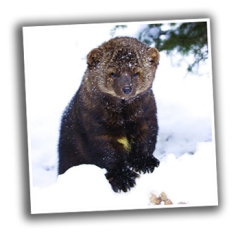 The elevation difference brought us face-to-face. I found myself staring into a fierce, furry-brown, teddy bear face. It exuded a stout confidence and an instinctual danger thumped. Eye-to-eye, neither of us moved. What was this thing? Suddenly from the reservoir of memory a recognition emerged—it looked like a wolverine. But wolverines aren’t in these woods, right? Fifteen unflinching seconds passed and then it leapt back into the woods. I stood mesmerized by the beauty and surprise of it—this was not something ordinary.
  I still think that Valerie Saving was right.
 She appeared on a hill on December 9, 1531. She spoke to Juan Diego in his native tongue of Nahuatl; the language of the Aztecas. She asked for a church to be built at that very site in honor of her, the Virgin Mary. Juan Diego took the request to the local priest, but his story was not believed. On December 12, following further instructions from La Virgen, Juan Diego was able to find and pick roses not native to Mexico. He rolled them up in his tilma and returned to the priest. When he unrolled his tilma to present the roses, there on the tilma was the image of La Virgen de Guadalupe; she was as dark as the natives themselves.
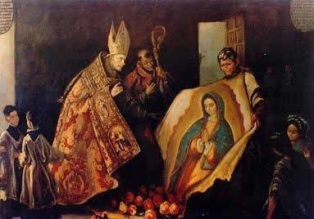 La Virgen de Guadalupe
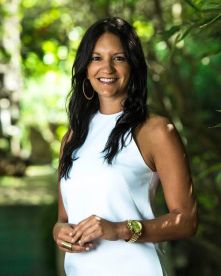 Standing as a stark and graceful contrast to the corruptions of freedom of religion, expression, and human rights we hear about every day, there was a grand display of feminine empowerment and beauty at the most recent