Oran Mor, The Great Song of Creation, Part 1 by Iona Jenkins

Celtic myth tells of the Oran Mor, the Great Song of Creation that upholds life itself.

I remember my sense of wonder and excitement when I first stumbled across this concept in The Mist Filled Path, written by Scottish/Irish/American shaman Frank MacEowen. I began an immediate quest to discover more, but internet searches produced very little information, and as there were no books available relating only to the Great Song, I concluded that perhaps information had been passed down verbally by Bards, slowly receding into the mist as Christianity became more established in the British Isles. Each time I mention the Oran Mor to someone else, they too become energised and enthusiastic, as if they sense the magic reawakening. MacEowen, who certainly encountered it on his own Mist filled Path, wrote:

“The reason we find no evidence of this Celtic Creation story, is because it is a living story – A story that waits for us to remember. In other words, no matter how hard we look, we will not find the story outside ourselves. We have all been woven into the story, it is our story, and it continues to unfold.”
p.113, The Mist-Filled Path, Frank MacEowen, 2002 New World Library
Continue reading “Oran Mor, The Great Song of Creation, Part 1 by Iona Jenkins”

Malaise and Numb Are We? by Karen Tate

Having finished my usual holiday calls to friends afar there seems to be a general theme.  We are wondering if we’ve all become numb?  Is there a general malaise infecting humanity?  Or at least Americans.  Do we all need a therapist? Or a great Mai Tai? Is it more than the orange elephant in the living room?

The theory started innocently enough.  Why are all the clothes and fabrics for furniture in hues of grey, black, brown and crème?  Where is the color? The life.  Could those who decide these things be suffering unconsciously from the same malaise or might it just be corporate strategy to save money by only offering a limited selection and often a poorer quality of goods at higher prices?  You’ve noticed the more for less we’ve been enduring for the last half a decade.  Corporations blamed Covid and supply chains as our peanut butter cups shrank while the cost exploded but they’ve never recalibrated post pandemic. They just continue to rob us, waiting for us to normalize their greed.  Breeding the manufactured consent.  Speaking of corporate greed, and never condoning violence but curious how you felt when the public sided with the shooter of the United Healthcare CEO?

Our conversations continued something like this…

Continue reading “Malaise and Numb Are We? by Karen Tate”

St. Brigid: Reproductive Justice and the Realms of the Miraculous by Elanur Williams

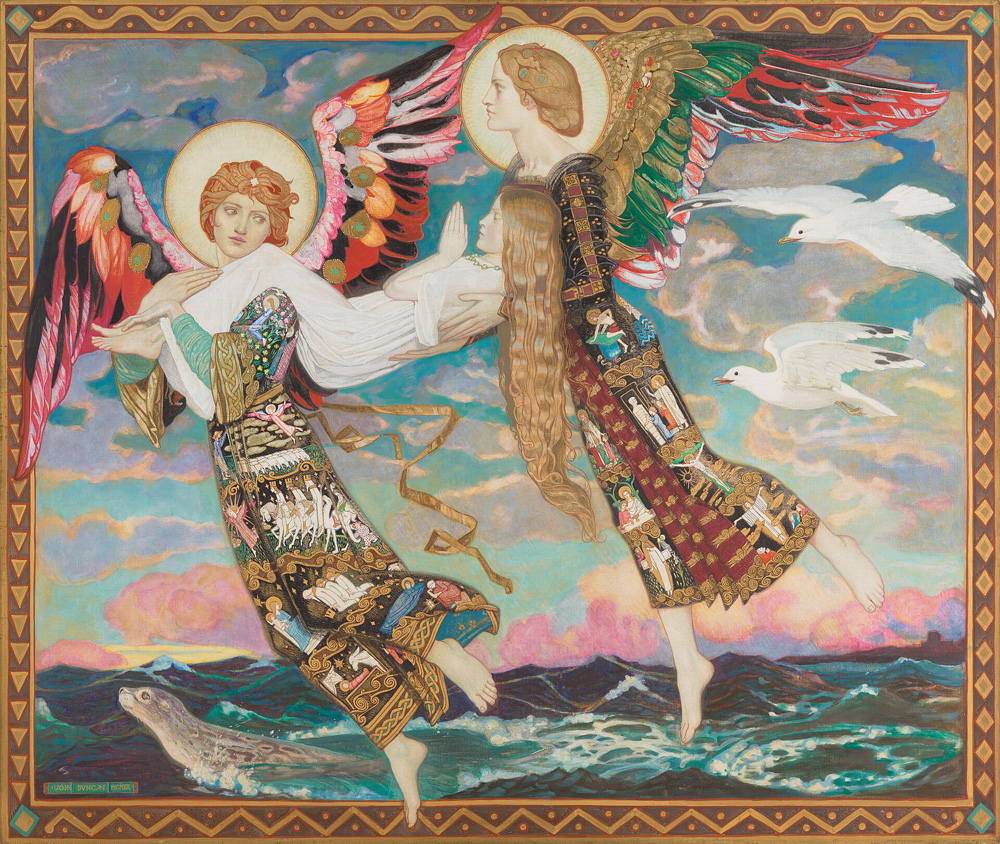
St Brigid being carried away by angels, in a painting by John
Duncan (1913)

One of my favorite saints is St. Brigid of Kildare, the patroness of poetry, learning, healing and protection. She is frequently called upon during childbirth. Brigid’s hagiographies are noteworthy for her remarkable abilities to heal and perform miracles—including her ability to make pregnancies vanish, for those who ask. In Vita Prima and Vita Brigitae (Life of Saint Brigit) published around 650 C.E. by Cogitosus, an Irish monk from Kildare, it is claimed that “Saint Brigid, by the very powerful strength of her faith, blessed a woman who had fallen [pregnant]…and the conception in the woman’s womb decreased and she restored her to health…without childbirth and its pangs.” The pregnant people in Brigid’s tales turned to Brigid to help them reclaim and restore their dignity. Consequently, their abortions served as catalysts for change. “Abortion miracles” have narrative and theological functions: they expose constructs of sexuality, chastity, purity, and sin. In addition, they test our understandings of healing—physical and spiritual—by revealing the intersectionality between medicine, pregnant people, power, and personal agency. Scholars have theorized the presence of “abortion miracles” in hagiographies, and whether they are to be read as a kind of defiance towards early Christian morality, or as a demonstration of chastity’s role and value in early medieval Irish Christianity. Some Irish penitentials view medieval abortions as malefic acts or as a kind of malevolent magic; however, according to Arica Roberts (2020), it can be argued the abortion miracles found in Irish hagiography can instead be read as “medicines of penance” and as contributing to healing.

Continue reading “St. Brigid: Reproductive Justice and the Realms of the Miraculous by Elanur Williams”

Movement of Infinite Mind Expands Faith in Humanity by Cheryl Petersen

Daania and I met while outdoors on a walking trail. At first, we crossed paths and echoed to one another “have a great day.” But sometimes we paced our journeys together, engaged in conversation, and got to know one another. Daania does not celebrate Christmas. I do. We both celebrate the forces that move us with love and truth.

One day, Daania and I moved with swift steps because the weather outside was frigid. The frosty air did not keep us from talking. Even though heavy scarves were double wrapped around our mouths and ears, we proved skilled at interpreting our muffled chit-chat.

Continue reading “Movement of Infinite Mind Expands Faith in Humanity by Cheryl Petersen”

Gardens Bloom Between our Wombs by Chaz J.

For years, I have dedicated my life to empowering and uplifting all women in all ways. I have loved women as mothers, aunties, sisters, friends, cousins, teachers, mentors, daughters, God, and most recently myself. The depth of sweetness and emotion for women runs as deep as my life’s work. My life’s work centers and finds a deep well of inspiration in women and women’s lived experiences. My feelings concerning women were confusing for a long time and for a long time I have loved women in every way, except two: sexually and romantically. Giving myself permission to love women in every way has been one of the most liberating personal experiences of my life. It is one of my most radical revolutions. It is self-acceptance and self love in totality. 

The object of my desires is fluid and delicate. She is intuitive  and evasive. She is real and ethereal. She is Wombman. She created and is the fundamental elements that constantly gives birth to the world around us. She has given birth to all of us. She is fire and fury. She is Mother Gaia. She is the winds of change. She is water’s depth and grace. She is the sunlight after a storm. She IS the storm purging impurities. She is a creator and she is destruction. She simply IS…

Continue reading “Gardens Bloom Between our Wombs by Chaz J.”

Resistance Checklist: Do It Loud. Do It Quiet by Karen Tate

Despite what you’re hearing out there, because it’s outdated information just being repeated in the echo chamber, Trump did not win by a landslide.  He has no legitimate mandate.  As of this writing one percentage point of the population separates how many votes each candidate got in this election and counting has not finished.

Many of us might still be recovering from the election disappointment and we’re trying to find our way forward.  Consider this:

“Many of us have been brought up on stories of praying to God the Father to save us, waiting for our prince to come, submitting to the greater wisdom of our husband or priest to guide us. We need to move from this way of being, into our own agency. But we must also recognise that we cannot do it all, nor do it alone, in the martyr mother myth so many of us have learned to embody.
This is not the time for being nice, biting our tongues or not rocking the boat. And yet these are also not times for making enemies or picking fights. Can we find other ways of engaging and challenging, visioning and contributing to transformation? What might these look like?” From Weaving Our Way Beyond Patriarchy – a compendium of over 80 women’s voices, launching today exclusively from Womancraft Publishing. com

Continue reading “Resistance Checklist: Do It Loud. Do It Quiet by Karen Tate”

Kamala Gave us a Tremendous Gift by Karen Tate

So I’m going to assume my readers don’t think meditation is a gateway for the devil to enter our minds and it’s not too woke.  I mean, it’s a pretty mainstream practice these days going way back.  Meditation originated in India, a very long time ago.  According to the Live and Dare website, the oldest documented evidence of the practice of meditation are wall arts in the Indian subcontinent from approximately 5,000 to 3,500 BCE, showing people seated in meditative postures with half-closed eyes. In fact today it’s a recommended self help tool and who among us didn’t need some self help after November 5?

So, I was doing a guided meditation and this figure comes toward me and hands me a box with a key inside but the meditation ended without my knowing what the key symbolized.  Then a few days later I was in another meditation circle and that box and key reappeared, only this time I got the message.  The key was certainty.  The key reminded me of a period in my life, some of my darkest days, when the road ahead was not clear, everything I’d planned for my life seemed gone and I had every reason to despair.  I felt those feelings again as I touched the key in the meditation, but I also felt that glimmer of certainty I had back then that if I just kept making my famous lists, putting one foot in front of the other, following my logic, everything would work out and in the end, it did.  Actually, in the end, there were even unexpected gifts in the troubles.  Call it my Higher Self, my Soul, God, Goddess, my intuition – whatever – I was being reminded in those guided meditations of my ability to persevere.  Of my resilience.  That good things are ahead and there are gifts in the suffering and challenges if we are willing to see them.

Continue reading “Kamala Gave us a Tremendous Gift by Karen Tate”

MOTHER OAK by Dale Allen

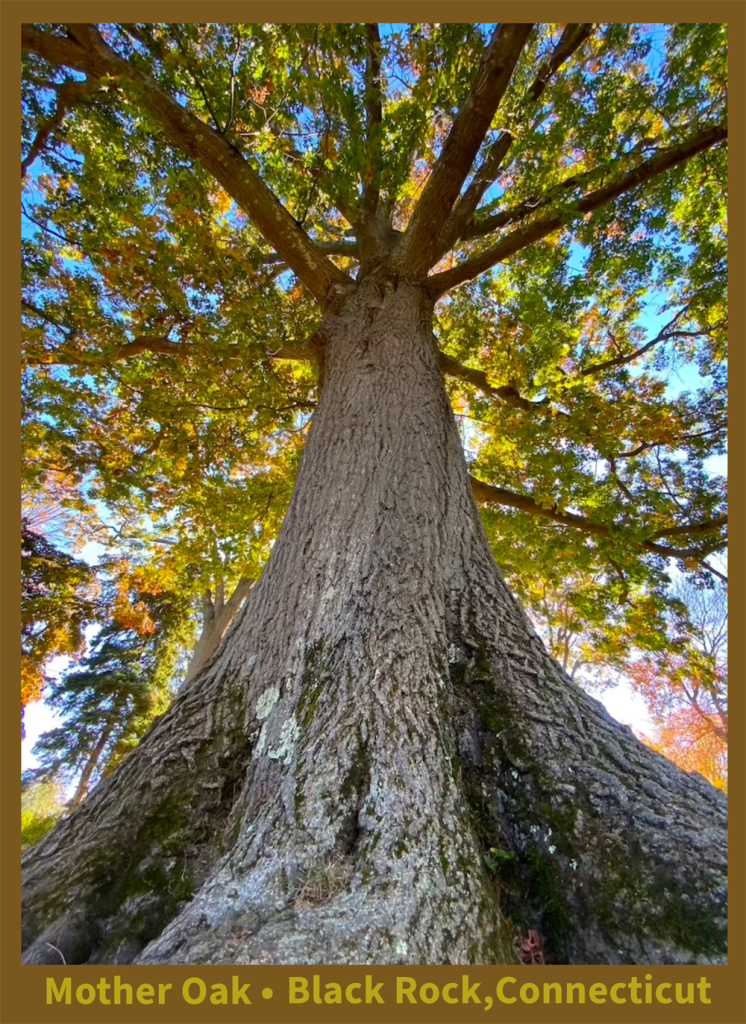
We sat on the in the leaves, my daughter and I, in the warm autumn sun under the Great Mother Oak.  Here and there fallen leaves danced lightly in the breeze.  It felt good to be directly connected to the ground, bent knees and bare feet on the land.  We leaned back and looked up at the tree in all her glory.  She was still filled with yellow green leaves… her canopy so high that from up there, she can “see” the other neighborhood trees with many years like she has.

She has been here in this place since the end of the 1700s or the beginning of the 1800s. She was here with the first European settlers of this place. Her mother had been here before that, with the last generations of the people who were of this land for 15,000 years or more: the Paugussett People. We could feel this history. We could feel the tree’s mother. And then, from beneath the ground where their energy remains steady, we heard the voice of the Paugussett. They thanked us for acknowledging their presence. They said that they can feel our profound love for this place where we live, here in Black Rock, Connecticut… our love for the trees, the leaves, the flowers, the osprey, the red tail hawks, the fox, the squirrels, the rabbits, the insects, the shore, the waters of coastal Connecticut (Long Island Sound), the shells, the sand, the sparkles, the historical homes, the families, the new babies. We love this land. We love our home. And the Paugussett saw this love. The Mother Oak saw this love.

Continue reading “MOTHER OAK by Dale Allen”

Samhain and the Waters of Hurricanes Helene and Milton, part 2 by Susan Foster

Part 1 was posted yesterday

On Samhain we are given the opportunity to come together in community to grieve our losses. We grieve for all those we have known personally who have passed over. But this year we also grieve for all those who lost their lives and homes in Hurricanes Helene and Milton and in the many other disasters around the world. We grieve as well for the other losses that occurred—of homes, of jobs, of community, of pets (many of whom also died or were separated from their owners). The losses are so enormous and overwhelming that we need the support that community provides to cope with them. We need to bind together in the strength of community to express our sorrow. Being aware of the death from so many natural disasters helps us to listen to the earth to see what She is telling us, to hear Her crying because She is weakened and out of balance, breaking apart under the strain.

 Feeling the earth’s grief from the hurts inflicted upon Her enables us to take stock of our policies, to change our course while we still can. As we float downstream on our raft, we can ignore what we see around us until we see the rapids ahead and say to ourselves, before we plunge over them, “Why didn’t we change course earlier?”

Continue reading “Samhain and the Waters of Hurricanes Helene and Milton, part 2 by Susan Foster”

Samhain and the Waters of Hurricanes Helene and Milton, part 1 by Susan Foster

Moderator’s note: While Samhain is past for this year, we are still in the section of the Celtic calendar which makes this blogpost, and its part 2 which will be posted tomorrow, relevant.

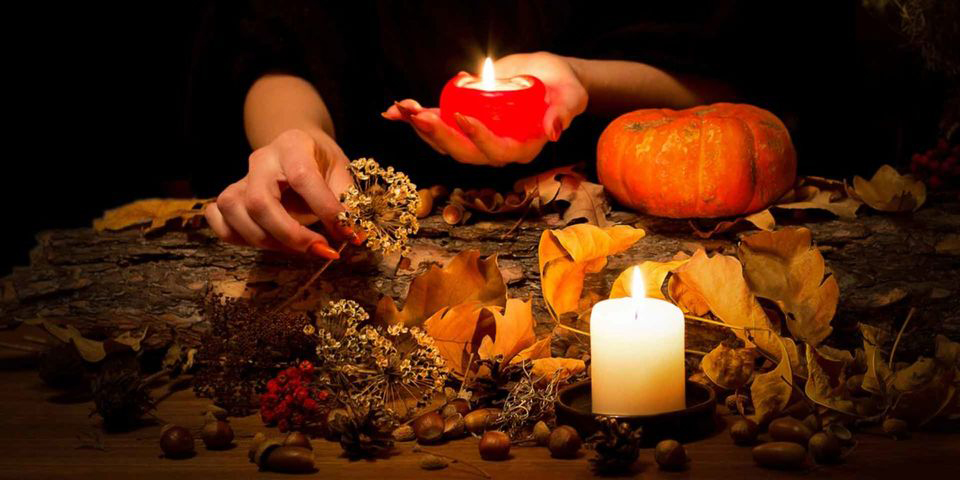
Samhain is an ancient Celtic festival, in fact the most sacred celebration in the Celtic year. Samhain is the New Year of the Celtic calendar. It is one of the eight holidays of the Celtic year—the solstices, equinoxes, and cross-quarter days—all of which mark the turnings of the seasons. Samhain is a time when the harvest had been completed; all the grains and late-maturing vegetables have been gathered in; the fields have been cleared, the old cast off, the fields lying fallow over the cold and dark of winter in order to make room for the eventual springing forth of new life. The New Year, begins in darkness at Samhain, is a reminder that all life emerges from the darkness, that death precedes rebirth. It is a time when the veil between the worlds of the dead and the living thinned, so that the presence of those who have gone before us is more clearly felt or even seen. It is a time to remember the ancestors as well as those newly departed—to grieve our losses, to let go so that we can move forward.

Samhain is the precursor of our Halloween. It was brought to this country by Irish immigrants during the potato famines in the 19th century. They brought their Celtic customs with them, but by that time Samhain was known as Hallows Eve, since the Irish were good Catholics. It struck a responsive chord with the American people, who called it Halloween. They adopted many of its customs, including lighting candles in gourds or pumpkins and dressing in costume. Today Halloween is celebrated as a spooky and fun time, observed with trick-or-treating and mischief-making, but originally it was a solemn holiday—a time to commune with the beloved dead, to honor the ancestors with food and drink, and to acknowledge death as part of a never-ending cycle of birth, death, and rebirth.

Continue reading “Samhain and the Waters of Hurricanes Helene and Milton, part 1 by Susan Foster”