
Three Wishes for the New Year: Peace, Kindness, and Dialogue in the Catholic Church by Michele Stopera Freyhauf

Freyhauf, Feminism, Religion, Durham, Old Testament, Blogger, Bible, Gender, Violence, Ursuline, John Carroll While I sit and write this post, Christmas celebrations are concluded and I prepare, with the rest of the world, to embark on a new year; a year with my idealistic hopes and want for a better future for humanity.  So for New Year’s I am taking out my golden lamp and making three big wishes:  peace, kindness, and dialogue in the Catholic Church.

Peace

“True peace is not a balancing of opposing forces. It’s not a lovely façade which conceals conflicts and divisions…. peace calls for daily commitment.” – Pope Francis

Peace transcends governments and countries.  Peace should be a daily commitment that each one of us lives every day and practiced in each of our relationships. Looking forward to a new year, I hope to put this into practice and  we will see a shift in politics and attitudes that reflect an ideal of peace and reconciliation – not just nationally, but communally. 

With peace also comes reconciliation.  Fighting takes too much energy.   Making a point to reconcile with that relative or friend that you had a falling out with is a goal that has the potential to bear fruit and be restorative.

Kindness

Kindness is the language which the deaf can hear and the blind can see.” – Mark Twain

With peace and reconciliation comes kindness.  This wish is a large request and one that the Pope calls us to embrace.    A kindness is required that reaches the poor and oppressed, that reaches non-Catholics including atheists, and, that touches every race, class, and orientation. We do not have the right to judge – a sentiment that the Pope continues to reiterate.

According to Julia Baird, “even scientists are now touting the physical and psychological benefits of kindness, compassion, and selflessness.  Multiple studies now show: a single act of kindness can trigger dozens more … and repetitive acts of kindness can make people happier, and less depressed.” This is not a new revelation, but a reminder of the benefits of kindness – a reminder we need to carry into the New Year.

We should, however, remember help the homeless, the children, and the oppressed. This group of people is often ignored the news media, but lack of attention to a problem does not diminish it.  According to the Pope, scandals are the news of today, but the children without food are not news worthy.  According to Pope Francis, we should not “interfere in the lives of others” in a way that is malicious, like gossiping or being boastful.  This behavior brings hurt, bitterness and envy.  Kindness is necessary for a better future for all of humanity.

Dialogue with the Catholic Church

“Fifty years ago, Vatican II spoke of communications.  Let us listen to, dialogue with, and bring Christ all those we encounter in life.” – Pope Francis

Let us not focus on rituals and rules in the Church; rather, we need to focus on the people of the Church.  People,

http://acatholicview.blogspot.com/2013/12/pope-francis-christmas-gift-to-romes.html

after all, make up the Church – not brick and mortar.  Because of this, we need to focus on dialogue – a dialogue with each other, regardless of belief or life choices.  This dialogue should be rooted in a positive attitude and carried out with love and humility.  It should include a focus that reaches out to facilitate peace.  This dialogue should also include the discussion of women’s roles in the Church.  There are so many things to discuss.  The Church is a human church.  With the invitation to dialogue and re-address so many of the untouched or misinterpreted teachings of Vatican II, might we move forward and rebuild this Catholic Church on the shoulders of one who served the poor, loved everyone, and gave of himself?

What are your wishes for the new year?  I would love to hear from you.

From my family to yours, may you have a peace-filled, prosperous, and delightful 2014.

Michele Stopera Freyhauf:  Doctoral Student in the Department of Theology and Religious Studies and a Member of the Centre for Catholic Studies at Durham University as well as an Instructor at John Carroll University’s Department of Theology and Religious Studies, Adjunct Professor in Religious Studies at Ursuline College and the University of Mount Union. Michele has an M. A. in Theology and Religious Studies from John Carroll University,  and did post-graduate work at the University of Akron in the area of History of Religion, Women, and Sexuality.  She is also a Member-at-Large on the Student Advisory Board for the Society of Biblical Literature and the student representative on the Board for Eastern Great Lakes Biblical Society (EGLBS).  Michele is a feminist scholar, activist, and author of several articles including “Hagia Sophia: Political and Religious Symbolism in Stones and Spolia”  and lectured during the Commission for the Status of Women at the United Nations (2013). Michele can be followed on Twitter @msfreyhauf  and @biblicalfem.  Her website can be accessed here and is visible on other social media sites like LinkedIn and Google+
“Enlightened Sexism” and The Media: The Cultural Attack on Feminism by Michele Stopera Freyhauf

Freyhauf, Feminism, Religion, Durham, Old Testament, Blogger, Bible, Gender, Violence, Ursuline, John CarrollWhat is a feminist mother of four daughters to do these days?  Look at our media and how girls and women are portrayed to our daughters, teens, and young adults. Then take a look at how media portrays the face of feminism, promoting every negative stereotype out there.  As I scroll through the magazines, listen to songs on the radio, and watch the programming targeted at girls in junior high and up, I cannot help but ask the question – Is the media trying to destroy feminism?

While this introduction might sound drastic, much truth lies behind the questions.  One merely needs to look around and watch former Disney Star, Miley Cyrus, twerk and make lewd gestures with a foam finger while grinding against a man, almost twice her age, as he sings about the blurred lines of sexual consent. When I saw the news stories and yes, watched the video, I was utterly mortified and stunned.  Gloria Steinem, in a statement that seems to condone this behavior stated that Cyrus’ performance (actions) is not a new phenomenon, but a product of American culture.  Instead of looking at it through the lens of degradation and influence, she defended the young star by saying:

 “I wish we didn’t have to be nude to get noticed. But given the game as it exists, women make decisions.  For instance, the Miss America contest… the single greatest source of scholarship money for women in the United States.  If a contest based only on appearance was the single greatest source of scholarship money for men, then we would be saying ‘this is why China wins.’ You know?  But that’s the way culture is.  I think that we need to change culture, not blame the people that are playing the game that exists.”

When Cyrus’ actions are boiled down to being “nude to get noticed,”  and we accept this behavior by merely chalking her performance up to  culture – isn’t it time to change culture?  Continue reading ““Enlightened Sexism” and The Media: The Cultural Attack on Feminism by Michele Stopera Freyhauf”

Enduring the Trials of Graduate School: From Conception to Labor Pains and Birth (Revisited) By Michele Stopera Freyhauf

Freyhauf, Feminism, Religion, Durham, Old Testament, Blogger, Bible, Gender, Violence, Ursuline, John Carroll

With the new school year in full swing, I thought this post from almost two years ago would be an appropriate reflection, encouragement, and outward support to those returning to school or nearing the completion of their degree.  Remember – do not give up – the sweat, sacrifices, and struggles are worth it in the end AND  You are not alone.  Remember the strength and courage it took to return to school or take that next step to pursue your educational goals will become the tool to help you persevere and reach that finish line!!

Going back to school at 30-something to complete a B.A. in a completely different field (from accounting to Religious Studies and Theology) was an interesting endeavor.  After many years of legal and business writing as well as crunching numbers, learning how to write academically, including formatting citations and using new technology was quite an undertaking that has proven to be rewarding.  All the searchable databases in the library no longer included card catalogues and microfiche.  This was amazing!  No more correction ribbon and electric typewriters (am I showing my age yet?!)  Going to college in 1985 is different then going back to college in 2006. Continue reading “Enduring the Trials of Graduate School: From Conception to Labor Pains and Birth (Revisited) By Michele Stopera Freyhauf”

Genetic Testing: The Ethical Implications of Expanded Newborn Testing – Who Benefits? (Part Two) by Michele Stopera Freyhauf

Freyhauf, Feminism, Religion, Durham, Old Testament, Blogger, Bible, Gender, Violence, Ursuline, John Carroll

With Angelina Jolie’s decision to have a double mastectomy due to a genetic test that revealed she carried the BRCa gene, the issue of genetic testing is in the forefront once again.  This is the second part of a three-part essay exploring genetic testing on newborns (part one and part two) and concludes with exploring personal choices and the psychological ramifications of genetic testing.

False Positives, Lack of Empirical Evidence, and Dangers in Expanded Newborn Screening

In the year 2000, most states only screened for about four conditions.   As of November 2008, most states adopted screening for the 29 recommended primary conditions and up to 25 secondary conditions (See President’s Council on Bioethics, “The Changing Moral Focus of Newborn Screening,” 36).    Since no federal mandate on newborn screening exists from state to state, this number varies due to the lack of understanding of the diseases or showing no proven benefit.   In fact, the twenty-five secondary conditions recommended  by the American College of Medical Genetics do not need urgent treatment in the newborn period or have no proven treatment (Also see Mary Ann Baily and Thomas J. Murray, “Ethics, Evidence. And Cost in Newborn Screening” Hastings Center Report (38, 2008), 28 ).

Then there is the multiplex technology of tandem mass spectrometry (MS/ MS) that can screen for over 40 “inborn errors of metabolism” from a single drop of blood (See President’s Council, “The Changing Moral Focus of Newborn Screening,” 9).  While this technology has reduced the numbers of false positives, it is still far from being reliable.  This is due to screening forBabySeq rare disorders on a population wide basis – about four million babies annually.  To illustrate this point, in 2007,  3,364,612 infants were screened for Maple Syrup Urine Disease (MSUD) in the United States and 1,249 tested positive. After retesting, only 18 cases confirmed a positive result (See President’s Council, “The Changing Moral Focus of Newborn Screening,” 14).  MSUD is a well-understood condition that shows some benefit for screening.  However, when we expand screening to add conditions that are not understood as well as mandate all newborns in the United States to be tested, false positives are likely to be in the tens of thousands (See also Beth Tarini, et al. “State Newborn  Screening in the Tandem Mass Spectrometry Era: More Tests, More False Positives” Pediatrics,  118 (2006), 448-456).

Continue reading “Genetic Testing: The Ethical Implications of Expanded Newborn Testing – Who Benefits? (Part Two) by Michele Stopera Freyhauf”

Genetic Testing: The Ethical Implications of Expanded Newborn Testing – Who Benefits? (Part One) by Michele Stopera Freyhauf

Freyhauf, Feminism, Religion, Durham, Old Testament, Blogger, Bible, Gender, Violence, Ursuline, John CarrollWith Angelina Jolie’s electing to have a double mastectomy because she carried the BRCa Gene, and her mother and aunt died at a very early age of the disease, the issue of genetic testing is in the forefront again.  This is a three-part essay explores genetic testing when it comes to newborn testing (part one and part two) and concludes with exploring personal choices, availability, and psychological ramifications of genetic testing.

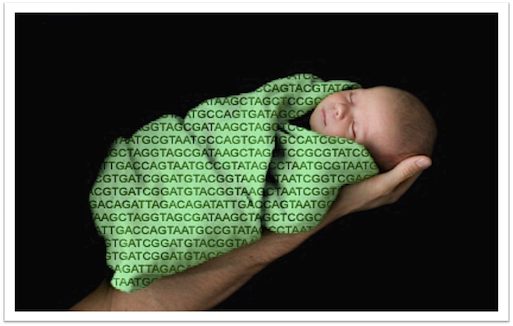
BabySeq
Picture originally found at http://www.ngsleaders.org/blogs.aspx

After nine months of worrying and diligent pre-natal care, the day to meet your unborn child is here.  Labor is long and for hours you lie in the birthing suite riding out contraction after contraction.  The moment finally arrives and you discover you have a son; ten fingers, ten toes and seemingly healthylungs by the cry that you hear.  He is then quickly taken over to the nurse’s station and a drop of blood from his heel is placed into a machine that in seconds will decode his entire genome. Soon your son’s future will be written in stone; he has a life expectancy of 30.2 years and has a 99% chance of dying from heart failure.  In that instance, your son has been labeled as an in-valid and he is now doomed to exist within a lower class of society, one that will prohibit him from pursuing his dreams. Society has discriminated against your new baby boy based solely upon his DNA.  A new form of eugenics is born.

This was the opening scene of the 1997 science-fiction movie called “Gattaca.” Besides pushing the bounds of human imagination, science fiction can serve as a warning about a future caused by the abuses of humankind.  The opening birth scene in this movie is quickly becoming a potential reality.  Now, a person’s entire genome can be decoded and in an instant, a person knows whether he or she will be susceptible to Parkinson’s disease, Alzheimer’s disease, Cancer, or other life threatening conditions.  Proponents of genetic sequencing believe that this is the holy grail of medical care and tout phrases like “personalized medical care” and “significantly reduced costs of healthcare.”  There is a rapid movement towards this goal through the proposed expansion of newborn screening for eighty-four conditions, most of which are not understood or have no known treatment. Continue reading “Genetic Testing: The Ethical Implications of Expanded Newborn Testing – Who Benefits? (Part One) by Michele Stopera Freyhauf”

Appreciating the Sacrament of the Present Moment by Michele Stopera Freyhauf

In order to be at peace, it is necessary to find a sense of history – that you are both part of what has come before and part of what is yet to come. Being thus surrounded, you are not alone; and the sense of urgency that pervades the present is put in perspective. Do not frivolously use the time that is yours to spend.  Cherish it, that each day may bring new growth, insight, and awareness.  Use this growth not selfishly, but rather in service of what may be, in the future tide of time. Never allow a day to pass that did not add to what was understood before. Let each day be a stone in the path of growth. Do not rest until what was intended has been done. But remember – go as slowly as is necessary in order to sustain a steady pace; do not expend energy in waste. Finally, do not allow the illusory urgencies of the immediate to distract you from your vision of the eternal.

                                                     (Elisabeth Kubler-Ross, The Final Stage of Growth, 167)

Freyhauf, Feminism, Religion, Durham, Old Testament, Blogger, Bible, Gender, Violence, Ursuline, John CarrollLast month we lost a good friend unexpectedly.  His death, just days after his 49th birthday caused me to confront my own mortality. His death also makes me think about that void in life that we leave as well as the legacies we leave behind. How will I be remembered?  Did I make a difference while on earth? Have I served and given back enough?   Continue reading “Appreciating the Sacrament of the Present Moment by Michele Stopera Freyhauf”

Protecting our Families: How the U.S. Falls Short in Protecting New Mothers (and Fathers) by Michele Stopera Freyhauf

Freyhauf, Feminism, Religion, Durham, Old Testament, Blogger, Bible, Gender, Violence, Ursuline, John CarrollLast weekend, I had the privilege of speaking at the National Convention for American Mothers, Inc. about motherhood in the 21st Century.  Because this is such a vital issue for mothers that live in the U.S. (since a large majority of families have two full-time wage earners), I thought it would be appropriate to share my speech here.  With the understanding that this a forum for feminism, I believe that this topic fits this forum because it continues to show how unequal the treatment is between the sexes – whether it is pay, position in employment, healthcare, education, or simply balancing the responsibilities of family/career.  For those that live in the United States, there is often a sense of exceptionalism, and as I clearly demonstrate in this speech, we are certainly a far cry from being role models that when it comes to protecting mothers (whether by birth or adoption) and families.

As a side note:  One topic that was not explored, due to lack of data, is how maternity/paternity leave impacts same sex couples who become new parents – I have to believe that this is a topic to also examine (and I am would encourage any feedback here).  

Recently the United States ranked 25 out of 165 countries for being the best place to live if you are a mother.  This number is up from 31 a year ago and places us between Belarus and the Czech Republic.

You may be asking yourself, Why isn’t the United States in the top five or even in the top ten? The answer to that question becomes evident once we examine how that determination is made. The categories examined are:

  • Mother’s education;
  • Child’s Health;
  • Economic status;
  • The Election of women to government office;
  • Breast feeding programs.  In the United States 75% of mothers breastfeed their babies, 35% continue to breastfeed after six weeks. The number shrinks because mothers usually return to work and find it difficult to to pump at the office;
  • Maternal death rate is another factor, which stunned me when I found out that the US has the highest maternal death rate of any industrialized nation. Approximately 1 in 2,100 women are at risk of dying during child birth;
  • Infant death rates is another category.  Infant deaths are estimated to be 8 per 1000 births – a number that throws us behind 40 other countries;

Why are We Troubled by a Homeless Jesus? by Michele Stopera Freyhauf

Michele Stopera Freyhauf Durham John Carroll Religion TheologyThere are standard depictions of Jesus that show a Caucasian male with blue eyes (some pictures have the occasional brown eyes), shoulder length brown hair, and usually wearing a tunic with sandals. Jesus’ demeanor is usually victorious, prayerful, inviting, and even reflects humility. Our culture creates an unrealistic depiction of Jesus so that in the United States (at least), we see a savior as a white male representative of the power structures that permeate every facet of life.

There are some variations of this image. The most common is this same image with dark skin. A depiction that makes Jesus more tangible to people of color. If we can accept this variation of Jesus, then why would we be upset when images become more culturally tangible, send a message that encapsulates Jesus’ ministry, or make us stop and think – challenging us to take our rose colored glasses off. When an artist creates an image of Jesus that is different than the standard described above, controversy occurs at varying levels. The artwork is removed or de-commissioned, protests occur, and in extreme cases, the artist will even receive death threats. Here is a small sampling of images:

Jesus-in-Jeans-by-Peter-Royle
Jesus in Jeans (Peter Royle) picture courtesy of Wikipedia http://en.wikipedia.org/wiki/File:Jesus-in-Jeans-by-Peter-Royle.

chocolatejesus
Sweet Jesus (Cosimo Cavallar) picture from Cavallaro’s website (http://www.cosimocavallaro.com/html/chocolate_page.html
Edwina Sandys: http://www.naplesnews.com/news/2008/mar/06/my-life-so-far-edwina-sandys-69-artist/
T Edwina Sandys: http://www.naplesnews.com/news/2008/mar/06/my-life-so-far-edwina-sandys-69-artist/
Crucified Woman at Emmanuel College

Continue reading “Why are We Troubled by a Homeless Jesus? by Michele Stopera Freyhauf”

Standing in Cautious Optimism with the Election of the First Jesuit Pope by Michele Stopera Freyhauf

Freyhauf, Feminism, Religion, Durham, Old Testament, Blogger, Bible, Gender, Violence, Ursuline, John CarrollFrom the time Benedict’s successor was revealed, I believed that we were witnessing something different – hopefully change.  Pope Francis I embraces many “firsts” – which is probably why the Cardinals chose him.  Change and reconciliation seem to be at the forefront – something the Church so desperately needs today.  Francis is the first Latin American Pope, first Jesuit Pope, first Pope to use the name of Francis after St. Francis of Assisi, a Saint held in high regard by Catholics.  When I heard his chosen name, I immediately thought of St. Francis, to whom my favorite prayer is attributed.  This is a prayer that inspires me and speaks about how I try to live my life –  as one who strives for peace, and provides love, hope, and compassion.  St. Francis’ story is a powerful story of conversion from a life of great wealth to one of voluntary poverty.  Francis received a revelation from Christ to “rebuild my Church,” in a way that embraces peace and love as well as providing protection for all of creation.  The notion of “Protector” was a major theme in Pope Francis’ homily during his inauguration mass.

As an unlikely choice for Pope, mostly due to his age and health, Francis reminds me of another unlikely advocate for the people – a man chosen to be Archbishop because of his passivity and his ill-health – Oscar Romero.  Romero surprised the people who placed him in office and stirred things up when he became a staunch advocate for the people that he served.  Romero’s “moment of conversion” revealed something spectacular that changed Latin America.  In his role as leader, he found his voice and became a defender for the poor and oppressed.  It is because of Romero that I am hopeful that Francis will provide (or at least start the wheels in motion to provide) changes to the Catholic Church. Continue reading “Standing in Cautious Optimism with the Election of the First Jesuit Pope by Michele Stopera Freyhauf”

Marriage as a Commodity (Satisfaction Guaranteed) by Michele Stopera Freyhauf

Freyhauf, Feminism, Religion, Durham, Old Testament, Blogger, Bible, Gender, Violence, Ursuline, John CarrollThis Saturday I will be presenting a paper about Cyberbrides at the United Nations Commission on the Status of Women.  While my focus for that paper is the impact on mothers and families, my research also revealed how some Cyberbrides (or Mail-Order Brides) are selected from internet catalogues with “satisfaction guaranteed” and how “International Marriage Broker” may be a cloak hiding the agencies’ involvement with human trafficking.

Cyberbrides are essentially mail-order brides, but like pen pals, they can chat and exchange pictures on the Internet and interact through video or instant chat.  There are almost 2.9 million website matches that turn up when Google-ing “Mail-Order Brides” within 19 seconds of pressing the “return” button. With the low cost of social media, a new venue to market and display this “commodity” is available.  Presently,  about 30 Facebook sites exist that advertise “Mail-OrderBrides. Continue reading “Marriage as a Commodity (Satisfaction Guaranteed) by Michele Stopera Freyhauf”