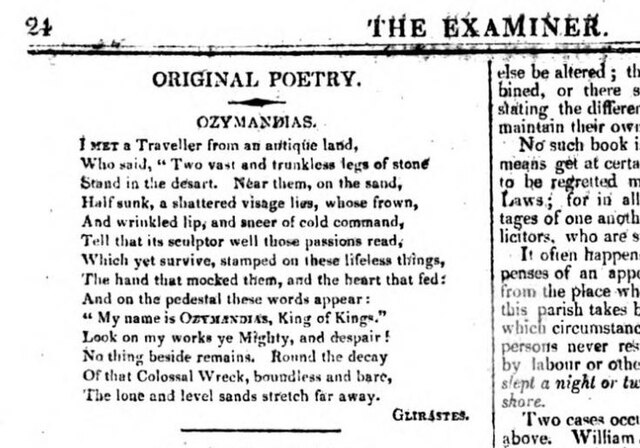
Ozymandias and Other Patriarchal Ego-isms by Janet Maika’i Rudolph

I met a traveller from an antique land
Who said: “Two vast and trunkless legs of stone
Stand in the desert . . . Near them, on the sand,
Half sunk, a shattered visage lies, whose frown,
And wrinkled lip, and sneer of cold command,
Tell that its sculptor well those passions read
Which yet survive, stamped on these lifeless things,
The hand that mocked them, and the heart that fed:
And on the pedestal these words appear:
‘My name is Ozymandias, King of Kings:
Look on my works, ye Mighty, and despair!’
Nothing beside remains. Round the decay
Of that colossal wreck, boundless and bare
The lone and level sands stretch far away.”

Percy Bysshe Shelley 1792 – 1822

There has been discussion of what to name Trump’s ever-expanding ballroom. Some have suggested naming it after Epstein. I would suggest naming it after Ozymandias from Shelley’s poem. 

There is something about building projects that feed to the patriarchal ego.  The Patriarchal ego stands on permanence, largess and if that involves crushing those “below” them, that is just how it is.  Pre-patriarchal pagan systems focus on the cycles of life and are based on an understanding that impermanence is what life is all about. Life works on cyclic movement. The seasons, the moon, the sun, the stars, all is in motion and all presages different aspects of the wheel of life.

Continue reading “Ozymandias and Other Patriarchal Ego-isms by Janet Maika’i Rudolph”

The Legacy of Carol P. Christ: THE REFUGEE CRISIS IN GREECE: A TEST OF OUR COMMON HUMANITY by Michael Bakas, translated by Carol P. Christ

This was originally posted on June 22, 2105

Note from Carol Christ: I returned home from the Goddess Pilgrimage to Crete a week ago to find my island, Lesbos, and my village, Molivos, overwhelmed with a refugee crisis of enormous proportions. We are a town of about 1000 permanent residents, and I would estimate that 10,000 or more refugees from the wars in Syria and Afghanistan have passed through our village in recent months. Local authorities and volunteers are exhausted, and there is an urgent need for help from the European Union. This week instead of my own blog, I am offering my translation of a moving plea for help from my dear friend and colleague in the Green Party, Michael Bakas, who by the way is himself a feminist.

Refugees in Mytiline 1914-1918There is nothing new about refugees fleeing from war. At the beginning of World War I, more than 50,000 people arrived in Lesbos from the nearby shores of what is now Turkey. At the end of the war many of these refugees returned to Asia Minor, but after the Greek army invaded and was driven back, the Asia Minor Catastrophe of 1922 sent nearly a million refugees to Greece.

Continue reading “The Legacy of Carol P. Christ: THE REFUGEE CRISIS IN GREECE: A TEST OF OUR COMMON HUMANITY by Michael Bakas, translated by Carol P. Christ”

Anne Brontë’s Agnes Grey: Lifting the Veil on Cruelty, part 2 by Maria Dintino

Part 1 was posted yesterday.

Here the reader further witnesses how young Tom treats his little sisters which is consistently cruel-hearted. Tom continues to describe how he will harm the helpless birds while Agnes desperately works to persuade him otherwise:

“But you shall see me fettle ’em off. My word, but I will wallop ’em? See if I don’t now. By gum! but there’s rare sport for me in that nest.”

“But, Tom,” said I, “I shall not allow you to torture those birds. They must either be killed at once or carried back to the place you took them from, that the old birds may continue to feed them.”

“But you don’t know where that is, Madam: it’s only me and uncle Robson that knows that.”

“But if you don’t tell me, I shall kill them myself—much as I hate it.”

“You daren’t. You daren’t touch them for your life! because you know papa and mamma, and uncle Robson, would be angry. Ha, ha! I’ve caught you there, Miss!”

“I shall do what I think right in a case of this sort without consulting any one. If your papa and mamma don’t happen to approve of it, I shall be sorry to offend them; but your uncle Robson’s opinions, of course, are nothing to me.”

This young charge of Agnes’s is threatening and manipulating her as he and the other children do often. Tom doesn’t realize he has hit a nerve with Agnes, where the brutal treatment of the most vulnerable is unbearable. This situation is indicative of the overall treatment she receives as a governess, as one less-worthy-than and stripped of power, yet blamed for the misbehavior of her charges.

“So saying—urged by a sense of duty—at the risk of both making myself sick and incurring the wrath of my employers—I got a large flat stone, that had been reared up for a mouse-trap by the gardener; then, having once more vainly endeavoured to persuade the little tyrant to let the birds be carried back, I asked what he intended to do with them. With fiendish glee he commenced a list of torments; and while he was busied in the relation, I dropped the stone upon his intended victims and crushed them flat beneath it. Loud were the outcries, terrible the execrations, consequent upon this daring outrage; uncle Robson had been coming up the walk with his gun, and was just then pausing to kick his dog.

“Tom flew towards him, vowing he would make him kick me instead of Juno. Mr. Robson leant upon his gun, and laughed excessively at the violence of his nephew’s passion, and the bitter maledictions and opprobrious epithets he heaped upon me. “Well, you are a good ’un!” exclaimed he, at length, taking up his weapon and proceeding towards the house. “Damme, but the lad has some spunk in him, too. Curse me, if ever I saw a nobler little scoundrel than that. He’s beyond petticoat government already: by God! he defies mother, granny, governess, and all! Ha, ha, ha! Never mind, Tom, I’ll get you another brood to-morrow.”

Uncle Robson’s appalling show of support and praise for Tom’s egregious behavior toward his governess underscores a deeply engrained and condoned misogyny. But here our usual grin-and-bear-it Agnes will not back down or be silenced.

“If you do, Mr. Robson, I shall kill them too,” said I.

“Humph!” replied he, and having honoured me with a broad stare—which, contrary to his expectations, I sustained without flinching—he turned away with an air of supreme contempt, and stalked into the house. Tom next went to tell his mamma.”

Agnes has risked her position in defense of her values, but Uncle Robson, who it is noted never pays his nieces any heed, has instilled and upholds his nephew’s cruel ways, no doubt leading him to become a person who will kick his dogs and treat all creatures deemed lesser, including girls and women, with disdain. Little Tom is “beyond petticoat government already,” encouraged and rewarded for not listening to any of the women in his life. Following the example of his father, uncle, and many of the other men in his life, Tom has already learned to disregard what women have to say.

And Tom’s mother, Mrs. Bloomfield, buys into the dysfunction wholeheartedly. The passage continues with an interaction between Agnes and lady of the house, with her defending the violent behavior of her son and blaming Agnes for interfering with his fun and games.

“It was not her [Mrs. Bloomfield’s] way to say much on any subject; but, when she next saw me, her aspect and demeanour were doubly dark and chilled. After some casual remark about the weather, she observed—“I am sorry, Miss Grey, you should think it necessary to interfere with Master Bloomfield’s amusements; he was very much distressed about your destroying the birds.”

“When Master Bloomfield’s amusements consist in injuring sentient creatures,” I answered, “I think it my duty to interfere.”

“You seemed to have forgotten,” said she, calmly, “that the creatures were all created for our convenience.”

I thought that doctrine admitted some doubt, but merely replied—“If they were, we have no right to torment them for our amusement.”

“I think,” said she, “a child’s amusement is scarcely to be weighed against the welfare of a soulless brute.”

“But, for the child’s own sake, it ought not to be encouraged to have such amusements,” answered I, as meekly as I could, to make up for such unusual pertinacity. “‘Blessed are the merciful, for they shall obtain mercy.’”

“Oh! of course; but that refers to our conduct towards each other.”

“‘The merciful man shows mercy to his beast,’” I ventured to add.

“I think you have not shown much mercy,” replied she, with a short, bitter laugh; “killing the poor birds by wholesale in that shocking manner, and putting the dear boy to such misery for a mere whim.”

“I judged it prudent to say no more. This was the nearest approach to a quarrel I ever had with Mrs. Bloomfield; as well as the greatest number of words I ever exchanged with her at one time, since the day of my first arrival.”

Agnes knows her place and if she wants to maintain her position to both assist her family and to prove she can handle the role, she must monitor herself and bite her tongue around her employers and their children. In both Agnes’s positions, the parents are portrayed as overly indulgent and uninvolved, allowing the children to misbehave and manipulate at every turn. The parents consistently take their children’s side and refuse to see any fault in them, lest it cast blame on their parenting. This creates an especially impossible arrangement for the governess to have any influence on the children, let alone get them to care about and complete their lessons.

Anne’s resting place at St. Mary’s Church in the seaside town of Scarborough, North Yorkshire.

At a certain point in the story it becomes quite clear how all will unfold, yet one cannot stop reading!

In the end, Agnes is rewarded with the love of one she has admired for some time. The icing on this happy-ending cake is that she is also reunited with the neglected dog, Snap, that one of the young women in her charge had given away, breaking Agnes’s heart. This delightful reunion takes place on the beach, a setting Anne Brontë herself cherished.

If one cannot bear the truth, don’t read Anne Brontë’s novels. Yet, it’s worth keeping in mind that if the ugly truth is kept undercover, it’s less likely to be addressed.

Anne Brontë is a Nasty Woman Writer.

© Maria Dintino 2024

Works Cited & Resources

Brontë, Anne. Agnes Grey. The Project Gutenberg eBook of Agnes Grey, 4 December 2020. https://www.gutenberg.org/files/767/767-h/767-h.htm

Ellis, Samantha. “Anne Brontë: the sister who got there first.” The Guardian. 6 January 2017.  https://www.theguardian.com/books/2017/jan/06/anne-bronte-agnes-grey-jane-eyre-charlotte

Holland, Nick. “Agnes Grey: Nothing short of genius.” Anne Brontë Blog, 9 April 2017.  https://www.annebronte.org/2017/04/09/agnes-grey-nothing-short-of-genius/

Anne Brontë’s Agnes Grey: Lifting the Veil on Cruelty, part 1 by Maria Dintino

Moderator’s Note: This piece is in co-operation with The Nasty Women Writers Project, a site dedicated to highlighting and amplifying the voices and visions of powerful women. The site was founded by sisters Theresa and Maria Dintino. To quote Theresa, “by doing this work we are expanding our own writer’s web for nourishment and support.” This was originally posted on their site on November 19, 2024. You can see more of their posts here. 

Anne, the youngest of the Brontë sisters, penned two novels in her short life. The first was Agnes Grey (1847), then The Tenant of Wildfell Hall (1848).

A sketch of Anne by her sister Charlotte.

It’s probably safe to say that Agnes Grey is the least read and appreciated of all the Brontë novels, of which there are seven. Emily’s Wuthering Heights and Charlotte’s Jane Eyre garner the most praise and attention. But Anne’s The Tenant of Wildfell Hall is not far behind, and by some accounts leads the pack.

Interestingly, all the sisters’ first novels were released in the same year, under their pen names Currer, Ellis, and Acton Bell. First was Jane Eyre in October 1847 and then Wuthering Heights and Agnes Grey together as a ‘triple decker’ in December 1847, with Wuthering Heights making up the first two parts, and Agnes Grey the third.

Continue reading “Anne Brontë’s Agnes Grey: Lifting the Veil on Cruelty, part 1 by Maria Dintino”

The Legacy of Carol P. Christ: Toxic Masculinity: “Masculinity Must Be Killed” by Carol P. Christ

This was originally posted on June 20, 2016

Carol Molivos by Andrea Sarris 2A few days ago I watched the movie An Unfinished Life starring Morgan Freeman, Robert Redford, and Jennifer Lopez. Though it was recommended as a sensitive psychological drama, and though on the surface level it criticizes (male) violence against women and animals, on a deeper level, it confirms the association of masculinity with violence, suggesting that violence is the way men resolve their problems with each other.

At the beginning of the film, Robert Redford, who lives on a ranch in Montana, picks up his rifle with the intention of shooting a bear who mauled his friend Morgan Freeman. This act of violence is stopped by local authorities who arrive to capture the bear. However, the bear is not removed to a more remote area, but rather is given to a local make-shift zoo where it is kept in a small cage. At the end of the movie, Redford frees the bear after Freeman realizes that it should not be punished for injuring him. The bear is last seen crossing a mountain ridge in the distance.

Redford is grieving the death of his only son who died in an automobile accident while his son’s wife (played by Jennifer Lopez) was driving. After being beaten by her current boyfriend, Jennifer Lopez escapes with her daughter and ends up on Redford’s doorstep, announcing that her daughter is Redford’s granddaughter.  Redford, who believes Lopez is responsible for his son’s death, grudgingly allows them to stay.

When Lopez’s boyfriend tracks her down in Montana, Redford drives him out of town, threatening to kill him with his rifle. When the boyfriend comes back, Redford shoots out the tires of his car, smashes the car’s windows with his rifle, and beats the boyfriend bloody before putting him on a bus out of town.

The movie asks us to condemn the boyfriend’s violence against Lopez and Redford’s desire to kill the bear, but it also asks us to condone and even to celebrate Redford’s violent acts against the boyfriend. After all, in this case, justice is done. Right?  Continue reading “The Legacy of Carol P. Christ: Toxic Masculinity: “Masculinity Must Be Killed” by Carol P. Christ”

The Erotic as Power, Notes on Audre Lorde by Janet Maika’i Rudolph

I’ve long kept a tract of Audre Lorde’s seminal piece The Uses of the Erotic near my computer. “The Erotic as Power” is her subtitle. If you haven’t read it, please do.  It is in her book Sister Outsider. And you can find it as a stand-alone here. It was written in 1978.

Lorde points out how the erotic is the opposite of pornography, in fact pornography is ultimately a denial of the erotic because it emphasizes sensation without feeling. “The erotic is a resource within each of us that lies in a deeply female and spiritual plane . . .” She goes on to note how it is through our bodies that we recognize and access this power. But she goes on, “We have been taught to suspect this resource, vilified, abused and devalued within Western society.”  In the hands of patriarchy this amazing and important resource often lies out of reach because it has become a source of shame and a sense of inferiority for women.[1]

I would add to the definition of patriarchy that one of its main goals is to damp down, even destroy, the erotic. We have seen this play out over thousands of years of history. Women are often viewed as either saints or sinners. Saints are denuded of this deep earthy power and sinners are those who flaunt it, or at least in the eyes of patriarchy.

Continue reading “The Erotic as Power, Notes on Audre Lorde by Janet Maika’i Rudolph”

From the Archives: “Be the Donkey: On Parshah Balak” by Ivy Helman

Author’s note: This post was originally published on this website on July, 10, 2022. This year, Balak was read in synagogues yesterday.

The Torah portion for July 16, 2022 is Balak (Numbers 22:2 -25:9).  Some of what happens in Balak is familiar: idolatry, divinely-sanctioned death penalties, and a plague.  But, did you know that this parshah has a talking female donkey who stands up to abusive behavior?  Perhaps not.  That talking donkey and the larger story of Balak’s attempt to curse the Israelites raises questions about gender, how we treat animals, choices, free will, violence, courage, and having one’s eyes open to what is really happening around one’s self. All of which is what we will be looking at today.

Balak begins with this story about Balaam.  The Moabite king, Balak, wishes to curse the Israelites because he is worried about their size and their impact on the land and its current inhabitants (22:3-4).  He sends representatives to bring  Balaam, a powerful man whose curses and blessings have tangible effects on their recipients (22:6), to him.  Balaam meets with those representatives and tells them to wait; he has to talk to the deity in order to know what to do.  The deity commands Balaam to stay put and to not curse the Israelites, for they are blessed (22:12). Indeed, a first in quite a while. 

Continue reading “From the Archives: “Be the Donkey: On Parshah Balak” by Ivy Helman”

Circle of Fire by Sara Wright

Moderator’s Note: This is the final part of Sara’s poem that was posted last week. You can read it here.

Part 1

She burned
 in raging fires
swamped by
merciless floods
crossed mountains
 of grief
so wide so deep
crushed Silence
in her sleep
unknowingly
accompanied
by Owls
and Winter Wren
Marked by Bear’s
sharp Protective
 Claws
 Circles of Fire

Continue reading “Circle of Fire by Sara Wright”

Census in Times of Fear by Xochitl Alvizo 

I received a notice from the U.S. Census Bureau recently that I was randomly selected to complete the “American Community Survey.” It came as a letter at first with instructions to complete the survey online. A few days later I received another letter saying “A few days ago, you should have received a letter from the U.S. Census Bureau asking me to complete the American Community Survey,” with big bolded letters that my “response is required by law.” I have since then received follow-up post-card reminders, a physical form survey with the same bolded message, and another post-card that they have sent repeated requests to complete the survey.

Continue reading “Census in Times of Fear by Xochitl Alvizo “

The Loving Tree By Janet Maika’i Rudolph

from Egyptian tomb of Pashedu ca. 1314-1200 BCE

Once there was a tree who loved two young children, twins, a boy and a girl.

Thay came everyday to play under her canopy. 

Gather her leaves and play fairies of the forest.

Climb her trunk and play in her branches

And sleep with their backs against her trunk

They loved the tree and the tree loved them. 

Time went by and the twins grew older.

They didn’t come to visit the tree as often.

One day when they did come, the tree asked them to play but they responded they needed money because they wanted to go on dates.

The tree responded, take my apples to sell.  But leave enough behind for the squirrels and birds and other animals so they can eat too. Leave enough behind for the seeds.

Continue reading “The Loving Tree By Janet Maika’i Rudolph”