Legacy of Carol P. Christ: Cry The Beloved Country

This post was originally published on Nov. 5th, 2012

With the final day of voting in the US election less than 24 hours away, I feel a deep sadness descending on my soul. 

This election will have far-reaching consequences in relation to a number of issues I care deeply about. Among them are health care, social services, a social safety net, a graduated tax structure that taxes the rich and to a lesser extent the middle classes in order to provide services for the poor, equal pay for equal work, a woman’s right to choose, and gay rights.  On these issues there is a clear choice between the two candidates for President and the two parties.

Democrats believe that health care is a human right, that social services should be provided for those who need them, that taxes should be paid by those who can afford to do so, that women have a right to equal pay and control of our own bodies, and that gays and lesbians should have all the rights of other citizens. Republicans believe that government does not need to provide or control health care, that social services are largely unnecessary, that it is unfair to tax the rich, that equal pay is not important if women have husbands, that the church and state should be making decisions about women’s bodies, and that homosexuality is a unnatural.  There is a clear choice on these issues.

For this reason, I urge all of you who have not voted yet—and those of you who are considering not voting–to vote, no matter how long the lines are, no matter what intimidation you may face, and no matter what discouragement and disappointment you may be feeling.*

Nevertheless I feel like crying.

I feel sad that just about half of all Americans who intend to vote will be voting for the rich, against the poor, and against women’s—my–independence.  Continue reading “Legacy of Carol P. Christ: Cry The Beloved Country”

Dyke March, Long Beach, CA 2025 by Marie Cartier

This year it is more important than ever to celebrate LGBTQ+ PRIDE. Here’s a taste of Long Beach, CA’s Dyke March. I was the emcee for the rally. My wife, Kimberly Esslinger was on the organizing committee and also created the first “Dykes After Dark” event– a poetry reading open mic– last year the poetry event was a pop-up with 15 people. This year the coffeehouse was filled to the max- 80 people or so, and the Dyke March itself had over 400. This is the thing: we need places to gather. And if you build it, we will come.

Continue reading “Dyke March, Long Beach, CA 2025 by Marie Cartier”

Showing Up, by Molly M. Remer

When we return home, I see a meme on social media that says: “Ten minutes online will show you everything that is wrong with the world. Ten minutes outside will show you everything that is right.” I think about the students and professors, each one alight with enthusiasm, with passion, for their work, their projects, their art, the contributions they are making. This is what we need. We need to see, spend time with, and BE people who are involved, connected, committed, and passionate. People who are creating instead of destroying. People who are connecting instead of controlling. People who are reaching out to offer what they can, who create and care, and who show up.

We may let connections thin
and interests slide,
forgetting that it takes work
to nurture and tend
to what we love,
that following what is easy
can be the wrong direction,
one that eventually leads
to the withering of what we value
and to the shrinking of our worlds.
We must evaluate the balance
between effort and ease,
yes,
but let us remember
that both are essential to thriving.
Let us lean into effort sometimes,
when there is meaning on the line,
put our backs into it,
feel sweat on our brows
and the satisfaction that comes
from choosing to immerse ourselves
in wholehearted living,
in presence,
in the work of reaching out
and holding on.

This past weekend, I went to my oldest son’s next college campus. The green spaces were filled with students working on art. The halls of the buildings were lined with art by high school students there for a visiting show. The art gallery was filled with diverse works of many mediums. The speakers for the day were filled with enthusiasm for their subjects, talking about study abroad trips to Paris and being part of the chorus or the band. We pass the student theater, abuzz with activity, and listen to a young man playing rippling tunes on the piano in the atrium of the library. This school is in a rural Missouri farming community, where we passed tractors laden with hay on the potholed road. Their mascot is a mule (“the only college with live mascot in Missouri!” they proudly report. The mule’s name is Molly, so I like her right away). Missouri is a “red state” and yet the students handed me the school paper with a front page story about protests at the capitol and a large color photo of someone holding an “Impeach Elon” sign. I happily picked up a library button proclaiming “libraries are for everyone” and another saying “what’s more punk than a library?” as well as snagging a “plant queer” sticker from the LGTBQ+ alliance table for my sister. The History table gives me a bookmark reading: “Don’t make me repeat myself.” –History

Continue reading “Showing Up, by Molly M. Remer”

Legacy of Carol P. Christ: Women For Peace–Take To The Streets

This post was originally published on Nov. 19th, 2012

Sometimes we are told that domination and violence and war are innate in human nature; therefore, it is futile to protest war.  But this is not true.

I oppose war because I oppose all forms of power-over, domination, and violence.  As a radical feminist and ecofeminist I believe that power can and should always be power-with, the power that nurtures the growth and development of self and others.  The power of Goddess/God is always and everywhere power-with and not ever power-over. 

Are violence and domination innate in human nature?  We have been told that we are the “naked ape” descended from “apes” who, like the chimpanzees with whom we share 98% of our DNA, were male dominant and violent. Do we, then, have any hope not to be violent and dominant?

Franz de Waal’s studies of the other “ape” species that shares 98% of our DNA, the bonobo, debunks this popular myth.  The bonobo live in peaceful matriarchal clans, and their response to conflict is to rub each others’ genitals until the desire to fight goes away.  They are living proof that species very much like us can choose to “make love not war.” De Waal says that the most we can conclude from studies of our ape relatives is that ancestors of human beings, chimpanzees, and bonobos had the capacity to evolve toward dominance enforced by violence, or toward more peaceful ways of resolving conflict.

Continue reading “Legacy of Carol P. Christ: Women For Peace–Take To The Streets”

From the Archives: Forgive Me My Ancestor(s) by Elizabeth Cunningham

This was originally posted on January 19. 2020. An ‘Update Note’ has been added at the end of the post.

Elizabeth Cunningham

When I was a child in the 1950s we often played cowboys and Indians. There is a photograph of my brother and me in no doubt inauthentic costume complete with feathered headdress. In kindergarten I named myself Morning Star. (I just googled and see that I must have gotten the name from the 50s television series Brave Eagle, the first with an indigenous main character. Morning Star is the female lead.)

When I was a teenager, my aunt came across a privately printed book The Gentleman on the Plains about second sons of English aristocracy hunting buffalo in western Iowa. My great grandfather accompanied them as their clergyman. I wish I could find that book now to see how this enterprise was presented. In my adolescent mind these “gentlemen” looked like the local foxhunters in full regalia. On opening morning of foxhunt season an Episcopal clergyman (like my father) was on hand in ecclesiastical dress to bless the hunt and then invited to a boozy breakfast.

Continue reading “From the Archives: Forgive Me My Ancestor(s) by Elizabeth Cunningham”

From the Archives: Tree of Life: The Festival of the Trees in an Age of Treefall by Jill Hammer

This was originally posted on January 22, 2019

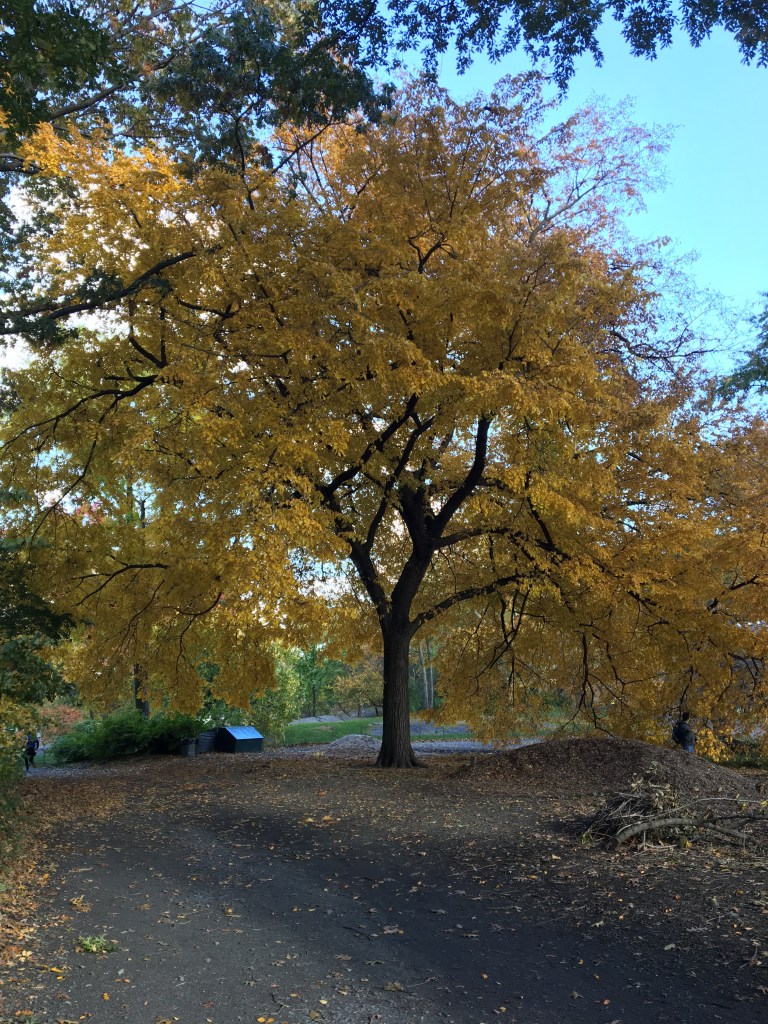
Almost every day, I walk in Central Park.  There are certain trees there I’ve come to know: the gnarled cherry trees by the reservoir, the bending willows and tall bald cypress by the pond, the sycamores that drop their bark each summer, the hawthorn not far from Central Park West.  Lately I’ve been taking photos of the trees to try to capture their essence, their posture in the world.  The trees around me feel like friends, which is what an ancient midrash (interpretation/legend) called Genesis Rabbah says about trees: that they are friends to humankind.  To me, they’ve always been a central manifestation of Mother Earth.

Currently, the national parks in the United States have no staff because of the government shutdown. Some people have taken the opportunity to cut down the rare and endangered Joshua trees in the Joshua Tree National Park—just for fun, I guess, or as a trophy of some kind.  Meanwhile, President Bolsonaro of Brazil recently has indicted that he wants to remove protection for the rainforest, in order to allow development.  It appears that my friends the trees have enemies.  Sometimes the enmity is for personal/corporate gain, and sometimes the enmity seems to have no reason at all.

Continue reading “From the Archives: Tree of Life: The Festival of the Trees in an Age of Treefall by Jill Hammer”

The Practices of Our Hope by Xochitl Alvizo

Years ago while I was a student at Boston University, a student group organized a spoken-word event. There were already some among the student body who were spoken word poets, but they also brought in Edyka Chilome, a poet, and as she refers to herself, a “cultural worker, futurist, and community weaver” (who’s also written with FAR as Erica Granados de la Rosa). She was not the first to speak, but before she did, she first took a minute to light some sage, lay it in a bowl in the middle of the circle space she had opened up in front of her, she called the four directions, and then said a prayer. 

Continue reading “The Practices of Our Hope by Xochitl Alvizo”

Legacy of Carol P. Christ: Green Solutions To The Greek Economic Crisis: We Are The 99%!

This post was originally published on May 28th, 2012

A green solution to the economic crisis insists that people and the environment can be saved together. We must dare to envision prosperity in conjunction with sustainability, social justice, nonviolence, and participatory democracy.

A rational analysis would make it clear that the Greek people did not “create” the economic crisis. Yet the poor and middle classes are being asked to “pay” for it. There is massive corruption in the public sector in Greece. But this should not blind us to the fact that the Greek people do not bear the major responsibility for creating the crisis. Those responsible include:

From the Archives: America, The Beautiful by Marie Cartier

This was originally posted August, 2018


There is a very white woman in a Lexus.
I could say her license plate number, but does it matter?
She’s that woman you’ve heard about—yelling at a brown woman
holding a sign, “I’ve lost my job. I have two kids. Help.”

The white woman leans out of her Lexus, “Go away! Go away!”
She will not move as other cars pile up behind her and the brown woman
does not “go away.” Where could she go at this point?
She’s surrounded. I watch from my car as I’m about to leave. I
take the yelling white woman’s picture. I get her license plate number. Continue reading “From the Archives: America, The Beautiful by Marie Cartier”

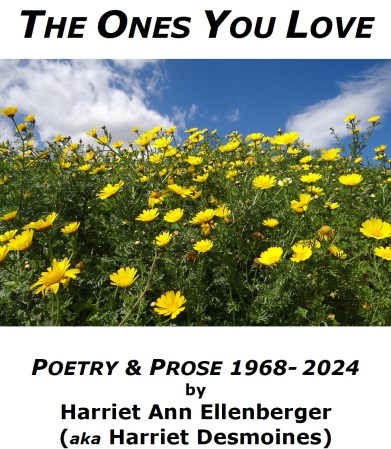
The Ones You Love, Poetry and Prose 1968-2024 by Harriet Ann Ellenberger (aka Harriet Desmoines), Book Review by Carolyn Lee Boyd

The Ones You Love, Poetry and Prose 1968-2024 is a half-century retrospective love letter from Harriet Ann Ellenberger to friends, family, and lovers; lesbian and overall feminism; lesbian feminist literature and theater; Nature; and those who have been victimized by war. Infusing the book is her overarching love of freedom, not only for herself, but for women, for humanity, and for the Earth.  Harriet has been using her authorial and editorial gifts for her entire adult life to move our planet away from extinction into new ways of being, and has now collected her best writings, both prose and poetry, into a single volume. The book is both a brilliant, truthful, unglossed portrait of herself as well as a glimpse into feminism, and lesbian feminism in particular, over decades through one woman’s experience. She often notes in introductions to various pieces that she no longer completely agrees with what she wrote so long ago, but she does not edit out these views, (speaking of her “younger fiery-feminist self,” she says “I’m proud of her courage and proud of the work she undertook” (11)) which offers us a better understanding of both her own progression of thoughts and ideas as well as what issues and points of view were of concern at the time. 

Of her most well-known achievement, she writes, “On July 4, 1976, the 200th anniversary of the American Revolution, Catherine Nicholson and I published the first issue of Sinister Wisdom, which has since become the longest-lived lesbian literature and arts journal in the world” (11). She explains the journal’s expansive perspective: “We exist in the interface between a death culture and the faint beginnings of a culture of — not humans — but life-lovers, a culture that embraces animals, plants, stars and those women who choose the future at the risk of their ‘sanity’ and security” (17). This is a vision she has carried with her ever since. 

Continue reading “The Ones You Love, Poetry and Prose 1968-2024 by Harriet Ann Ellenberger (aka Harriet Desmoines), Book Review by Carolyn Lee Boyd”