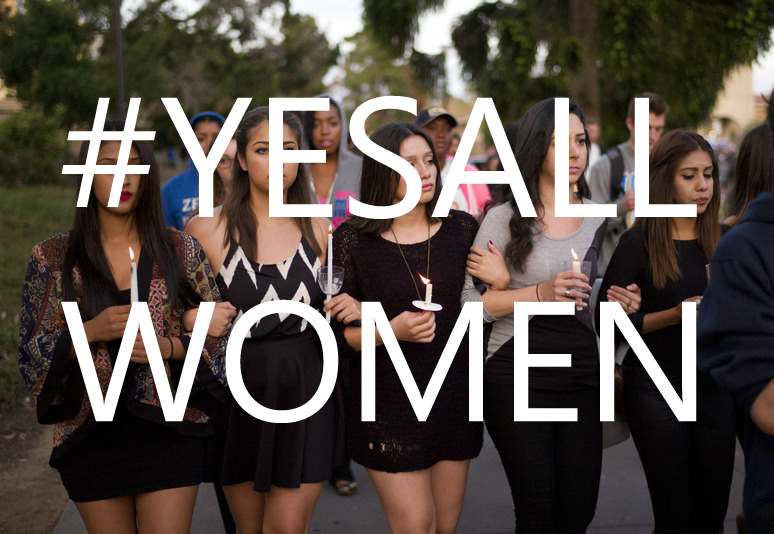
Supporting Gender Equality in the Church Results in Excommunication by Gina Messina-Dysert

Gina Messina-Dysert profileIt is unnerving to think that excommunication is still a real threat in the 21st century. Within both the Catholic and Mormon Churches members continue to be bullied into submission with such threats. Today, speaking out against gender injustice seems to be a sure way for one to end up expelled from her or his community. Kate Kelly, a human rights attorney and Mormon feminist, has become the most recent in a long line to be rebuked for speaking out about gender discrimination and is waiting to learn her fate following a trial by LDS Church leaders. Continue reading “Supporting Gender Equality in the Church Results in Excommunication by Gina Messina-Dysert”

The Girl Who Lived: Reflections on Malala, the Middle East, and Feminism by Erin Seaward-Hiatt

Erin-Close-Up-BWAs I return home from a busy day signing off on proofs and churning out cutesy paper patterns, I find my husband, Neil, at the kitchen table. He wears a complicated frown as he pores over a score of tiled browser windows telling various iterations of a singular story. “Come here,” he says, flipping to a second tab, “you’ve got to see this.” It’s The Daily Show, and as I poise for Tea Party zingers and Obamacare barbs, I see instead a girl in hijab, a brilliant smile, and a whole new hope for world politics.

The story was all about a girl. Malala Yousafzai achieved international fame one day when she took a Taliban bullet to the head. Her vocal support for girls’ education had earned her a spot on the Taliban’s hit list. It’s a group with an all-too-familiar radical bent that thrives, among other things, on the cultural ideal of women’s inferiority and silence. One moment Malala was boarding a bus and the next, she faced a hopeful assassin, eager to erase her words and her work from the world. Continue reading “The Girl Who Lived: Reflections on Malala, the Middle East, and Feminism by Erin Seaward-Hiatt”

The Outraged Ancestral Mother by Molly


crop027During the fifth week of the Rise Up and Call Her Name curriculum by Elizabeth Fisher, “We honor the Outraged Ancestral Mother and the belief that the sacred and secular are one.” When I priestessed this session for my women’s circle, I was caught by the idea of the Outraged Ancestral Mother and we spent some time discussing her and the degree to which humanity has hurt our planet. The next morning while I was practicing yoga, snippets of a poem came floating to my mind. I had the distinct feeling that the Outraged Ancestral Mother was ready to speak to me. I went down to the woods to listen to what she had to say.

Continue reading “The Outraged Ancestral Mother by Molly”

Boys Don’t Cry (or at least the shouldn’t when they are interviewing you for a job) by Natalie Weaver

Natalie Weaver

I want to begin by saying that I am grateful for my work.  It is no small thing to have a relatively secure academic position, especially in a climate when tenured and full-time appointments represent a disgracefully small percentage of all teaching positions throughout the country.  Nevertheless, a certain degree of professional movement is welcome for the purposes of growth and renewal if and when opportunity arises.  It is on this basis that I have been receptive on a few occasions to apply for appointments at the invitation of search committee chairpersons.  When I have been solicited for an application, I have in turn applied.

It is a curious thing because when you are contacted out of the blue you think something like… “ah, they must like me… they must know something about my work.”  And, it is true that on the occasions when I was asked to apply for something, I was invited to come in for an interview.  This furthers, of course, thoughts like… “great, this is going somewhere.”  And, in my case anyway, I start thinking about and even planning in a tentative way for what a move would constitute, the logistics of change, the impact on my family, the disruption of my current obligations, and so on.  Showing up for an academic interview midcareer involves much more than preparing a research presentation, which is also no small task.  The whole affair is psycho-socially weighty, and that reality is intensified by the fact that it drags on for months.  It can take more than six months from the time of the initial contact to the interview to receiving news of the final outcome. Continue reading “Boys Don’t Cry (or at least the shouldn’t when they are interviewing you for a job) by Natalie Weaver”

Thank You For Your Service by Esther Nelson

Esther Nelson

We hear it everywhere these days–five words directed towards women and men in military uniform, but also directed towards “vets”–people whose histories include “time served” in some branch of the armed services.  TV show hosts say those five words before adding, “Let’s give a hand to the brave people in uniform who keep us safe.”  Government officials shout it out in military gatherings, “Thank you for your service to the greatest democracy in the world.”

School systems partake in the spirit of it all by surprising an elementary or middle school-aged child during a reading or math class with a father’s (rarely a mother’s) sudden appearance–back home from the war zone safe and sound–at least for now.  Airlines “support our troops” by inviting men and women in uniform (usually wearing army fatigues) to board their flight before the rest of us do.  It’s a trite phrase, “Thank you for your service,” repeated over and over again much like, “Have a nice day.”  What exactly are we thanking our men and women in uniform for?

Some would say our brave young women and men keep us (citizens of the USA) safe from those who would take “freedom” (our way of life, our values, whatever it is we hold dear) from us.  In other words, those in military service are our saviors.  They give up their lives (or are willing to do so) in order that we may live.  In mythology, stories with this theme abound.  Who of us is not familiar with the Christian story/myth telling about Jesus dying for our sins so that we may live eternally–free from death, the consequences of our sin?  So, thank you vets for dying (or, at least being willing to die) so that we can live. Continue reading “Thank You For Your Service by Esther Nelson”

#BringBackOurGirls is Making an Impact by Gina Messina-Dysert

Gina Messina-Dysert profileIt has been more than a month since Boko Haram militants kidnapped nearly 300 girls from their school in Nigeria.  The social media cry for justice #BringBackOurGirls has fostered global attention; however some have criticized the campaign claiming it is low level information that does not offer any real purpose.  It has been argued that hashtag activism is lazy, frictionless, and functions more as a self-serving public acknowledgment of concern rather than an act for justice.  Likewise, it has been stated that it is the privileged outsider rather than those who need help that launches campaigns like #BringBackOurGirls.  I won’t deny that such critiques do have a basis; however we must also acknowledge that #BringBackOurGirls is making an impact.

https://www.youtube.com/watch?v=0oUG-7YL11E

Continue reading “#BringBackOurGirls is Making an Impact by Gina Messina-Dysert”

Who’s Got the Money by amina wadud

amina 2014 - croppedAfter doing my usual pre-travel research (expected weather, electrical plug usage and currency exchange rates) I tried to amply prepare for a continuous trip between India and Switzerland on one ticket: not too many clothes in my suitcase, but enough for the climate disparity. At the time I checked in, that disparity was something like 90 to 60 degrees (F) respectively. I opted for cotton clothes with layers and sandals with or without socks. As it turned out, India got hotter (nearly 100F) and Switzerland got colder (45F) with biting rain and winds. So I spent a LOT of my down time in my hotel room.

I had stuff to read, casual and work related and managed to keep myself busy. On occasion, I would turn on the TV. All the stations in Fribourg were in French or German with one exception: the financial news channel. I could only take that news for so long. My last day in Fribourg, there was a break in the news and instead they played back-to-back episodes of some program about the “super rich”. It turned out to be more distressing than the news. You’d expect people with so much money to have one thing you might wistfully dream about. But nope, I really have no interest in private planes or huge yachts with custom fitted gold faucets, or Ferraris and Lamborghinis. Yes, I would like to live near the beach, but a small bungalow would do me just as well—no need for the 25,000 square feet vacation home they were showcasing. Continue reading “Who’s Got the Money by amina wadud”

Christian Sex Ain’t So Vanilla by Andreea Nica

Andreea Nica, pentecostalismMy recent literary digests have included memoirs and nonfiction audiobooks on sex, relationships, and non-monogamy. A recent listen, Open: Love, Sex and Life in an Open Marriage by feminist activist Jenny Block, provides insight into the paradigmatic features of open marriage drawing on the personal experiences of a bisexual woman. Currently, I’m musing over my latest read: The Ethical Slut: A Practical Guide to Polyamory, Open Relationships & Other Adventures written by psychotherapist Dossie Easton and author and sex educator Janet W. Hardy. Through my literary adventures, I can’t help but reflect on my own sexual conditioning and upbringing in the Pentecostal church.

The authors of these feminist-friendly, sex-positive books and social movements did not exist in the church I grew up in, and I feel quite saddened by this. While my sexual conditioning in the church was far from liberating, these reads have helped me realize that the religious community wasn’t as mundane as I thought. My early sex education which was conservative consisted of the anatomical and biological basics (Arizona education system, need I say more?) and early conditioning of sex morals and ethics in the church. The latter was more influential to my perception of sex, gender, and relationships. Of course the media and my peers constructed my views of sexual culture and gender norms, but the church had the greatest impact during my childhood and adolescence. Continue reading “Christian Sex Ain’t So Vanilla by Andreea Nica”

Film Radical Grace Highlights Nuns’ Response to Vatican Reprimand

Radical GraceWhile the Catholic Church has sought to control US Nuns through what has been called the “New Inquisition,” it has been unsuccessful in its efforts.  The film Radical Grace documents the response of Sr. Simone Campbell, Sr. Jean Hughes, and Sr. Chris Shenk and is nothing short of brilliant.  Producers Rebecca Parrish and Nicole Bernardi-Reis chronicle their holy journeys in maintaining their vows by challenging the Vatican.  A full review of the film can be read here.

Please consider supporting the film through its crowdfund campaign.  The opportunity to meditate with Sr. Simone is incentive enough!  Congrats to Rebecca and Nicole on their fantastic project and much gratitude to Sr. Simone, Sr. Jean, and Sr. Chris for reminding us that “love is blind but obedience shouldn’t be.”

On April 30, the Vatican Doctrine of Faith “told the leadership group they were ignoring procedures for choosing speakers for their annual conferences and questioned if their programs were promoting heresy,” dashing hopes that the new pope would take a different attitude toward the nuns.

Continue reading “Film Radical Grace Highlights Nuns’ Response to Vatican Reprimand”

Transforming the Church from Within or Without? by Xochitl Alvizo

“Power belongs to those who stay to write the report!” stated Jeanne Audrey Powers during her presentation at the Religion and the Feminist Movement conference at Harvard Divinity School back in 2002. Though the statement sounds a little funny, it does raise a good question about how one participates in creating change. Where does the power for change and transformation lie? Is it in the writing of reports; is it from within institutions; from without? This question seems to be of particular relevance to those of us who have feminist visions and commitments and also remain involved in Christian churches – churches of a tradition with deeply embedded patriarchal habits and practices.

Recently, this concern was raised in a class for which I am a TA. We were talking about the fact that some feminist theologians develop feminist systematic theologies; by definition a cohesive theological system done from a feminist perspective. In part, the motivation is to reclaim the systematic way of doing theology and have it stand alongside other widely recognized theologies – but do so in a feminist way. Additionally, the traditional systematic format gives it validity and may serve to temper the prevailing habit of teaching feminist theologies as so-called ‘contextual’ theologies (as if other theologies are not also contextual, but that’s a topic for another post). A critique of this development, of course, is that by writing systematic theologies feminists are simply reinforcing patriarchal forms and patterns of academentia instead of expanding and creating new ones. Continue reading “Transforming the Church from Within or Without? by Xochitl Alvizo”