My Father’s Daughter by Xochitl Alvizo

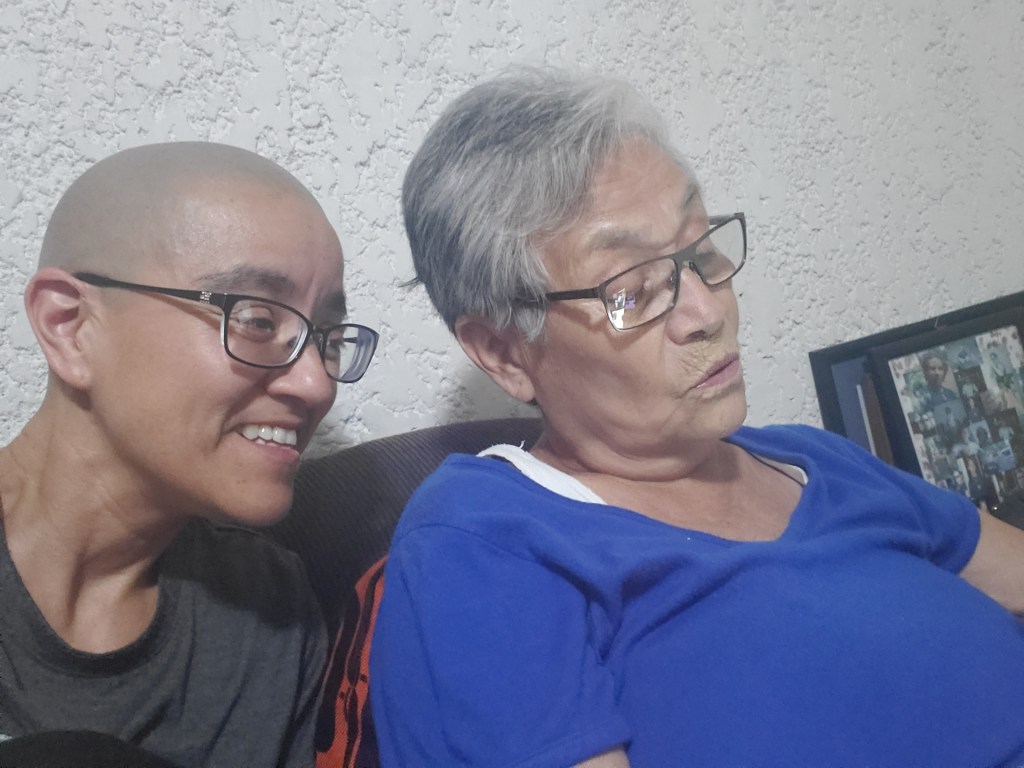
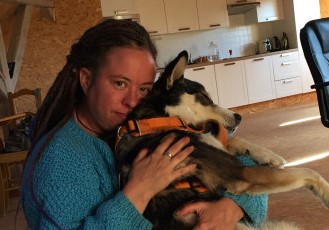
Me with my aunt, my dad’s eldest sister.

I was sometimes told I look like my grandmother on my dad’s side, and although it wasn’t meant as a compliment, I always welcomed it as such. I wanted to be like my grandma. She was a tough, no-nonsense woman who was light-hearted and spunky to the very end of her life. She had a serious expression on her face most of the time but would playfully and unexpectedly stick out her tongue at neighbor-friends when they passed by her house. She had well-developed patterns of good-natured banter with most people in her neighborhood. She was well-known and well-liked, and people also knew not to mess with her. So, if I could be thought to be anything like her, I was good with that.

She lived in Mexico and my family in the United States. In Mexico, even as a younger kid, we were allowed to move around town on the bus if my older cousin was with us. We always landed and stayed with my mom’s side of the family and usually only went to visit my dad’s side for an afternoon or two during the course of our time in Guadalajara, where my parents were from. I couldn’t wait to surprise visit my dad’s side of the family – my grandma, aunt, and grandpa who all lived together. We never announced our visit in advance; so it was fun for me to get to walk into the patio of their apartment complex and find my grandma, as usual, standing in the doorway of her front door, smoking. She was a businesswoman, always running a small business, selling basic grocery items from home, so her door was always open. And she was almost always right there, standing just outside her door, a serious expression on her face, and a smoke in hand.

Continue reading “My Father’s Daughter by Xochitl Alvizo”

Rosh Hashanah and the Goddess – redux – by Joyce Zonana

On our table, the crimson pomegranate seeds my mother had carefully separated from the skin glistened like jewels illumined from within; a pale green jam made from the grated flesh of a gourd, scented with rosewater and studded with thin slivers of blanched almonds, shone with a numinous, interior light. Bowls of black-eyed peas simmered with cinnamon and tomatoes were arrayed beside a delicately-flavored leek omelet, breaded and fried brains, roasted beets, fresh dates, apples, and—best of all—a previously untasted new fruit of the season: usually fresh fig or persimmon or prickly pear.

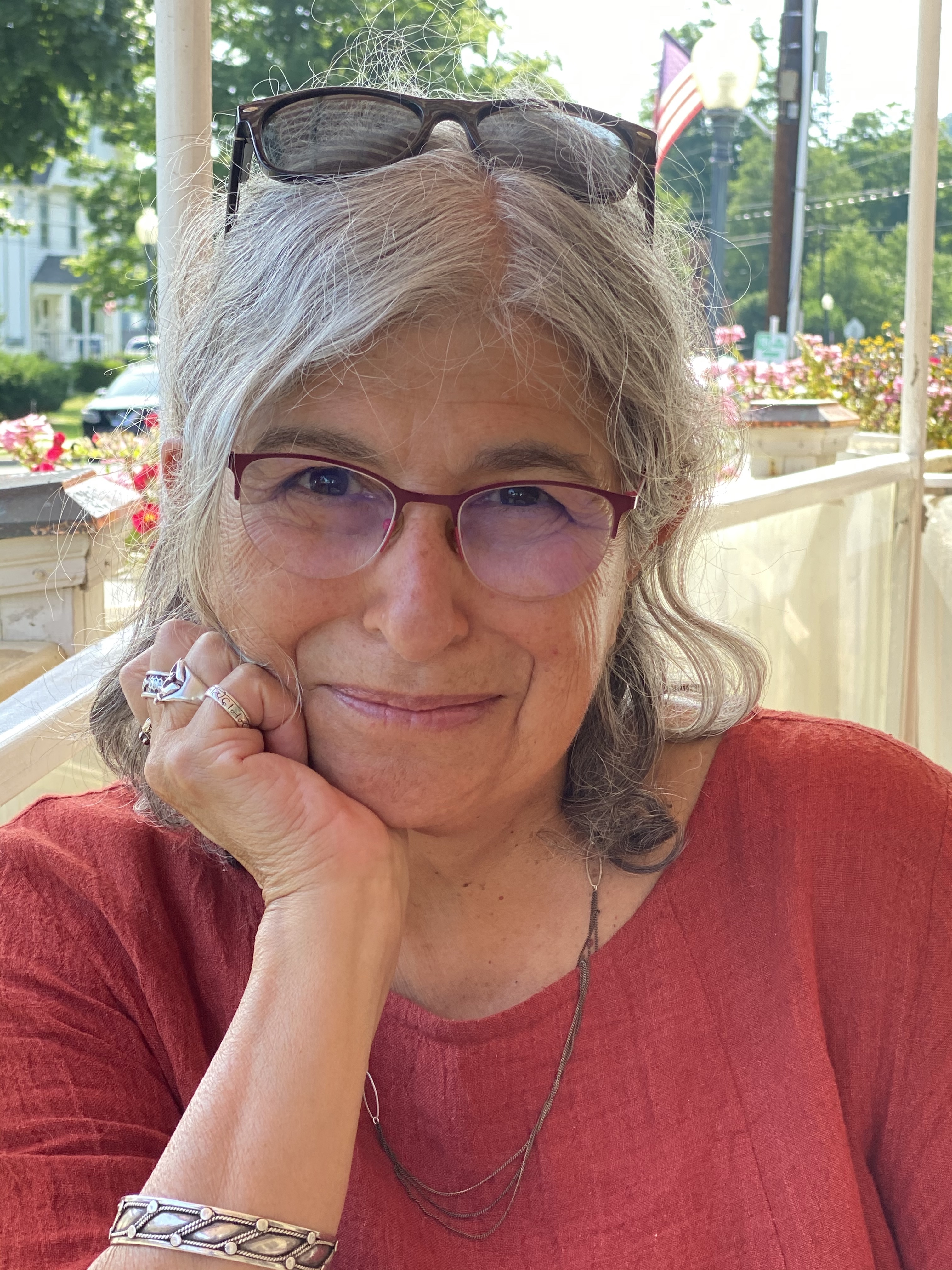
Joyce Zonana

When I was growing up in my Egyptian Jewish immigrant home, each of the High Holidays was imbued with sacredness, thanks largely to my mother’s efforts to create a meaningful gathering of family and friends. Around a long table, covered with an embroidered white cloth and set with sparkling silver and delicately fluted china, she served at each season the festive meal that made manifest for us the presence of the Divine.

My father, an Orthodox Jewish man, followed the tenets of his faith, praying each morning and attending synagogue each week. But it was my mother who brought to life the seasonal festivals that also characterize Judaism. As a child, I longed to pray with my father and I envied my brother and male cousins who studied and recited the ancient Hebrew; I resented having to polish silver and set the table. But today I’m grateful for my mother’s quiet teachings.

Passover had special meaning for us because our family’s departure from Egypt seemed a reenactment of the ancient Exodus. But Rosh Hashanah, that holy day without explanatory narrative, seemed even purer in its celebration of abundance and blessing, renewal and return.  Each year, I looked forward to the new moon in Tishrei that coincided with the arrival of autumn in New York and the beginning of the school year.

Continue reading “Rosh Hashanah and the Goddess – redux – by Joyce Zonana”

We Are Not Oppressed Because We Remember pt. 3: Sowing Seeds and Braiding Hair by Chasity Jones

Today, once again, I got to touch the earth!

While planting and constructing my indoor container garden, I thought about how my ancestors put seeds into their children’s hair so that in case they were taken away to live and die in chains, they would at least be able to sustain themselves with a piece of the motherland. Rice, okra, yams, watermelon, and so MANY more crops that would go on to make white slaveholding Americans so rich (passing their wealth to their descendants and zero reparations for the descendants of enslaved Africans), that they were willing to fight a war to sustain their evil practices of owning human beings as chattel (Check out High on the Hog Netflix documentary which was adapted from a book by Dr. Jessica B. Harris). Enslaved Africans brought these foods to the new world, a direct result of slavery.

As I wash my daughter’s hair (which for Black women and girls is a PROCESS!!), as I moisturize her hair, and as I braid my hair, I am thankful that no one has a right to my child and that I do not need to fear her enslavement. Instead, I manifest her revolutionary future to carry the torch of our ancestors. A Torch and a commitment to elevate our community and move the community forward. I leave it up to her to choose how she will carry that torch forward!

Continue reading “We Are Not Oppressed Because We Remember pt. 3: Sowing Seeds and Braiding Hair by Chasity Jones”

The Red Hand on the Cave Wall by Carolyn Lee Boyd

As I have gotten older, I find I am drawn more to non-anthropomorphic, inexpressable-in-words, nature, and everyday focused visions of the Divine. Whereas before my spiritual practice involved more rituals and circles, unusually indoors, with others, now I more often engage in solo quiet contemplation, outside in the wild when I can. I think more about ways of being rather than ways of doing and more about the small messages I want to leave to generations to come instead of  major accomplishments.  I feel as if I am contracting in towards the center of the spiral of my spiritual journey.

All over the world, very ancient cave art includes hand prints made by painting or blowing ochre around a hand or putting ochre on a hand and pressing it to the wall. Research has shown that about 75% of these were made by women, making them a very early form of feminist art. I wonder if some of them might have been made by women who had transformations and thoughts similar to mine. Here is a poem in the voice of such a woman. 

Continue reading “The Red Hand on the Cave Wall by Carolyn Lee Boyd”

We Are Not Oppressed Because We Remember by Chasity Jones

Many questions are asked of us as a community, but the answers which are so complex that we should be commended for even attempting to answer, are heard- if they are not interrupted- but rarely understood. As a Black mother and wife, I have accepted the fact that no one will understand my struggle outside of other Black mothers and wives. After being asked questions about how my community relates to slavery, I am convinced that no one outside of my Black American community will ever understand how slavery has impacted our lives, identities, family structures, trauma, and deaths. Furthermore, it has yet to be understood how the past of slavery continues to impact these areas as a people.

Firstly, although slavery has left an immense imprint on our racial memory, the Black community is not stuck in slavery simply because we bring it up. It is brought up because it is a part of our story and we should not be made to feel ashamed of it. Just because you are tired of hearing about it or uncomfortable does not mean that Black Americans should be made to feel as though should avoid speaking of our history. Some many pro-Black groups and movements emphasize and celebrate the achievements of Black Americans before, during, after, and despite slavery. However, these movements threaten the dominant culture, and much of their achievements are ignored or perceived as threats and terrorism. It is hard to educate ourselves and our children about our ancestor pre-enslavement because our legacy, history, sacred knowledge, and culture were destroyed and our memories were erased and replaced with the bible and colonialist interpretations of scripture. Many of these scriptures are interpreted to justify slavery and are still used to justify police brutality, mass incarceration, and psychological warfare on Black Americans. Nevertheless, we do what we can to celebrate ourselves and our heritage. In doing so, we cannot ever forget slavery.

Continue reading “We Are Not Oppressed Because We Remember by Chasity Jones”

Touch the Earth by Chasity Jones

I was recently asked how I reconcile being a Christian with also being a critic of Christian theology, traditions, and culture. I am asked this often and my answer is always the same. I have not found reconciliation and might always be finding a way to reconcile this – an endless cycle of trying to make my heart fit into a structure in which centers whiteness and domination.

This time is different though. When I was asked my mind immediately returned to the Earth. Nature. Creation. How I have always longed for a plot of sacred Earth of my own in which I would continually give birth to and create life in various ways. How so far this dream has seemed from my brown fingertips. Never in my almost twenty-nine years, have I imagined I would have the opportunity to own my own land. However, in the last few years since I worked and lived on a farm and have been manifesting with lunar energy and ritual that one day I would harvest and care for a land of my own. A land that I would pass down to my children. A land in which we would find God. A land which would sustain us.

Continue reading “Touch the Earth by Chasity Jones”

On Tazria-Metzora and Covid: Saving Lives, Saving Worlds, and Saving the World by Ivy Helman

It is often said that every year when you read the same Torah passages, you are in a different place, spiritually and otherwise.  Therefore, one will always be learning new meanings and discovering new insights from them.  No more is that true than in this week’s Torah parshah Tazria-Metzora.  

Tazria-Metzora (Leviticus 12:1- 15:33) is a double parshah containing a list of rules concerning ritual purity and impurity, mostly having to do with leprosy.  The parshah begins with the requirement for women a certain number of days after childbirth to immerse in a mikvah as well as offer animals for sacrifice at the temple.  Then, it commands the circumcision of a boy child at 8 days of age.  The next three chapters discuss an extensive list of what has to be all possible encounters with leprosy, including the infection of a home itself. The parshah prescribes various interactions between lepers, homes with leprosy, and the kohenim.  Mostly, the kohenim decide if the skin lesions people or houses have are leprosy, another skin disease or harmless.  If diseased or if the lesions are inconclusive, the people and houses enter quarantine. The kohenim also consult on whether a leper or house is healed and how to go about atonement.  For atonement, former lepers immerse in the mikvah and pay for the kohenim to offer specific sacrifices at the temple. Homes also undergo a type of ritual purification by the kohenim when they have been healed of leprosy. This double parshah ends with immersion requirements for emissions of semen and menstrual blood. 

Historically, there are two considerations, which I have discussed in other posts, to address first. To begin with, there is the ancient world’s understanding of disease as punishment for sin.  This sin can either be the sin of the diseased person or punishment from generations past.  For more about how this cycle of sin, punishment, repentance and atonement work as well as my thoughts on it, see here.    

Continue reading “On Tazria-Metzora and Covid: Saving Lives, Saving Worlds, and Saving the World by Ivy Helman”

Grown Little Girl, Grow Little Girl by Chasity Jones Selenga


I have newly found myself a wife and in the throes of motherhood. In many feminist circles, I have encountered anti-family and anti-wifehood sentiments. The understanding is that to be a wife, and, to be a wife that chooses to start a family, is an oppressive position to occupy as well as the antithesis of the feminist movement. Though I am not typically a fan of tough physical, emotional, soulful labor, these two positions have been the highlights of my life so far.

My daughter embodies both my husband and me, physically. However, she is and will become her own person-soul. She is so young, but her soul is eternal, and has experienced eternity. I am here to help her navigate remembering who she is. She inhabits the intersection of Blackness, divinity, femininity, and infinity. Motherhood has greatly increased my capacity of appreciation for women and what women are capable of doing. Especially from the intersection of Blackness and woman-ness. From the capacity to create, labor, and deliver life to the task of raising Black children in a country that would have them annihilated, emotionally traumatized, and made to accept they are inferior.

Continue reading “Grown Little Girl, Grow Little Girl by Chasity Jones Selenga”

Another Bow to Hestia by Carol P. Christ

I am not big on New Year’s resolutions, but this year I have vowed to change one of my habits. I have always been house-proud and love using my artistic flair to decorate my home in beauty. I have had a cleaning lady most of the time for many years, so my homes have been relatively clean. The living room and dining room have always been ready to receive guests. But I didn’t always do the dishes or clean the surfaces in the kitchen right away, clothes I had worn often sat on chairs before I hung them up, and I didn’t make the bed every day.

Now that I think about it, this habit goes back to my childhood and teen-age years, when my not picking up things in my bedroom was a bone of contention between me and my mother. Joyce Zonana wrote recently about how she rejected her mother’s role as homemaker and “dutiful” wife when she was young. Only now during the Covid crisis, she writes, is she beginning to enjoy the traditional women’s work of cooking regularly and knitting.

When I was a teen-ager, I sewed all of my clothes (both because we didn’t have a lot of money and because, as I was very tall and very skinny, most ready-made clothes didn’t fit). I was a second mother to my baby brother. For me, those were the fun parts of women’s work. But I hated washing dishes and cleaning the house, and I did not learn how to cook. I suppose I recoiled from the repetitiveness of those tasks. I was also aware that my father ruled the roost, and though I would never have criticized him, I knew that one of my mother’s jobs was to please him. Laura Montoya’s meditation on her grandmother’s life in a recent blog reminds us that the failure of homemakers to meet their husbands needs or wants can lead to violence.

When I went away to college, I learned to disparage all of women’s work, including the parts of it I had loved. I was taught that the “life of the mind” was the highest pursuit and that the “life of the body” was secondary. I now see this aspect of university culture as brainwashing of the highest order. Continue reading “Another Bow to Hestia by Carol P. Christ”

Homebound by Joyce Zonana

When my parents left Egypt, they left behind everything they’d grown up with, all the objects that carried their deepest associations and memories. They taught me to scorn such “things”—what others value as mementos or souvenirs—rightly reasoning they can be lost in a moment. But while we have them, it is lovely, I’m learning, to let the spirits embedded within them, the memories and feelings they evoke, surround and comfort us. As I move through this house, I feel bound to my own and others’ histories, embedded in a rich and complex life that nurtures and sustains me. And as I sit still and knit, I sense that I am knitting (knotting) up the by now long, loose threads of my own life, shaping them into a coherent and satisfying whole.

Joyce ZonanaWhen I was growing up, home was the last place I wanted to be. It’s not that ours was an abusive or angry household: both parents loved me and my mother labored to create a calm, clean space to contain us all. It’s just that I felt suffocated.

Part of the problem was that we were immigrants. My parents were struggling to find their way in an alien culture, and, with little else to hold onto, they clung to their customs and traditions. I wanted to be “American,” to mingle with classmates, to venture into the vastness (New York City!) just beyond our door. The Middle Eastern culture from which we hailed had strict rules for women and girls, and my mother expected me to follow them. She herself was an excellent cook, a creative seamstress and scrupulous housekeeper, a devoted and dutiful wife. I rejected all of it, refusing to cook, ripping out seams, balking at my weekly chores of dusting and vacuuming and ironing. Instead I dreamt of life as a writer, a renegade, an outlaw. My role models were hobos and witches and gypsies; more than anything, I yearned to be free, longing to “walk at all risks,” like Elizabeth Barrett Browning’s Aurora Leigh.

Continue reading “Homebound by Joyce Zonana”