Second Class Citizen by Sara Wright

Second Class Citizen


When he backed me

up against the tree

inching towards me

menacingly

with his big powerful car

I couldn’t believe

what was happening.

I was holding the space

for a car full of dogs

waiting to park

just behind him.


He got out of the car

And I said

You can’t do this

this spot is taken.

Six feet tall, he sneered

You can’t save spaces

in a parking lot.

Continue reading “Second Class Citizen by Sara Wright”

Pig/Sow – Animal Spirit Guide by Judith Shaw

judith shaw photoPigs, who were called boars in the wild, were the first animals to be domesticated. Pig domestication occurred about 9,000 – 10,000 years ago in two places – central China and Neolithic Anatolia in modern day southwestern Turkey.

Around 7,000 years ago when the Anatolians moved into Europe with their domestic animals and plants, they interacted with the indigenous Mesolithic hunter-gatherers and facilitated an interbreeding of their domestic pig and the local wild boar. The European swine descends from this interbreeding.

The mythical and cultural associations assigned to Pig in all its forms is very contradictory – sacred and beneficial to some, demonic and unclean to others. For our purposes here, we will concentrate on the positive associations. Continue reading “Pig/Sow – Animal Spirit Guide by Judith Shaw”

Sweet Honey Bee – Animal Guide, by Judith Shaw

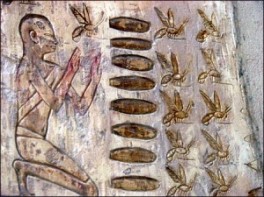
judith shaw photoBees have been part of the human community since the days of prehistory. Cave paintings created by Neolithic people in Spain from between 6000 and 8000 BC show them gathering honey from wild bee colonies.

The earliest record of beekeeping in human-made hives dates back to Egypt of 2400 BC.

egyptian bee keeper
The Egyptian Bee Keeper

Bees themselves have been around for even longer than their association with humans. The oldest bee fossil was found in Myanmar enclosed in amber. It is 100 million years old.

Worldwide, Bee is a symbol of good luck, abundance, hard work and community. The ancients believed that the bees’ ability to make honey was a gift from the divine. Bees who give us their sweet honey –  used for food, drink and medicine – are found in myth and story all around the world.  Continue reading “Sweet Honey Bee – Animal Guide, by Judith Shaw”

Swan – Guide to Love and Spiritual Evolution by Judith Shaw

judith shaw photoSwan glides gracefully across the mirror-like surface of the lake, stirring sensibilities of purity, loyalty and love in our hearts. Her long, curved, delicate neck reflects in the water as gentle ripples spread out behind her. Swan evokes feelings of peace and can signify self-transformation, intuition, sensitivity, and the soul.

Continue reading “Swan – Guide to Love and Spiritual Evolution by Judith Shaw”

Fox Wisdom – Cunning, Camouflage and Persistence by Judith Shaw

judith shaw photoFox, as a member of the Canidae family, is related to wolves, jackals and dogs. But unlike these animals who hunt in packs, fox hunts alone.

Fox is intelligent, clever and cunning. While it is persistent, fox is gentler and less aggressive than wolf. Fox is associated with feminine magic, offering the power of the feminine to both men and women.

Continue reading “Fox Wisdom – Cunning, Camouflage and Persistence by Judith Shaw”

Querying in the Context of Religion and Science by Sara Wright

How do we respect materialistic/mechanistic science – the myth of our time – when it continues to use non-human sentient beings for it’s own gain?

How do we respect religions for the harm or damage that these beliefs may cause for animals, plants and people who live on the Earth?

These are important questions, and for me the two are intimately related. Science and religion are two lenses humans use to perceive the world. Continue reading “Querying in the Context of Religion and Science by Sara Wright”

A Feminist Retelling of Noah’s Ark by Trelawney Grenfell-Muir

My daughters came to me after Sunday School one day, concerned about a story they had heard in which God drowned almost everyone on Earth. So I sat down and thought about why a community might want to tell that story, and what valuable wisdom might be lifted from it for my children. Here is what I told them:
God/ess  has  many  faces,  which  help  us  understand  different  things we  need  to  know  at different  times.  Sometimes we think of God/ess  as  Crone,  an  old,  old  woman  crowned  with  silver  hair  as  an  emblem  of  her  wisdom,  who helps  us  learn  to  let  go  of  anything  that  is  holding  back  the  wellness  of  our  community  and ourselves.  Continue reading “A Feminist Retelling of Noah’s Ark by Trelawney Grenfell-Muir”

Dragonfly, Guide to Transformation and True Sight by Judith Shaw

judith shaw photoDragonfly, dragonfly darting quickly hither and yonder, up and down, left and right –  a transparent shimmering spark with effervescent wings, representing the dreamtime and the illusionary nature of reality.  Dragonfly, dragon – both immortalized in mythology worldwide.

Continue reading “Dragonfly, Guide to Transformation and True Sight by Judith Shaw”

On the ‘Naturalness’ of Inequality by Ivy Helman

29662350_10155723099993089_8391051315166448776_oIn some regards, life on Earth seems to depend on some basic inequalities.  For example, differences in size, height, strength, speed and endurance advantages some and disadvantages others.  Depending on another for survival is another type of inequality. Being able to adapt to change increases one’s likelihood of survival as well.  

In this regard, inequality is natural, a normal part of existence.  In fact, the exploitation of such inequalities supports and perpetuates life on this planet.   Darwin said as much. Evolutionary theory does as well. At one point, we, homo sapiens, replaced our Neanderthal cousins.  Lions kill and eat gazelles. Some iguanas in the Galapagos Islands were able to become great underwater swimmers in order to reach edibles; those who couldn’t died. Continue reading “On the ‘Naturalness’ of Inequality by Ivy Helman”

Elen of the Ways and the Antlered Goddess (Part 2 of 2) by Deanne Quarrie

Deanne QuarrieClick here to read Part 1, published Sunday March 18.

Imagine a fairy chain stretched from mountain peak to mountain peak, as far as the eye could reach, and paid out til it touched the high places of the earth at a number of ridges, banks and knowls. Then visualize a mound, circular earthwork, or clump of trees, planted on these high points, and in low points in the valley, other mounds ringed with water to be seen from a distance. The giant standing stones brought to mark the way at intervals, and on a bank leading up to a mountain ridge or down to a ford the track cut so deep as to form a guiding notch in the skyline as you come up.
– The Old Straight Track by Alfred Watkins.

The Deer Goddess of the Ancient Caledonians were called Colossal Old Women. They were all local spirits, all with different names.  Their stores were similar, however as they went with the herds, milked them in their respective districts. Their deer were called “fairy cattle.” The deer were always in the care of the female. In many myths the fairy woman transforms herself into a deer, often antlered.

The bean-sidhe are mistresses of the place and are called the Cailleach or Cailleach Mhor (Huge Od Woman). They are the giants of Celtic myth who sang to the deer calling them “darling deer” or “beast of my love.”  All these giantesses are wild, showing no sign of domestication and they date back to Paleolithic times. Continue reading “Elen of the Ways and the Antlered Goddess (Part 2 of 2) by Deanne Quarrie”