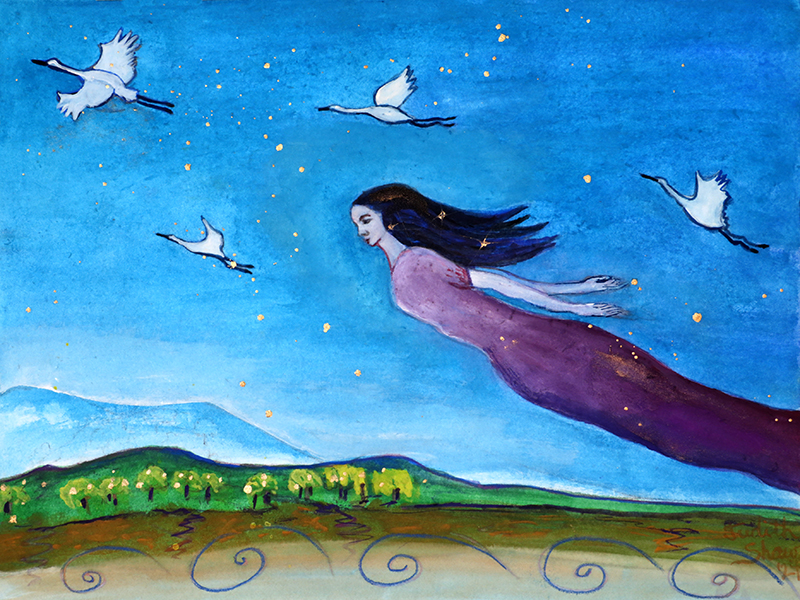
Women Fly Free by Judith Shaw

Artists tend to develop their own visual language over the course of a career, returning again and again to certain motifs. That’s certainly the case for me with trees, women and goddesses, doorways and passages, ancient symbols, flowers, and animals — in particular birds — emerging again and again.

Flying Free by Judith Shaw
Continue reading “Women Fly Free by Judith Shaw”

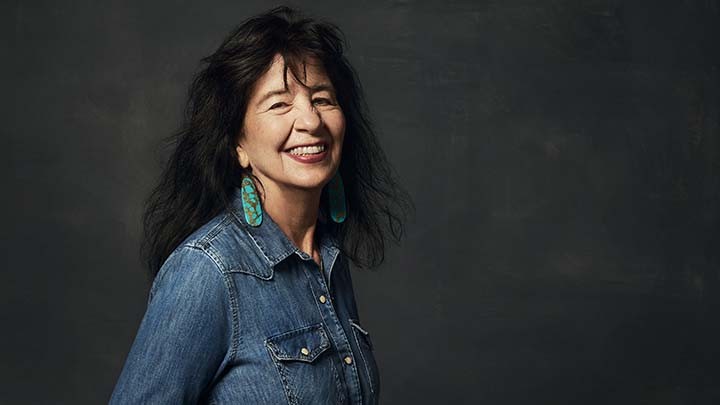
POET WARRIOR BY JOY HARJO: HEALING HEARTS AND NATIONS by Maria Dintino

Moderator’s Note: This post is presented as part of FAR’s co-operation with The Nasty Women Writers Project, a site dedicated to highlighting and amplifying the voices and visions of powerful women. The site was founded by sisters Theresa and Maria Dintino. This was posted on their site in 2021 and then again on March 21, 2023. You can see more of their posts here. 

“MY INNATE IMPULSE IS HEALING, WHICH IS ALSO STANDING UP FOR JUSTICE, WHICH CAN HEAL HEARTS AND NATIONS.” – JOY HARJO

Healing hearts and nations is what Joy Harjo does. Standing up for justice is what Joy Harjo does. Joy Harjo is a teacher and leader for our times, for all times.

When she asks this question in her book, Poet Warrior:

“What do I do with this overwhelming need for justice in my family, for my tribal nation, for those of us in this country who have been written out of the story or those who appear to be destroyed or perverted by false story?” (46),

Continue reading “POET WARRIOR BY JOY HARJO: HEALING HEARTS AND NATIONS by Maria Dintino”

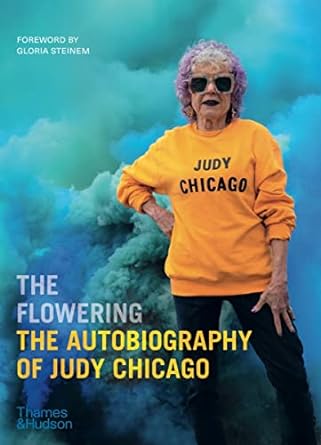
Judy Chicago, Feminist Trailblazer by Joyce Zonana and Janet Maika’i Rudolph

“Instead of looking to the male world for approval, I had to learn to rely on my own instincts. In some strange way, the rejections I faced strengthened me, but only because they forced me to learn to live as I saw fit and to use my values and judgment as my guides.”
The Flowering: The Autobiography of Judy Chicago 

Available here.

Janet: I live near New York City and am fortunate to be close to many museums. The New Museum has been showing an exhibit by Judy Chicago that takes up the entire facility of four floors. And it is remarkable. Not only is the breadth of her work astounding but so are the stories of how she has had to fight to be accepted in a man’s world of art. Joyce Zonana first recommended that I go. This blogpost came about as part of a discussion between the two of us.

Continue reading “Judy Chicago, Feminist Trailblazer by Joyce Zonana and Janet Maika’i Rudolph”

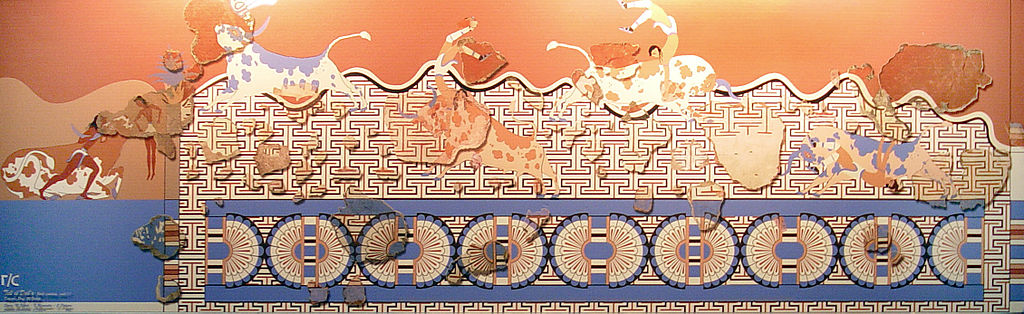
Imagine a World of Beauty for Beauty’s Sake by Carolyn Lee Boyd

Reconstructed Minoan Frescoe: Martin Dürrschnabel, CC BY-SA 2.5 <https://creativecommons.org/licenses/by-sa/2.5&gt;, via Wikimedia Commons

Imagine a world where beauty is revered just for bringing pleasure and joy; where buildings abound in graceful, naturalistic, lively renderings of animals and plants; where the human body is magnificent art; where everyday objects for all are ornamented with complex, graceful imagery. Imagine a world where “beauty” is not a narrowly defined style of attractiveness or an attribute of works created by a small elite, but a revelation of life’s joy created by all, an expression of delight in the Earth, and a bridge to the worlds within us. If we look back across human history, we will find all these expressions of “beauty for beauty’s sake,”

From our earliest millennia, “where you find humans, you will find art,” says pre-historian Jean Clottes (Marchant). People carved zig zags in shells 500,000 years ago (Handwerk). About 164,000 years ago, people left behind in South African caves ochre and pierced shells, perhaps for jewelry (Marchant). Artists created the oldest cave paintings yet found, stunning in their realism and movement, in Spain 65,000 years ago (Handwerk).

Continue reading “Imagine a World of Beauty for Beauty’s Sake by Carolyn Lee Boyd”

Finding Happiness Through Nature and Creativity by Judith Shaw

We live in difficult times. Daily we hear of culture wars, real wars, mass shootings, floods, fires and multiple other climate disasters and human clashes. 

How on Earth can one maintain a positive outlook and experience genuine happiness? I’ve discovered a few activities that effectively pull me out of dwelling on past challenges or worrying about future uncertainties. These activities consistently guide me back to a state of inner peace and contentment.

Continue reading “Finding Happiness Through Nature and Creativity by Judith Shaw”

Every Atom of Our Being by Annelinde Metzner

In the vibrant, sensual, lush season of Beltaine, when all the world (at least in our hemisphere!) awakens to greenness, rebirth and new life, I’m pulled to express myself through the body.  The Goddess is our body, and the Earth’s body, and that of all beings.  The sacred is in every atom of our being.  The snake, and the apple, and the tree are all symbols of Her, and She gives us the many gifts of our body without shame.  She loves to hear us singing back, as She sings to us.

Continue reading “Every Atom of Our Being by Annelinde Metzner”

From the Archives: Archy and Mehitabel by Barbara Ardinger

This was originally posted on December 1, 2019

Archy the Cockroach and Mehitabel the Cat were introduced to the world in 1916 by Don Marquis, a columnist for the New York Evening Sun. Marquis was more than a mere columnist; he was a social commentator and satirist admired by nearly every famous writer of the first quarter of the 20th century. Franklin P. Adams, for example, said Marquis was “far closer to Mark Twain than anybody I know” (see note).

Continue reading “From the Archives: Archy and Mehitabel by Barbara Ardinger”

Legacy of Carol P. Christ: GODDESS AND SACRED COW: A RE-EXAMINATION OF THE MYTHOLOGY OF THE SACRED BULL

This was originally posted on August 5, 2013

Most archaeologists and visitors to museums assume that when they see a horned bovine, they are faced with the image of the male God or the image of the bull sacrifice.  In the minds of many, these two are one, as we have been taught that the male God who was the consort or son-lover of the Goddess was sacrificed. Yet horned Goddesses are not infrequent in the history of religions and Hindus still revere the sacred cow.  

Cattle have played an important role in human life from the beginning of agriculture.  Cows provide milk which is also turned into butter, cheese, and yogurt.  Most of the young males and some of the females are killed for meat or leather, while a few males are kept to impregnate the females.  Though the “raging bull” is the lens through which most of us think about mature male bovines, I have been told by a friend who raised cattle that in fact bulls are for the most part gentle and even sweet–though of course they are also potentially dangerous.

Continue reading “Legacy of Carol P. Christ: GODDESS AND SACRED COW: A RE-EXAMINATION OF THE MYTHOLOGY OF THE SACRED BULL”

Love and The Last of Us

I was excited and thought I knew what to expect. I know what happens in the game after all. But after watching episode three, Long, Long Time (aired Jan. 29, 2023), I found myself considering what seems like something new in a zombie story as well.

Warning: Contains spoilers for The Last of Us video game and HBO series! (Oh, and for The Walking Dead… And maybe a few other zombie films too.)

I remember when Naughty Dog released the first iteration of its popular game, The Last of Us (2013) because a friend of mine worked with the sound design team for the game. This friend started out as a game tester and through years of effort, was eventually creating game sound and dialogue. The release was a BDF for his personal success and at the time, felt like something new in gaming: it was realistic, cinematic, and emotional. (And incidentally, it was reviewed very, very well.) This past month HBO released The Last of Us as a TV series. I was excited and thought I knew what to expect. I know what happens in the game after all. But after watching episode three, Long, Long Time (aired Jan. 29, 2023), I found myself considering what seems like something new in a zombie story as well.

Continue reading “Love and The Last of Us”

From the Archives: Brigid, Goddess of Healing, Poetry, and Smithcraft by Judith Shaw

This was originally posted on January 31, 2013

Brigid, the Celtic Goddess of Healing, Poetry, and Smithcraft, begins her reign on Imbolic, February 2, the midpoint between winter solstice and spring equinox. On this day the ancient Celts held their Fire Festival in honor of Brigid and the growing light. In Scotland, as recently as the mid-twentieth century, houses were cleaned and the hearth fires rekindled on February 2, to welcome in  Brigid.  Remnants of this festival are found in America today on Groundhog Day.

Like the Cailleach, She existed in many places and  was known by many names.  The Irish called her Brighde; she was Bride in Scotland,  Brigantia in Northern Britain, and Brigandu in France.  Some called her Brid, Brig or Brighid.  Later she was transformed by Christianity into Saint Bridget.  Her older name was BREO SAIGHEAD.   Her name has various interpretations, many relating to fire – “Power,” “Renown” “Fiery Arrow of Power ” “Bright Arrow”, “The Bright One”, “The Powerful One”, “The High One” and “The Exalted One”.

Continue reading “From the Archives: Brigid, Goddess of Healing, Poetry, and Smithcraft by Judith Shaw”