Feminist Freedom: Finding, Following, and Painting Freya Stark by Angela Yarber

“There can be no happiness if the things we believe in are different from the things we do.” –Freya Stark

angelaOk. I’ll admit it. We all have our secret indulgences, don’t we? It is Valentine’s Day, after all. Shouldn’t we indulge a moment? After years of having my mind mired in the esoteric quandaries of the academy and the heart-yearnings of ministry, I needed an outlet, an escape. And when I couldn’t literally escape to some beautiful far-flung land via travel, I found my freedom nestled up with a good travel memoir. Travel essays, memoirs of finding oneself in another land, became my way of wandering, wondering, and learning about the world. A shelf full of dusty travel essays became my secret indulgence.

Along the way I decided to support feminist and women writers, pouring through every edition of The Best Women’s Travel Writing, sometimes in one sitting. Over and over I found these thoughtful writers referring back to one person, the pioneer of women’s travel, the founder of this far-flung freedom. Her name was Freya Stark. Years ago I began researching her life, reading The Passionate Nomad, and some of her many writings based on her travels all over the world.

Born in Paris in 1893, she was one of the first European women to travel and write about the Middle East, adding Arabic and Persian to the English, French, Italian, and Latin she already knew. There are tales of her riding camels through rebel territory, taking refuge in Bedouin camps, diving into shark-infested waters off the coast of Turkey simply because the water called to her and was too beautiful to avoid immersion, or in her old age (she lived to age 100), driving wildly in her hand-crafted “camper” through the Italian countryside. She lived boldly, going where few women had gone. She lived wildly, caring little about the restraints of decorum. She claimed, “It is the beckoning that counts, not the clicking latch behind you.” It’s no wonder that she inspired and empowered the many women travel writers that have followed in her fearless footsteps. Continue reading “Feminist Freedom: Finding, Following, and Painting Freya Stark by Angela Yarber”

Painting Women from Judges – Part 1: Jephthah’s Reflective Daughter by Melinda Bielas

Melinda BielasThe story of Jephthah’s daughter – found in the Hebrew Bible, Judges 11:29-40 – is a difficult story to read. The first time I read it, I was in my Christian high school Bible class and I could not understand why our teacher did not address the violence done by a father to his daughter. In my experience, Christians dismiss much of the violence done to women in the Hebrew Bible as evidence that ancient fathers, brothers, and husbands really did not care for their daughters, sisters, and wives. Since today men love the women in their lives, the ancient problem is no longer an issue, and we can continue with more pressing issues – or so the unspoken logic goes.

However, some feminist scholars – such as myself and Dr. Tammi Schnider – argue that it was common for fathers to love their daughters in the Hebrew Bible, and Jephthah is no exception. His daughter is his only relative in the text, and presumably the only person impatiently waiting for him to return from the war he led. Yet, because of the vow he makes to the deity – a vow the deity does not request or acknowledge – he sacrifices his only loved one. Why would he make such a vow? Why would his daughter go along with it? These are two of the questions I could not help but yell as I struggled with the text. Continue reading “Painting Women from Judges – Part 1: Jephthah’s Reflective Daughter by Melinda Bielas”

Painting Lottie Moon, Redeeming Lottie Moon by Angela Yarber

angelaI never imagined I’d paint her. Though I was not raised in church, I have vivid memories of worshiping in Southern Baptist Churches, churches where women’s voices were not permitted behind the pulpit, churches where women could never dream of ordination, churches that damned LGBTQ folks to hell with a pound of a fiery fist on a well-worn bible perched atop an angry pulpit. Canonize a Southern Baptist woman into the sainthood of Holy Women Icons? No, thank you.

Though I am an ordained Baptist minister myself, it’s important to remember that there is a vast spectrum of belief and practice when it comes to the Baptist church. Because our polity is non-hierarchical and we are anti-creedal, one cannot easily say, “All Baptists believe ______ or all Baptists practice _______.” Whether you are as conservative as the Southern Baptist Convention or as liberal as the Association of Welcoming and Affirming Baptists, we all share some core Baptist distinctives: the separation of church and state, believer’s baptism, the autonomy of the local church, freedom of conscious, and the priesthood of all believers. Learning of these distinctives as a young feminist searching for a faith to call my own, I was immediately drawn to the core Baptist tradition. They reject hierarchy. All are supposed to be equal. It is up to the individual conscious to determine what one believes. And it is up to the individual church to determine how that particular community of faith will practice those beliefs. It is feminist to its core. Southern Baptists feel otherwise, which is why they refrain for ordaining women and claim that they should be submissive to their husbands.

Continue reading “Painting Lottie Moon, Redeeming Lottie Moon by Angela Yarber”

Twelfth Night: Men’s Dance Rituals in Northern Greece by Laura Shannon

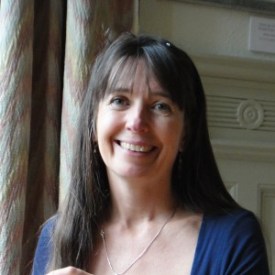
Laura Shannon square crop

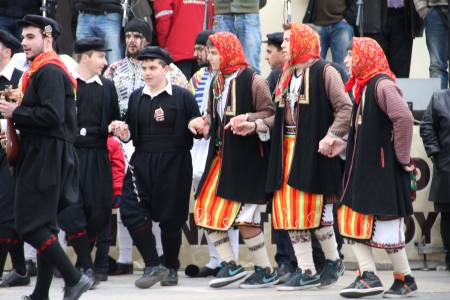
The twelve days between Christmas and the New Year are still held to be holy days in Greece, a mystical and dangerous time when mischievous spirits emerge from the underworld, seeking to wreak havoc in the human realm. On the 6th of January, Theophania or Twelfth Night, masked men in goatskins and sheepbells dance through the streets to dispel these spirits, awaken the fertility of the earth, and ensure a good year. The name Theophania, literally ‘the appearance of god’, here refers to the return of the sun after the winter solstice, and fire and light are very important to this holiday.

The rituals I describe here come from six tiny villages in the region of Drama, just south of the Rhodope Mountains, close to the border between northern Greece and Bulgaria. Similar rituals featuring masked, bell-wearing men appear all through the Balkans and Central Europe as far as the Swiss Alps. They will dance through the village streets, in the cemetery, and in front of every house, in a ritual of blessing and catharsis which has roots in age-old worship of Dionysus, god of fertility and wine.

For me, who came to Greece to study women’s traditional songs, dances and costumes, it makes a refreshing change to observe ritual customs almost exclusively performed by men. These activities take place in winter, either at Theophania or during Carnival, in contrast to spring and summer rituals which are chiefly in the hands of the women.  However, as we shall see, in order for men to assume ritual abilities and responsibilities normally ascribed to women, some of the men must dress in women’s clothes.

Here I would like to mention Carol Christ’s recent analysis of essentialism in feminist theory in her excellent post of September 15. In Carol’s words, the essentialist view holds that the “‘essential qualities’ of a thing (a table, a horse, a woman, or a man) precede the ‘existence’ of any individual in the group to which it belongs; these qualities are universally—always and everywhere—expressed by members of the group.”

Carol and I both live in Greece, where, as in many other parts of the world, tradition assigns quite different tasks and attributes to men and to women. Without reawakening the essentialist discussion here, I would just like to say that modern-day feminists do not have to agree on whether women and men are essentially or inevitably different; however, in order to understand Balkan culture, we do need to realise that people here believe in these differences and have done since ancient times.

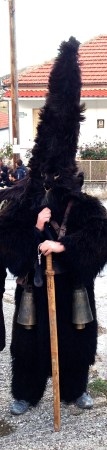
Angelos Keras, the Archigos (leader) of the Arapides in Monastiraki (photo: Spyros Taramigos)
Angelos Keras, the Archigos of the Arapides in Monastiraki

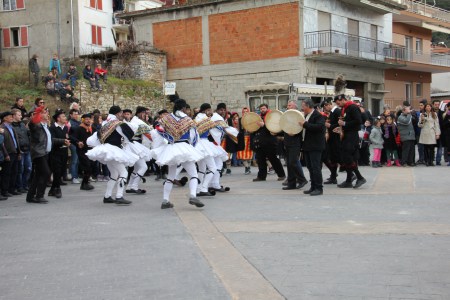
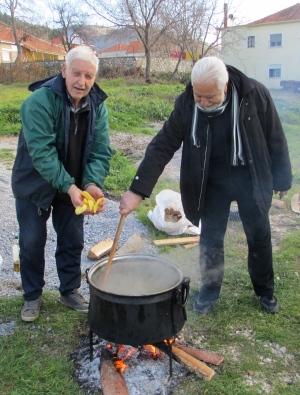
Back in Drama, in the village of Monastiraki, preparations have been underway for days. The night before the big event, a designated house – half-ruined, but still with a roof intact – slowly fills with the joy of friends and acquaintances greeting one another. Red wine flows, and traditional goat soup is served free to all. A fire has been kept burning here continuously throughout the twelve nights of Christmas, producing sacred ash with healing and protective powers. Musicians play through the night, producing archaic sounds on the Macedonian bowed lyra or kemene, accompanied by large goatskin tambourines called daheres. These are the only instruments. The overall effect is all the more hypnotic as the musicians play in absolute unison; even the singing is monophonic, in a musical structure intended to emphasise old values of community and coherence.

Meanwhile, people dance the same few dances over and over. As on all ritual occasions, the repetition of familiar simple step patterns frees the dancers to focus on the inner work of igniting their own good mood and raising good energy (kefi) to bless the community.

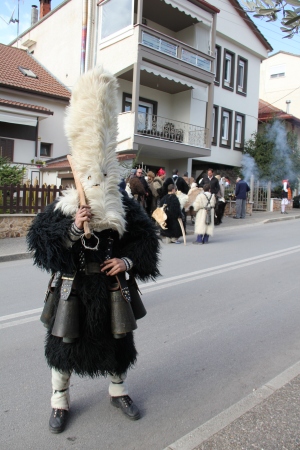
After dancing and drinking all night, the male celebrants help each other dress in the early hours of dawn. They are truly fearsome in shaggy dark skins, tall conical masks, and wide leather belts from which swing three pairs of heavy double bells. One of their names, koudonofori, means bell wearers; they are also called Arapides, the Black Ones or Moors.

Looking behind the apparent racism of the terminology, these ritual dancers blacken their skin with burnt cork both to invoke the power and protection of the sacred fire, and also in order to enter the realm of darkness. Here, the dark is seen as the repository of the earth’s fertile powers, which their bells and dances aim to awaken, as well as the realm of things ‘not seen’ , such as the spirits known as kallikantzari, which pose a threat to the new light and the new year. They themselves must go unseen, in masks and disguises, to enter this realm.

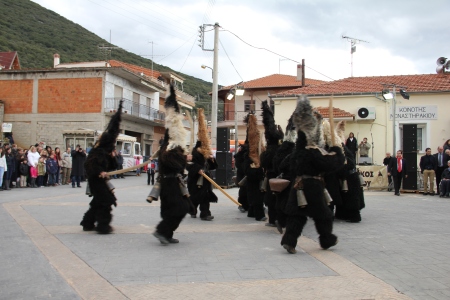
'Arapides', masked ritual dancers at Theophania (January 6) in Monastiraki (photo: Lenka Harmon)
‘Arapides’, masked ritual dancers at Theophania in Monastiraki

Brandishing long wooden swords, this group – known as a tseta – appears fully capable of driving out any number of kallikantzari. The phallic swords and headdresses leave one in no doubt that the Theophania rituals are men’s rituals, yet the ability to give new life, to enter the realms of the dead, and to bestow the blessing of fertility are essentially women’s powers. To claim these powers, some of the men must dress as women, as Dionysian revellers have done since ancient times. These are theGilinges, or Brides. 

Pappoudes ('Grandfathers') with lozenge-shaped beaded amulets, and Gilinges ('Brides') in Ksiropotamos (photo: Lenka Harmon)
Pappoudes (‘Grandfathers’) with lozenge-shaped beaded amulets, and Gilinges (‘Brides’) in Ksiropotamos

Wearing women’s clothing may be a means for men to temporarily gain access to the realms of life and death, where normally only women may go, or to symbolically give birth to the life-affirming fertility and joy which bring renewal at this dark and hungry time of the year. (Men wearing women’s clothing for ritual purposes are depicted in archaeological finds dating back to the 5th C. BCE; I think we see it today in the ecclesiastical robes worn by Christian priests.) In an additional affirmation of what is seen as women’s power, the Brides’ costume is rich in goddess embroideries, while all the members of the party wear beaded amulets in the lozenge-shaped symbol of female fertility going back to Neolithic times. Goddess symbols are also stamped on many of the bells.

As well as the Arapides and the Brides, the tseta includes Pappoudes or Grandfathers in Thracian men’s traditional dress, and Evzones or Tsoliades wearing short white pleated foustanella kilts and thetsevres, a special garment made of twelve large white kerchiefs sewn into a triangle densely fringed with beads, sequins and coloured threads, which takes four months to prepare.

Musicians and 'Tsoliades' ritual dancers in Monastiraki (photo: Lenka Harmon)
Musicians and ‘Tsoliades’ ritual dancers in Monastiraki

There is also an occasionally appearing Bear, who some say represents ancient worship of the Goddess Artemis.

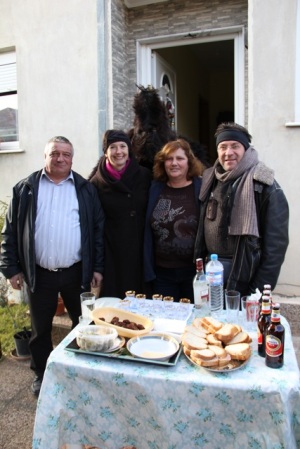
As they journey together through the village, the bell-wearers leap and stamp, swinging their bells back and forth in an apotropaic din – this will indeed awaken the earth! – almost drowning out the eerie sound of the lyras and daïres. The Evzones dance with athletic half-turns which send their short kilts sailing up to their waist, emphasising (so I am assured) the fertile power of the male generative organs, without revealing the organs themselves.  At every house the entire tseta is rewarded with abundant food and drink, in the living tradition of sacred hospitality which is the most powerful blessing of all.

Hospitality to strangers in Ksiropotamos (photo: Lenka Harmon)
Hospitality to strangers in Ksiropotamos

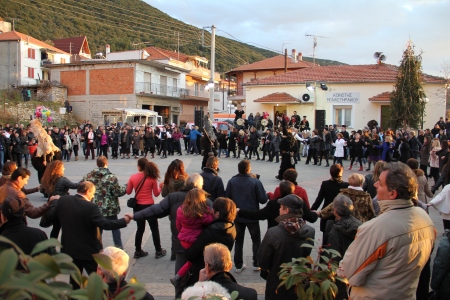
By three o’clock, the whole village gathers at the plateia to dance. Hundreds of people spiral into a single circle with one leader, keeping the large centre open as a sacred space for the tseta to enact ancient rituals of death and resurrection, plowing and planting, and the hieros gamos or sacred wedding. The dancing goes on until dusk and then continues at a taverna through a second consecutive night.

IMG_4982 - 4
Everyone joins in the great circle dance in the plateia of Monastiraki

Each village has its own variation of the Theophania rituals. In some places, children and women also participate: in Ksiropotamos young girls dance in traditional costume, while in Petrousa, all the dahereplayers are teenage girls. Some traditionalists view this change with unease, but I must confess my pleasure at seeing thirteen young women lined up like priestesses of Cybele from the time when the drummers were women. Here too, people dance at crossroads, springs, sacred trees and finally around an enormous bonfire.

Cauldrons at the crossroads in Ksiropotamos (photo: Laura Shannon)
Cauldrons at the crossroads in Ksiropotamos

Fire is important in all the Theophania rituals, and cauldrons on open fires are a key part of the festivities. This is another symbol of women’s power adopted on this occasion by men – traditionally, women cooked in pots; men roasted meat over an open fire. In Petrousa, the Dance of the Cooks can still be seen. Although it is no longer danced around the cauldrons themselves, the symmetrical step pattern still focuses the energy or ‘fire’ of the dancers in a particular way.

It seems to me that these fire-focused rituals hint at the unnamed presence of the Goddess Hestia, whose domain is centred on the hearth, source of light, warmth, food and all that is beneficial to the home. The nikokira, the lady of the house, was seen since ancient times as Hestia’s priestess. Her role is to tend the sacred fire through practical and ritual work and to literally focus its brilliance (estiazo, fromHestia, means ‘to focus’) so that it may bless the household and all its inhabitants. In ritual activities such as the Theophania, through the mediation of men dressed as women, this focused fire can be brought once a year from the private space of the home – the realm of the women – into the public space of the village, the realm of the men.  This union of men’s and women’s fertile powers is the hieros gamos, the holy spark of blessing which ensures health, wealth, happiness and abundance for all in the coming year.

Nikos Papadimitriou, an Arapis in Ksiropotamos (photo: Lenka Harmon)
Nikos Papadimitriou, an Arapis in Ksiropotamos

Continue reading “Twelfth Night: Men’s Dance Rituals in Northern Greece by Laura Shannon”

Painting for the Earth by Jassy Watson

JassyI have spoken about the Social Responsibility of the Artist on numerous occasions. This blog approaches similar subject matter, but in relation to using art as a potent tool for change and as a platform for raising awareness of important environmental and ecological issues that all of humanity is currently faced with.

All forms of art have the potential to be tools for healing. I believe that through the creative process the relationship with self and the environment can be transformed. Why? Because when creative work is approached from a place of passion and purpose and art is brought to life with intention, great shifts can occur. Not only for the artist, but also for the viewer. I believe wholeheartedly that I can approach the canvas and paint intentionally to heal the earth and deepen my connection to it, and in doing so inspire others to deepen and honour a connection to the earth creatively.

There are many contemporary artists who are agents of environmental change and who are using their creative gifts and talents to build awareness and provoke thought through their work and process. Many artists, such as myself are working with transformative approaches and processes towards a new vision that is ecological and participates with the living cycles of nature. Many topics are approached such as oceans, climate change, water quality, recycling, water purification, natural disasters, de-forestation, endangered species and more.

Artists today are finding all sorts of inventive ways to call attention to the problems facing our environment, as corporate greed and profit impose destruction on our planet. While each artist works very differently and explores diverse territories, they share awareness about the critical loss of natural resources and a desire to save the planet from human destruction.

Take the words of Nigerian painter Jerry Buhari:

“Today the talk of the world is about an endangered Earth. One often wonders how much of the talk is backed with genuine concern and the will to take positive steps. But it should not surprise the world that artists are in the forefront of the discussion on the environment.”

Eco-feminist artist Ann T. Rosenthal and activist artist Steffi Domike have been collaborating on environmental installations for years. Their wall installation, Watermark: Wood, Coal, Oil, Gas (2011) consists of four panels that illustrate an evolutionary timeline of energy resources—wood, coal, oil and natural gas.

shallow-ann-rosenthal-200x300

Dominique Mazeau is a poet and artist from Santa Fe, New Mexico. She has made an exquisite journal of poems and drawings of cleaning up the Rio Grande River over many years. She has made sculptures from the trash and she teaches school children about the river with her poems and her art.

There are many more Eco-feminist and Environmentalist/Activist artists such as Charla Puryear and Helene Aylon using their art to raise awareness of ecological issues. These few examples alone demonstrate that art, in its myriad of forms, has the capacity to effect positive change on the earth and its environments.

Artists are catalysts for change, and this “change” takes place when we feel deeply for a precious cause. I feel deeply for the state of the earth and feel that it is largely humanity’s spiritual disconnection from the earth and from the earth as sentient that has contributed to the current state of not only the health of the earth body, but also the health of our bodies.

Coming up in October I will be presenting an exhibition ‘Voices for the Earth’ in Bundaberg, QLD Australia. This exhibition will feature the works of select regional artists who are using their art to speak for the earth. It is held in conjunction with RONA-16 an Earth Arts Festival as part of the The Rights of Nature Tribunal that is taking place the same month. Artists of all genres from around Australia are participating in creative activities to raise awareness of the urgency required to make the necessary changes so that ways can be found to make the health of our planet an absolute priority.

I know that more has to be done, and some might see ‘art’ as a hedonist, self absorbed way to attempt to bring about change – but the power of image should NEVER be underestimated.

I am Painting for the eARTh.

This Earth is my sister
I love her daily grace
Her silent daring
And how loved I am.
How we admire this strength in each other
All that we have lost
All that we have found
We are stunned by this beauty,
And I do not forget
What She is to me
And what I am to Her.

(from Susan Griffin, Woman and Nature – The Roaring Inside Her, p.219, caps added).

'The Earth is my Sister'
‘The Earth is my Sister’

Jassy Watson, who lives on the sub-tropical coast of Queensland Australia, is a Mother of four, passionate organic gardener, Intuitive/Visionary & Community Artist, Teacher, Intentional Creativity Coach and a student of Ancient History and Religion at Macquarie University, Sydney. She is the Creatress of Earth Circle Studios; a school for the Sacred Creative Arts. Jassy teaches regular painting workshops in person, nationally and internationally, and online based around themes that explore myth, history and our connection to the earth. 

Morrigan, Celtic Goddess of Sovereignty, War and Fertility by Judith Shaw

judith Shaw photoMorrigan, Celtic Goddess of War and Death, is a dark goddess we mortals tend to approach with fear and trepidation. A great Warrior Goddess, She represents the more terrifiying aspects of female energy; sensuality, magic, prophecy, revenge, and war. She could either shapeshift into a crow or raven or be accompanied by them.  In the Ulster cycle stories she also appears as a cow, a wolf and an eel.  This indicates Her connection to prosperity, sovereignty and the land.  Encompassing all essential divine functions, She is the Goddess of War, Sovereignty, Fertility and the Land.

Continue reading “Morrigan, Celtic Goddess of Sovereignty, War and Fertility by Judith Shaw”

Dancing Daughters of the Living Goddess by Laura Shannon

Laura Shannon

A lifetime of research has convinced me that the women’s ritual dances and costumes of Greece are living remnants of ancient Old European Goddess traditions.  In previous posts on FAR I have written about these dances and embroideries, as well as the Midwives’ day rituals which honour the wise women, and the healing effects the women’s circle dances can have. All of these threads came together again in my most recent trip to Thrace.

Today trisected into Greek, Bulgarian and Turkish parts, Thrace is a wild landscape of mountains, forests, rivers and fertile fields. Less than one hundred years ago Greeks, Slavs, Turks, Pomaks, Gagaouzides and other ethnic groups lived and mingled freely throughout the whole area, and although the traumatic wars of the 20th century precipitated a huge upheaval of refugee movement and new settlement, Thrace is still home to a great variety of different peoples here who have kept their customs alive.

In Greece, Thrace is the most northeasterly region, and Evros is the very topmost bit of it, rising up like a thumb between Turkey and Bulgaria. I started visiting the villages of Evros some years ago and have  been back many times. When friends invited me to celebrate my birthday there recently I jumped at the chance. All the villages we went to are Greek Orthodox, with visible elements in costume and culture – such as the Goddess embroideries – which survive from pre-Christian times.

We started off in Pentalofos, my favourite village, with music, dance, song, feasting, and wonderful grandmothers in splendid traditional costumes. In this village they still spin, weave, sew and embroider their festive dress by hand. I have my own costume from Pentalofos like the one Kyria Koula is wearing (on the left), made for me by her, Kyria Loulouda and other women of the village.
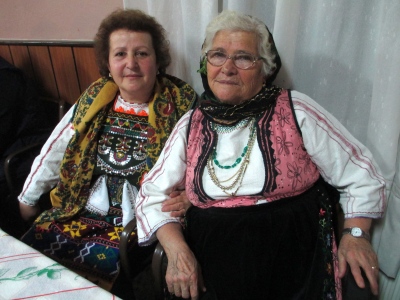
photo 2

The bodice features a triple butterfly design, connected to the ancient labyris / double axe. It is also a symbol of transformation, not least the transformation of individual women – through dance, song and ritual dress – into manifestations of radiant feminine strength and beauty, moving beyond their personal identity and concerns in order to embody a larger power. This phenomenon is represented by the image of a woman with wings, easily discerned in the butterfly design here and in other villages.
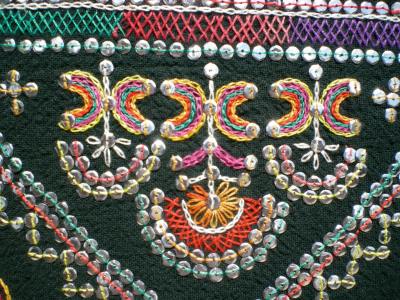
Photo 1

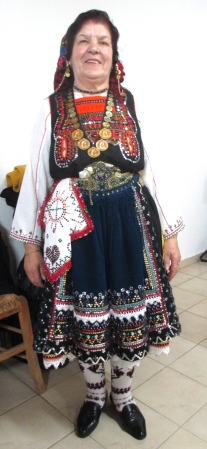
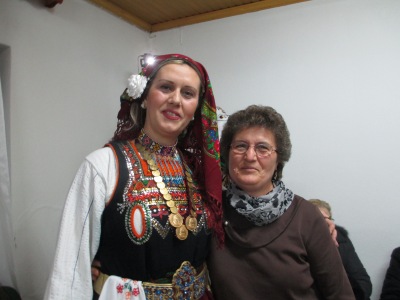
Other villages have their own version of the Thracian women’s costume, as in Doxapara where we went next:
3_IMG_5562

4_IMG_5610
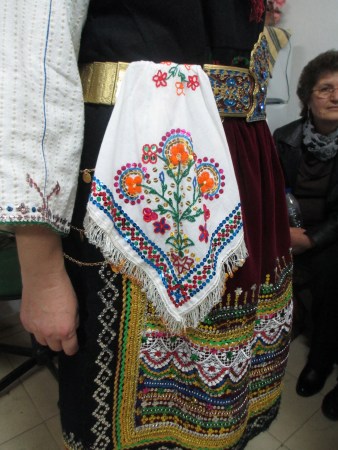
Chryssa, on the left, wears the costume made by her mother, on the right.
5_IMG_5609

Chryssa’s handkerchief is embroidered with a flamboyant sun-headed Goddess/flower motif.  An ancient V-shaped motif of spiral horns, or perhaps a pair of wings, appears on her sleeve in red. This motif is more discreet, but its central location affirms its importance. Women’s hands – which created all this and much more – were considered holy and worthy of protection. As on the handkerchief, Goddess figures are often depicted with radiant, extra-large or winglike hands.
6_IMG_5567
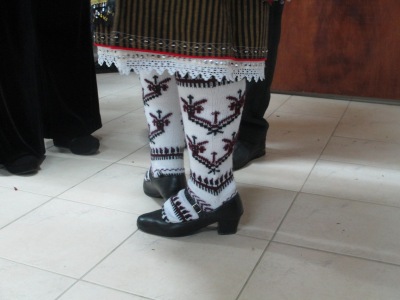
Knitted socks in Doxapara depict winged Goddess figures in red, black and white.

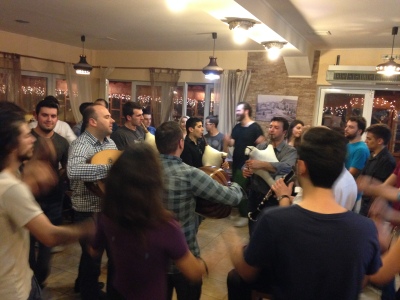
We celebrated my birthday eve in a little taverna in Oinoi, a village of Gagaouzides, Turkish-speaking Greek Christians from Bulgaria. Friends (and friends of friends) needed no persuading to dance up a storm.
7_IMG_1444

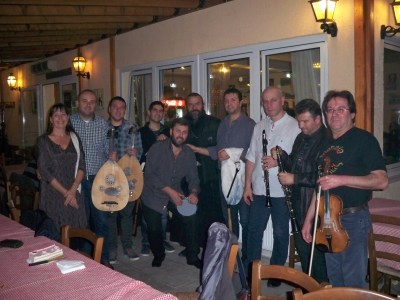
Music was provided by gaidas (bagpipes), laoutos (lutes), clarinets, violin and doumberleki, not to mention everyone singing along. The ‘Happy Birthday’ songs, both English and Greek versions, sounded fantastic with this orchestra.
8_100_0896

9_IMG_1436
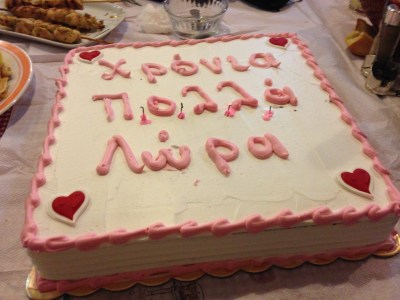
Hospitality is a sacred obligation in Greece, as in many parts of the Balkans, and dancing must be accompanied by feasting. My birthday cake weighed 3 kilos and fed 75 people. ‘Many years, Laura’!

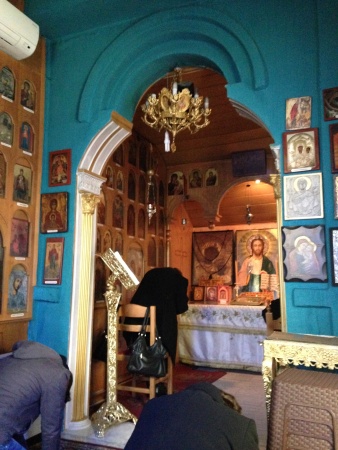
On the morning of my birthday, while everyone else was still asleep, I went to a favourite church in Kleissos, which has a little side chapel filled with 144 icons of the Virgin Mary, whom Greeks call the All-Holy One, the Panayia. As you see, people pray to her very fervently here. The images are copies of famous miraculous icons from other places like Tinos and Kythira. The Panayia of Kleissos is also believed to be a miracle-working icon; I can attest to its power from past experience.
10_IMG_1466

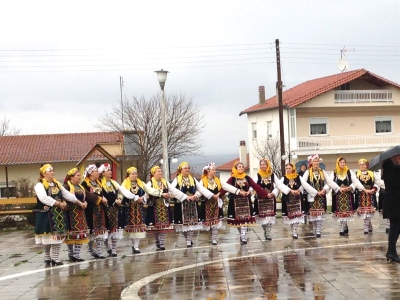
Later we proceeded to Ambelakia, a village I had not visited before.
11_IMG_1576

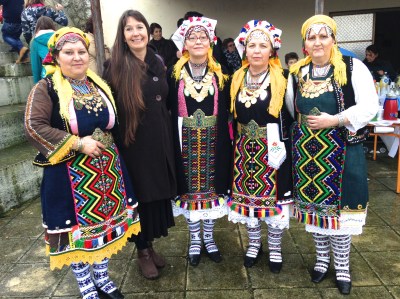
These women are Marides, an ancient Thracian tribe. Their costumes feature many Goddess embroideries and, on their socks, the recurring motif of the wild bee. Priestesses in Thrace and other areas were once known as bees (mélisses).

The women here told me about the ancient festival they keep, called ‘Gynaikokrateía’, Gynocracy or Women’s Rule. It is related to Thracian Midwives’ Day celebrations (described in a previous post) and falls on the same day, January 8th.  On this day, they told me, gender and power roles are reversed and women take over the town hall, village square, cafes and other male-dominated public spaces. They exact toll payments from passing vehicles, which they use to buy wine. The women’s unrestrained merriment and public drunkenness, unthinkable on the other days of the year, is combined with ribald and satirical skits lambasting men’s misbehaviour. This sharp commentary is remembered, laughed over and talked about for months afterwards, thus providing an apparently innocent, yet effective, social deterrent to abuses of power.
12_IMG_1593
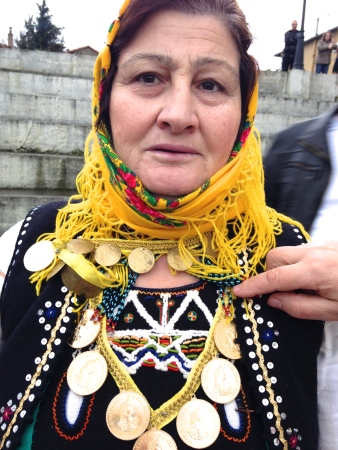
Marides women’s costumes can be ‘read’ as a treasury of ancient women’s wisdom hidden in plain view, an open secret for those with eyes to see. Yellow headscarves with long fringes resemble both sun and rain, life-giving elements of agriculture both originally identified with the Goddess. Woven aprons illustrate flowing life force, womb energy and women’s awesome creative power, with Goddess/Tree of Life figures inside the central rhombs.
13_IMG_1617
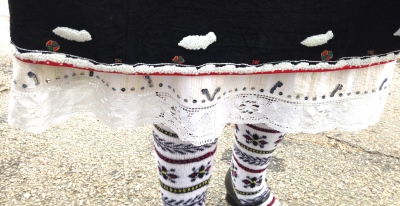
Spiral horns reappear on the hem of the underdress. Sacred symbols on this spot simultaneously pronounce and protect the power of what lies directly above. ‘Doves’ encircle the hem of the black overdress; ‘bees’ adorn the socks.
14_IMG_1614
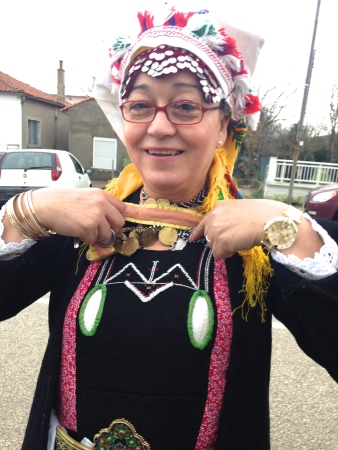
In the central place on the heart of the bodice: the winged Goddess motif, a sign of the dancing priestess and a key Thracian symbol for thousands of years. This powerful image is usually invisible, hidden under scarf fringes, beaded necklaces and garlands of gold coins, but the women revealed it to me because I knew it was there and asked to see it.
15_IMG_1648

16_IMG_1603
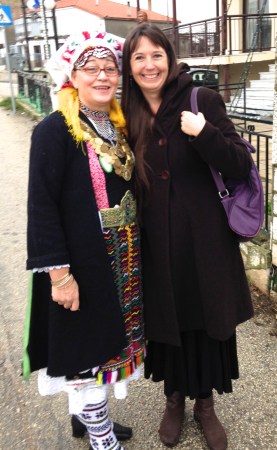
As much as I loved meeting them, they loved meeting me – as they would love to meet any woman who can recognise them for what they are and what they wear.
17_IMG_1571
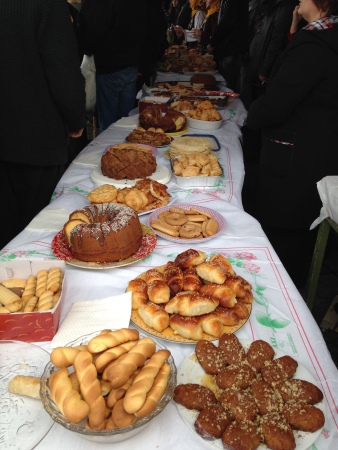
And of course there was another feast.

It was a fabulous birthday. I even danced, managing to overcome lingering injuries from a bicycle accident I had had some months before. Giving myself to the healing energy of women sharing steps together, I felt radiantly joyful and truly alive, as if at a momentary crossroads of space and time, simultaneously fleeting and eternal.

In Thrace, I feel extremely privileged to witness the survival of motifs and ritual customs with roots in Neolithic Old Europe, as well as key values from the Old European worldview articulated by Gimbutas, Carol P Christ, and others: respect for nature, a sense of interdependence, the need for social justice and the importance of community celebration.

We are blessed to live in an age where these and other ancient treasures of women’s wisdom, are now returning, visibly and consciously, to our own culture. Patriarchal domination has not and will not manage to destroy these riches from the past. At this time of the winter Solstice, I wish us all the healing joy, connectedness, and love in abundance which these dances embody, to warm us and guide us all into the rebirth of the year.

Love & blessings,
Laura

Laura Shannon has been researching and teaching traditional women’s ritual dances since 1987. She is considered one of the ‘grandmothers’ of the worldwide Sacred / Circle Dance movement and gives workshops regularly in over twenty countries worldwide. Laura holds an honours degree in Intercultural Studies (1986) and a diploma in Dance Movement Therapy (1990).  She has also dedicated much time to primary research in Balkan and Greek villages, learning songs, dances, rituals and textile patterns which have been passed down for many generations, and which embody an age-old worldview of sustainability, community, and reverence for the earth. Laura’s essay ‘Women’s Ritual Dances: An Ancient Source of Healing in Our Times’,  was published in Dancing on the Earth

Painting Aurora by Angela Yarber

angelaFor those of us in the northern hemisphere, December is one of the darkest months. The days are shorter. Night comes earlier. Each morning I eagerly await the dawn, the potential sliver of sunshine seeping through my window and warming my otherwise cold wintery skin. For those of us who struggle with seasonal depression, December can be difficult. The colder and shorter days cast shadows on our spirits as we yearn for the warm glow of light. Each December as we inch toward the winter solstice, I am reminded of the Goddess of the Dawn, Aurora, and of the unique ways in which a variety of wisdom traditions invoke the coming of light amidst the stark December night skies.

So, this December I welcome Aurora into the vast witness of Holy Women Icon with a folk feminist twist that I feature each month: Virginia Woolf , the Shulamite, Mary Daly, Baby Suggs, Pachamama and Gaia, Frida Kahlo, Salome, Guadalupe and Mary, Fatima, Sojourner Truth, Saraswati, Jarena Lee, Isadora Duncan, Miriam, Lilith, Georgia O’Keeffe, Guanyin, Dorothy Day, Sappho, Jephthah’s daughter, Anna Julia Cooper, the Holy Woman Icon archetype, Maya Angelou, Martha Graham, Pauli Murray, La Negrita, Tiamat/tehom, Mother Teresa, and many others.

Aurora is the Goddess of the dawn in Roman mythology; each morning she soars across the sky to announce the arrival of the sun. As the nights grow longer and longer, I can think of few other goddesses I hope for more than Aurora. In fact, many faith traditions invoke the coming of light during this month of long nights and short days.

In my own tradition, we are not yet celebrating Christmas (despite the capitalist consumer onslaught that has been on full throttle since October). Rather, we still dwell in the deep blue darkness of Advent, when we wait, long, and prepare for light to be birthed into our world. For most Christians, a candle is lit each Sunday during Advent and the light grows brighter as they anticipate the birth of Christ. Continue reading “Painting Aurora by Angela Yarber”

Revolution Through Rituals by Jann Aldredge-Clanton

Jann's pictureA revolution is happening through Divine Feminine rituals! More and more faith communities are reclaiming the power of the Divine Feminine in sacred rituals.

Rituals move feminist theory and theology/thealogy from the head to the heart. Words and visual symbols in rituals shape our deepest beliefs and values, which drive our actions. Multicultural female divine images in our sacred rituals affirm the sacred value of females throughout the world who continue to suffer from violence, abuse, and discrimination. For feminism to transform our culture, we need Divine Feminine rituals in faith communities. In Women-Church: Theology and Practice, Rosemary Radford Ruether writes: “One needs communities of nurture to guide one through death to the old symbolic order of patriarchy to rebirth into a new community of being and living. One needs not only to engage in rational theoretical discourse about this journey; one also needs deep symbols and symbolic actions to guide and interpret the actual experience of the journey from sexism to liberated humanity” (p. 3).

As I was growing up in the Baptist tradition, hymns were my favorite part of our rituals. One of the hymns I loved singing was “He Lives,” increasing in volume along with the congregation as we came to the refrain which repeated over and over the words “He lives.” Not until many years later could I even imagine singing or saying, “She lives.” I had learned to worship a God who was named and imaged as male. But while studying in a conservative seminary, I was surprised to find Her. I discovered female names and images of Deity in scripture and in Christian history. As an ordained minister, my call has included writing, preaching, and teaching to persuade people that we need multicultural female divine names and images in rituals if we are to have social justice, peace, and equality. My call expanded to writing Divine Feminine rituals, including lyrics to familiar hymn tunes. Continue reading “Revolution Through Rituals by Jann Aldredge-Clanton”

Dance of the Bees: Reading the Language of the Goddess by Carol P. Christ

bee women dancing croppedThe image from an ancient Cretan bowl (c.1700 BCE) from the Sacred Center of Phaistos pictured here has often been interpreted as an early depiction of Persephone’s descent or rising. But are clues from later Greek mythology pointing in the right direction in this case?

Recently, my colleague Mika Scott posted the Phaistos bowl image on our Goddess Pilgrimage Facebook site in conjunction with the bee pendant from Mallia. This juxtaposition led me to think again about the importance of bees and pollination in agricultural societies and to offer an alternative reading of the symbolism on the bowl. Continue reading “Dance of the Bees: Reading the Language of the Goddess by Carol P. Christ”