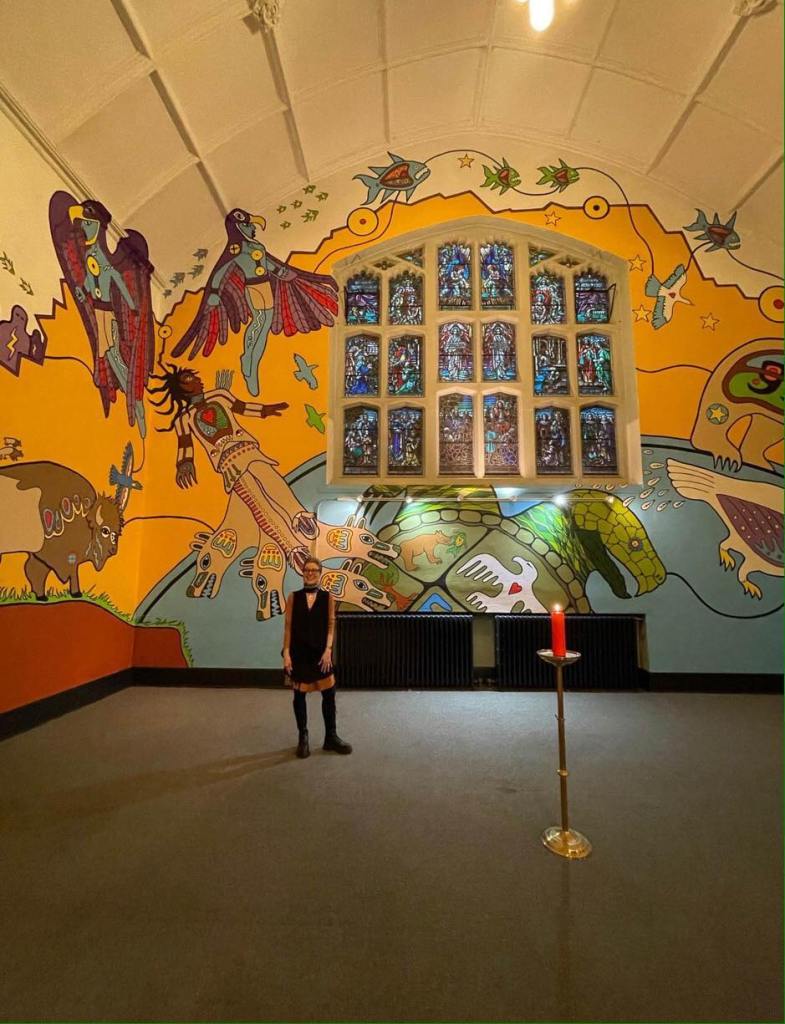
Grandmother’s Story by Judith Shaw

The past few years have been way too busy. Every winter I longed for quietness and solitude – for time and space to see and feel the strong bones of tree trunks and branches standing sharp against the sky and to gaze in awe into the fathomless winter night.  And yet responsibilities and duties continued to yell at me for attention. The quiet gifted by Winter slipped away and soon I was on the treadmill of action offered by Spring and Summer once again.

Continue reading “Grandmother’s Story by Judith Shaw”

The Motomami Theology: “Segundo chingarte, lo primero Dios.”* Part II

*“God comes first. Fu*king you, a close second.”

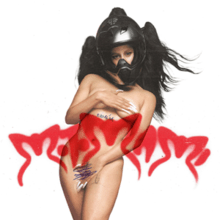
In Part 1 of this post, I described my first encounters with Rosalía’s music and visual arts, which are controversial for many, but I find them wonderful. I mentioned how she integrated God, mainly Catholic references and images, into a story of love and suffering in El Mal Querer. But I finished emphasizing my surprise when I listened to the album Motomami, since she managed to combine reggaeton (sexual-indecent music) and her views of God.

So, here is my attempt to describe Rosalía’s theology in Motomami. (Before I start, let me say: yes, I heard every song multiple times collecting references of God or the Christian tradition, so I hope you enjoy it.) Rosalía understands God as someone who controls our destinies amid grief and joy. In Como un G she says “It’s sad when you want something, but God has different plans for you” (“Qué pena cuando quieres algo pero Dios tiene otros planes pa’ ti”.) In Diablo, she says, “What God gives, God takes back” (Si Dios te lo da, te lo quitará), referring to her fans who first loved her but afterward became haters. God also protects us from an evil former partner when she says in Despecha‘ “May God forbid I go back to you” (“Que Dios me libre de Volver a tu la’o). God also is our help and supports our choices. Rosalía brings this concept talking about her identity as a woman, her freedom and autonomy in Saoko: “I know who I am, and I don’t forget where I’m going. I’m driving while God guides me. I am mine and I transform myself” (“Sé quién soy, y a dónde voy nunca se me olvida. Yo manejo, Dios me guía.)

Continue reading “The Motomami Theology: “Segundo chingarte, lo primero Dios.”* Part II”

The Motomami Theology: “Segundo chingarte, lo primero Dios.”* Part I

*“God comes first. Fuc*king you, a close second.”

I went to Rosalía’s promotional concert for the Motomami album in Boston a month ago. I knew some songs from her 2018 album El Mal Querer (Bad Love), a musical masterpiece. That album made Rosalía a visible star in the constellation of musicians and composers in Hispano-American mainstream music. The album has a particular story that Wikipedia explains very well:

The album was written by Rosalía and co-produced with El Guincho on an initial low budget as an independent artist. Presented as experimental and conceptual, revolving around a toxic relationship, the album was inspired by the anonymous 13th-century Occitan novel Flamenca. Therefore, every song on the album is conceived as a chapter of the book. It served as the singer’s baccalaureate project, graduating from Catalonia College of Music with honors. [Read more here]

In El Mal Querer, Rosalía mixed electronics, contemporary dances and rhythms, and traditional flamenco sounds and movements in a beautiful musical and visual collage. Some musically conservative audiences characterized the album as the “profanation” of traditional flamenco music, but there’s no doubt that Rosalía brought the genre back to life and made it mainstream again.

Continue reading “The Motomami Theology: “Segundo chingarte, lo primero Dios.”* Part I”

The Legacy of Carol P. Christ: Dance of the Bees: Reading the Language of the Goddess

This blog was originally posted on December 1, 2014

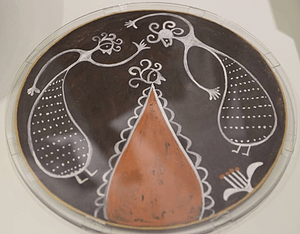
The image from an ancient Cretan bowl (c.1700 BCE) from the Sacred Center of Phaistos pictured here has often been interpreted as an early depiction of Persephone’s descent or rising. But are clues from later Greek mythology pointing in the right direction in this case?

Recently, my colleague Mika Scott posted the Phaistos bowl image on our Goddess Pilgrimage Facebook site in conjunction with the bee pendant from Mallia. This juxtaposition led me to think again about the importance of bees and pollination in agricultural societies and to offer an alternative reading of the symbolism on the bowl.

Continue reading “The Legacy of Carol P. Christ: Dance of the Bees: Reading the Language of the Goddess”

The Legacy of Carol P. Christ: Weaving and Spinning Women: Witches and Pagans by Max Dashu A Review

Moderator’s Note: This was originally posted on September 19, 2016

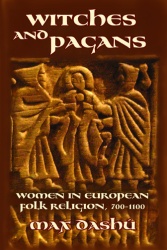
Max Dashu’s  Witches and Pagans: Women in European Folk Religion 700-1000 challenges the assumption that Europe was fully Christianized within a few short centuries as traditional historians tell us. Most of us were taught not only that Europe became Christian very rapidly, but also that Europeans were more than willing to adopt a new religion that was “superior” to “paganism” in every way. Careful readers of Dashu’s important new work will be challenged to revise their views. When the full 15 volumes of the projected series are in print, historians may be forced to hang their heads in shame. This of course assumes that scholars will read Dashu’s work. More likely they will ignore or dismiss it, but sooner or later–I dare to hope–the truth will out.

witches-and-pagans-cover

History has been written by the victors—in the case of Europe by elite Christian men. These men may have wanted to believe that their views were widely held, but Dashu suggests that they were not. Combing artistic and archaeological records, Dashu finds (to give one example) that images of Mother Earth nursing a snake are far from uncommon and can even be found as illustrations in Christian documents and on Christian monuments. Clerics rage against people—particularly women–who continue to visit holy wells and sacred trees and to practice divination and healing rituals invoking pagan powers. To paraphrase Shakespeare: “Methinks the cleric doth protest too much.” Were these things not happening and happening often, there would have been no need to condemn them.  Using these clues, Dashu provides intriguing new readings of the Poetic Edda and Norse sagas.

Continue reading “The Legacy of Carol P. Christ: Weaving and Spinning Women: Witches and Pagans by Max Dashu A Review”

Voice-ing the HEaRt: The Sixty-Six Books of the Bible by Margot Van Sluytman

Wall of Welcome, photo by Troy Gonsalves

When Reverend Anne Hines of Roncesvalles United Church in Toronto invited me to write a poem for Easter Sunday 2020, I had no idea that this invitation would become a dance with Word via words, that would alter my very own relating and relationship with my métier: poetry. A relationship that began to take me back into reading The Bible in a manner that shone a powerful light on the fact of that book’s capacity to shake, quake, challenge, and enlighten from the place of love, Wisdom, and indeed, inclusivity.

Each Monday I receive three to four words or phrases based on the book around which the Sunday sharing will be grounded. I read the chapter. I read with the HEaRt of womyn’s voice-ing. I read to unearth, to divine, to HEaR what is being invited, and how. The underpinning of my HEaRt’s listening, is the question: how does Godde wish for us to love?

Continue reading “Voice-ing the HEaRt: The Sixty-Six Books of the Bible by Margot Van Sluytman”

The Egg by Annelinde Metzner

Art by Deb Pollard Materials: Watercolor, markers, and vintage pearl button on paper.

In 1989 I was 37 years old. My body’s sacred work, centered around eggs, hormones and fertility, strongly governed my everyday existence.  I’m sure that influence is strong for all women of that age, mothers or not, body conscious or not.   I was directing a large women’s choir in Asheville, Womansong, composing and arranging for the women’s voices, as well as leading ritual-like rehearsals in a seated circle on the floor (pretty sure I can’t do that any more!) where I would often read my latest poems.

     Now I know that the egg of our own existence was carried in our mother’s wombs while in our grandmother’s bodies. I can see how my imagination in 1989 would go further and further afield, to women’s relations with all the egg-bearers, flora and fauna, of our amazing Earth. Quite a family we are!

Continue reading “The Egg by Annelinde Metzner”

Carol P. Christ’s Legacy: Kassiani: Placing a Woman at the Center of the Easter Drama

This blog was originally posted on April 13, 2015. You can read the original comments here.

For many years I been told of the beautiful Hymn of Kassiani, sung only on Easter Tuesday night, but I had never heard it until this week. For many this song is the high point of Easter week.

Kassiani, also known as St. Kassia, was a Greek woman born into a wealthy family in Constantinople (now Istanbul) about 805 to 810 AD. According to three historians of the time, she was intelligent and beautiful and selected as a potential bride for the Emperor Theophilos. The chroniclers state that the Theophilos approached her and said: “Through woman, the worst,” referring to the sin of Eve. Clever Kassiani responded, “Through woman, the best,” referring to the birth of the Savior through Mary.

Apparently unable to accept being put in his place by a woman, Theophilos chose another bride. Kassiani founded a monastery in Constantinople becoming its first abbess. She was an outspoken theological advocate of icons during the iconoclastic crisis (for which she was flogged). One of only two women to publish under her own name during the Byzantine Middle Ages, Kassiani wrote both poetry and hymns. Up to 50 of her hymns are known today, with 23 of them being part of the Greek Orthodox liturgy

.

Continue reading “Carol P. Christ’s Legacy: Kassiani: Placing a Woman at the Center of the Easter Drama”

From the Archives: The Quality of Mercy by Barbara Ardinger

This was originally posts on October 4, 2020. You can see the original comments here.

The quality of mercy is not strained;
It droppeth as the gentle rain from heaven
Upon the place beneath. It is twice blest;
It blesseth him that gives and him that takes…

This speech (Act IV, scene 1) from The Merchant of Venice, given by Portia in disguise as a boy lawyer (and Bassanio doesn’t even recognize her!), may be one of Shakespeare’s most famous. In the play, as we know, Shylock, a Jewish moneylender, and Antonio, a merchant waiting for his ships to come in, make a bargain, one part of which is that if Antonio doesn’t pay on time, Shylock gets to collect one pound of his flesh. Antonio’s ships don’t come in, the case is taken before the Duke of Venice, and Portia appears in disguise to solve the legal issues. She goes immediately to Shylock and speaks this speech to him.

Continue reading “From the Archives: The Quality of Mercy by Barbara Ardinger”

From the Archives: Longing for Hermitage by Elizabeth Cunningham

This blog was originally posted on October 20, 2013. You can read the comments here.

At least since the days of the Desert Mothers in the 4th and 5th centuries CE, there have been women in the Christian tradition (and doubtless other traditions) who have lived lives in religious solitude, whether by choice or circumstance.  In Medieval Europe many churches had anchorholds, small enclosures inhabited by men or women dedicated to a life of solitude and prayer. The word anchorhold implies that the presence of the anchoress or anchorite grounded the church community, but the word derives from the ancient Greek verb (pronounced anachōreō) for to retire or withdraw.  Anchoress Julian of Norwich is still revered as the author Revelations of Divine Love, possibly the earliest surviving book written by a woman in the English language.  Six centuries after her death, her vision of Jesus our Mother continues to challenge, comfort, and inspire.

Continue reading “From the Archives: Longing for Hermitage by Elizabeth Cunningham”