

 My previous post on this site, Trauma Healing through Communal Dance, on February 1, told of a traumatic event and its lingering effects, including insomnia, brain fog, nightmares, tearfulness, migraines, anxiety, and fear. Now I’m hearing reports of similar symptoms from virtually all of my friends who are affected by the trauma of the coronavirus pandemic.
Three months ago, Greek communal dance helped me recover from my traumatised state. Now, nobody has access to communal practices like circle dance to help us get through it.
So how do we heal when we all need healing? When we don’t have access to the things which would normally help us heal?

There is a lot of talk right now about strategies, small and large, which can keep us sane in this crazy time. Many speak of the ‘silver linings’ we can find in this enforced retreat, and I have found a few myself. But I have also heard from people who aren’t in a safe place, or who just aren’t coping well.
Even if you are blessed with a peaceful home, access to nature, and continuing income, not everyone is made for isolation. The lockdown can be particularly hard on extroverts. And many people may find that high stress levels in this time of separation, loss, and uncertainty awaken old ghosts of unhealed trauma.
My earlier blog named some of the therapeutic aspects of communal circle dance, including connection with others, shared movement synchrony, realignment with ‘my self, my body, my place between heaven and earth, and my home in the human community.’

As I wrote in Medusa and Athena: Ancient Allies in Healing Women’s Trauma, “Past trauma can be transformed through ‘physical experiences that directly contradict the helplessness, rage and collapse that are part of trauma’ and which foster a renewed sense of self-mastery. Because trauma tends to be experienced in ‘isolated fragments’, treatment particularly needs to engage the entire organism, ‘body, mind, and brain’.”
So, dancing is perfect. Circle dance, particularly, is my ideal method of trauma healing. But how can we dance without a circle?
A lot of us are dancing on platforms including Skype and Zoom, but the slight time lag with this technology means that true synchrony is impossible; everyone’s movement appears slightly off the beat. Nevertheless, I love seeing cherished faces, talking together, and dancing despite the distance.
My favourite way to dance ‘in circle’ is without any online technology, simply connecting in heart and spirit. Since the start of the lockdown, my network of dance students, friends, and colleagues in different countries have been ‘meeting’ at set times twice daily, and it is deeply moving to join together in this way. We light a candle for loved ones, health workers, key workers, and anyone who is unwell or needs extra support at this difficult time. Then we each dance the same sequence of circle dances, plus our personal favourites. Knowing that my friends are all dancing in their own homes, and that we are all thinking of each other at the same time, is very precious.
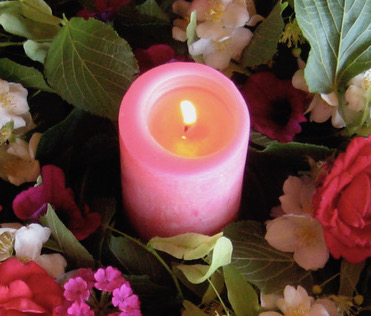
If you too are separated from your loved ones, you can choose a time every day to stop what you are doing so you can think of one another, with no need for online technology. You don’t have to dance; just put on your favourite music and know you are connected.
Doing things you love can also provide an antidote to trauma – cooking favourite foods, lovingly repotting houseplants, or embarking on a fun creative project – anything you enjoy can connect you to your own power and experience of mastery as a source of healing. With my housemates here in Canterbury, we created a beautiful Easter feast – twice, first for Western and then for Orthodox Easter – with photos of our missing loved ones on the table. It was such a simple act, but nourishing on so many levels.
Time in nature connects us with the flow of life force which is in each of us. As we walk outdoors, feeling the earth below and the sky above, we can remember when we have come through challenges in the past, and let those memories reassure us that we will come through this now too. It was the same earth under our feet then, and it’s the same sky around us now and so it will be in the future when all of this is behind us.

Sometimes a larger crisis, like this pandemic, can put things in perspective, and bring us closer to forgiveness and healing. To support this inner process, I have found the Hawaiian indigenous practice of ho’oponopono to be very powerful. Hawaiian scholar and educator Mary Kawena Pukui describes it as a practice of forgiveness and reconciliation, for family members to ‘make right’ broken relations and prevent problems from erupting.
What can we do to foster forgiveness, move beyond blame, and focus on what we have in common? One recent story on the Karuna website tells how rival gangs in South Africa are now cooperating to deliver food to the vulnerable in their community. Amazing!
There is always something we can do, for ourselves and for others. And let’s not forget the larger context: life as we knew it has hit the pause button, and we have a chance to make some different choices in preparation for when we once again press ‘play’. Maybe we will find that all of us – and all of humanity – are suddenly dancing to a more beautiful tune.
Laura Shannon has been researching and teaching traditional women’s ritual dances since 1987, and is considered one of the ‘grandmothers’ of the worldwide Sacred / Circle Dance movement. She trained in Intercultural Studies (1986) and Dance Movement Therapy (1990), and is currently pursuing postgraduate studies in Myth, Cosmology, and the Sacred at Canterbury Christ Church University in England. Her primary research in Balkan and Greek villages seeks out songs, dances, rituals and textile patterns which descend from the Goddess cultures of Neolithic Old Europe, and which embody an ancient worldview of sustainability, community, and reverence for the earth. In 2018 Laura was chosen as an Honorary Lifetime Member of the Sacred Dance Guild in recognition of her ‘significant and lasting contribution to dance as a sacred art’. Her articles and essays on women’s ritual dances have appeared in numerous publications, including Re-Enchanting the Academy, Dancing on the Earth: Women’s Stories of Healing Through Dance, She Rises! Vol. 2, Inanna’s Ascent, Revisioning Medusa, and Spiritual Herstories – Call of the Soul in Dance Research. Laura is also Founding Director of the non-profit Athena Institute for Women’s Dance and Culture. She lives in Canterbury, Greece, and the Findhorn community in Scotland.
- Trauma Healing through Communal Dance
- Greek communal dance
- Medusa and Athena: Ancient Allies in Healing Women’s Trauma in Revisioning Medusa: from Monster to Divine Wisdom, edited by Glenys Livingstone, Trista Hendren and Pat Daly. Girl God Press, 2017, 206-222. www.thegirlgod.com. This excerpt cites Bessel Van der Kolk, The Body Keeps the Score (2014), pp 4, 40, 53.
- Hawaiian indigenous practice of ho’oponopono
- Mary Kawena Pukui
Karuna website: This site collects positive stories in the time of coronavirus. ‘Karuna’ is a Sanksrit word meaning compassion. Their site motto: ‘Karuna spreads faster than corona.’ - Rival gangs in South Africa are now cooperating
 Just a few months ago, not long after turning seventy, I was diagnosed with mild osteoporosis. I had thought that all my yoga, my occasional forays to the gym, my daily walking, my frequently consumed leafy greens and yogurt , my calcium supplements would protect me. I had thought I was different from most other women my age, that I could avoid taking the medication that I knew was sometimes problematic. But the bone density scan revealed what I had feared, and because both of my parents declined and died shortly after hip fractures, because I had once broken an ankle, I decided to accept my doctor’s sober recommendation: that I begin a weekly dose of alendronate. It would be the first chronic medication I would ever be prescribed.



 Feminism and Religion