The Journal Gender a výzkum/ Gender and Research

I would like to introduce this community to Gender a výzkum (in Czech) or Gender and Research (in English), a transdisciplinary, peer-reviewed journal founded in the year 2000 and dedicated to research in Feminist and Gender Studies in the Czech Republic.  While the journal’s main focus is work pertaining to Central and Eastern Europe, it is open to a wide range of geographical locations and topics.  The journal, which publishes articles in Czech and English, often puts out calls for individuals or groups of people to edit monothematic issues.  Past monothematic issues include feminist reflections on Covid, an issue on the use of language concerning sex and gender, gender in popular culture, children, adolescence and sexuality, feminist interpretations of Islam, and postcolonial and decolonial thinking in feminist theory to name just some. If you would like to read them, the journal is available online as well as in print.

Continue reading “The Journal Gender a výzkum/ Gender and Research”

Legacy of Carol P. Christ: Transcendence, Immanence, and the Sixth Great Extinction

This was originally posted August 4, 2014

In my recent blog “The Flourishing of Life and Feminist Theology” I discussed Grace Jantzen’s view that theology should focus on “natality” or birth and life, rather than life after death or life apart from this world. This week Tikkun magazine published its summer issue with a feature called “Thinking Anew about God.” In it two male thinkers, one Buddhist and one Christian, argue for a similar turn toward the world in their traditions. Their calls for religions to focus on this world were published the same week scientists warned that the world stands on the brink of the sixth great extinction.

I have come to believe that any religion espousing cosmological dualism (devaluing this world in favor of a superior reality such as heaven) and individual salvation (the idea that what ultimately happens to me is disconnected from what ultimately happens to you) is contributing to our world’s problems rather than offering a solution. … [Religions should] stop emphasizing the hereafter and focus instead on how to overcome the illusion that we are separate from this precious, endangered earth. –David Loy, Buddhist, writing in Tikkun Summer 2014

Continue reading “Legacy of Carol P. Christ: Transcendence, Immanence, and the Sixth Great Extinction”

INTERBEING by Elizabeth Ann Bartlett

“Every life bears in some way on every other.”

                                                                                -Susan Griffin, A Chorus of Stones

This line from Susan Griffin’s profound investigation into the ways our lives are interwoven through war has been echoing in my mind frequently in recent days, as we find our hearts breaking and outraged by a distant war. In the depths of our compassion, we ache with the suffering of families huddling together in bomb shelters, a birthing woman and her baby dying on a stretcher after a maternity hospital is bombed, the poignant strains of a Chopin etude played by a woman on her piano – the only thing to survive her bombed out home.

This truth of Griffin’s words echoes throughout ancient wisdom traditions — in the indigenous recognition that all our relations — animals, plants, water, earth, stone — are kin; in the African concept of Ubuntu — “I am because we are;” in the Buddhist precept of interdependent co-arising, which Buddhist monk Thich Nhat Hanh called simply “interbeing.” As he described it:

Continue reading “INTERBEING by Elizabeth Ann Bartlett”

Buddhist Misogyny Revisited – Part II by Barbara McHugh

Read Part I here first

Webster defines myth as “a usually traditional story of ostensibly historical events that serves to unfold part of the world view of a people or explain a practice, belief, or natural phenomenon,” and in this way myths tell us who we are. Unfortunately, they include stories, from Adam and Eve to Cinderella and Sleeping Beauty, that define women by using criteria such as gullibility, passivity, and the size of their feet.

But today women are shining light on the likes of Circe, Mary Magdalene, and Briseus, the young woman dismissed by Homer as an impediment to Achilles’s higher purposes. These stories counter the traditional narratives that restrict women, as well as men, to roles that rob them of their full humanity. In my novel, Bride of the Buddha, the Buddha’s wife embarks on a spiritual journey of her own. When her quest leads her to the Buddha’s all-male sangha, she disguises herself as a monk, eventually becoming Ananda, who in the scriptures is the Buddha’s attendant, the one who struggles with all the questions unenlightened practitioners face today.  The answers to these questions cannot be stated as propositions; they must be felt and lived. Hopefully, my version of Ananda suggests new possibilities for feeling and living these responses. If this “violates” the myth, it does not violate the Buddha’s fundamental views.

Continue reading “Buddhist Misogyny Revisited – Part II by Barbara McHugh”

Mantra and Meditation in Buddhist Hospice Chaplaincy to Alleviate Anxiety by Karen Nelson Villanueva

Karen Nelson Villanueva has recently successfully defended her doctoral dissertation, “Invoking the Blessings of the Tibetan Buddhist Goddess Tara Through Chanting Her Mantra to Overcome Fear,”

Mantras are not just the prescribed sound formulas or sentences found in Eastern religions, but they can also be thought of as the words or phrases that we continually repeat to ourselves. The word mantra comes from Sanskrit and its roots are manas-, meaning “mind,” and -tras, which can be translated as “tool.” Thus, mantra is a tool to protect the mind.

How often do we engage in negative self-talk like “It’s my fault” or “I’m to blame for what’s happened to me” or “No one loves me”? These expressions can become mantras, as we believe their messages from constant repetition. In hospice and hospital settings, one often finds patients who have convinced themselves that “This is God’s punishment” or “Everyone has forgotten me” or “I’m so scared.” These phrases, rather than protect the mind, become what is believed by the mind and may lead to increased anxiety, stress, and depression, and consequently the need for spiritual and emotional support.

Chaplains, as members of the care team in hospice and hospitals, provide spiritual and emotional support to patients and their families. Most often, chaplains attentively listen to patients and their caregivers (often family members) about the patients’ life story, their relationships, their dreams unfulfilled, and their wishes for those whom they are leaving behind. Chaplains take part in family meetings where decisions are made about patients’ care, sometimes interjecting to ask for clarification of medical terms and to ensure that the family understands. Sometimes, the chaplain will lead prayer with the patients and their families, and at other times, the chaplain will pull other tools from her toolbox such as mantra meditation.

Continue reading “Mantra and Meditation in Buddhist Hospice Chaplaincy to Alleviate Anxiety by Karen Nelson Villanueva”

Sacred Activism through Lucid Dreams: A Dream of Enthronement by Alaya A. Dannu

I am a Vajrayana Buddhist. I follow the Buddha Dharma via the Vajra path. My journey to the Dharma was through lucid dreams. I have not once had a human teacher, in this lifetime, to teach or guide me to/on this path. My teachers have been the Dakinis, the Mothers, or a variety of emanations of the Divine Feminine embodying many forms of wisdom. They are the ones that have provided me with the practices to engage and the ways in which I need to BE, in order to DO, in this lifetime.

“How do you know these dreams are not from your mind?”

Do you know how many times I have heard this question, from sangha members of less melanin? Did you know that it has always been a Western Buddhist that has challenged my experiences, yet those that follow the Buddha Dharma in Asia would always inquire about them from a place of curiosity?

Continue reading “Sacred Activism through Lucid Dreams: A Dream of Enthronement by Alaya A. Dannu”

Beyond Human Rights by Esther Nelson

For way too long, the only meaning I found in my life happened when peering through one specific, religious prism. Then I discovered what’s called the academic study of religion.  Observing the many ways people find meaning through their own experiences with God (or their “ultimate concern”) shattered the tightly-sealed insulation around my worldview.  Those things that comprise religion (stories, concepts of the holy, ritual, symbols, social structures), coupled with our individual experiences create a powerful reality affecting us individually and communally.

Some of my students identify as agnostic or atheist. They’re happy to have shed (or never put on) garments they perceive as obstacles.  Rarely do they realize that religious “truths,” because they are taken to heart by people and implemented into the social fabric, shape the world they inhabit. When we discuss the ways religion affects women within society, they are far more likely to think about women’s lived realities in terms of human rights, not religious identity.  Religion is seen as something superfluous (at best) or an impediment towards progress (at worst).

Continue reading “Beyond Human Rights by Esther Nelson”

In the footprints of Machig Lapdron by Mary Sharratt


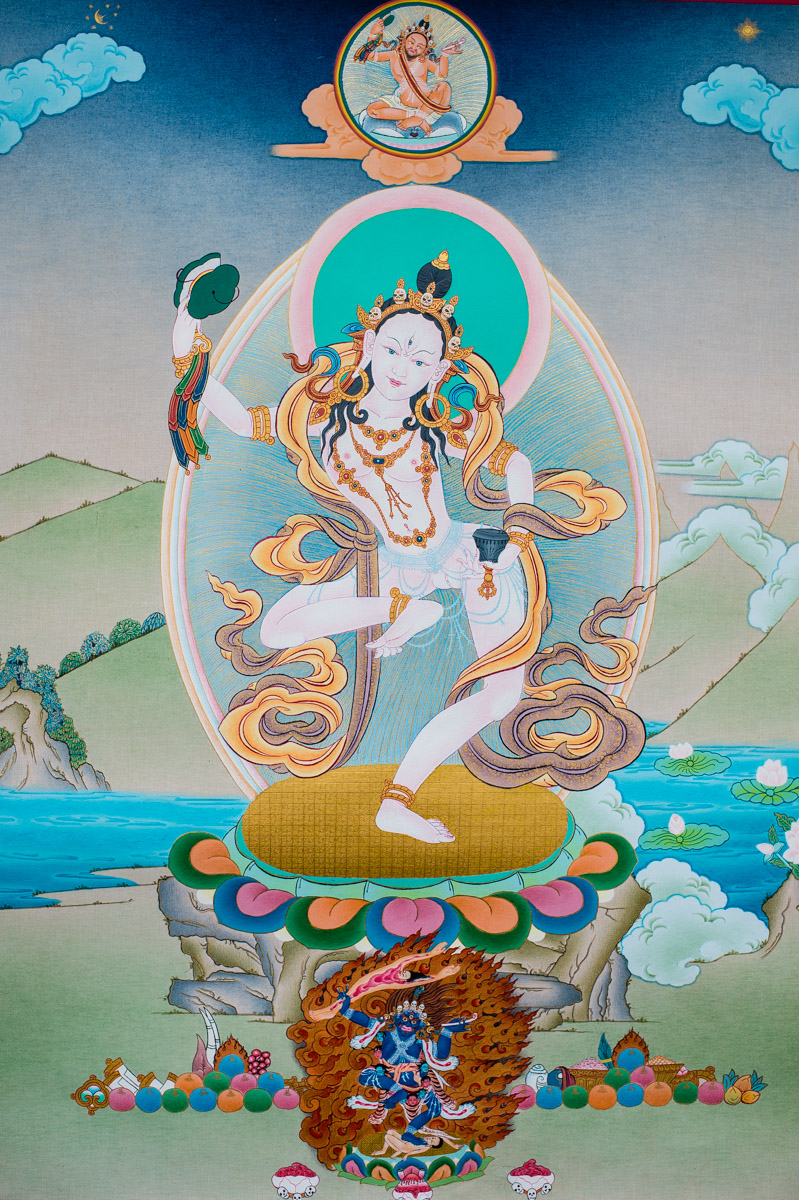
Machig Labdrön with Padampasangye

Machig Lapdron, female Tantric Buddhist mystic and lineage founder

I’ve just returned from an illuminating trip to Bhutan, high in the Himalayas. Bhutan is a Buddhist kingdom and the world’s youngest democracy.

On our last full day in this enchanting land, my husband and I drove with our guide over the nearly 4000 meter pass of Chelela and into the Haa Valley which doesn’t see that many tourists. Our goal was the Hermitage of Juneydrak, where Machig Lapdron (1055-1145 CE), the famous female Tantric mystic, master, and lineage founder, once meditated.

Continue reading “In the footprints of Machig Lapdron by Mary Sharratt”

“When You Know for Yourselves” by Oxana Poberejnaia

A female friend recently posted an article by a woman writer about motherhood. The article was entitled “Children are NOT life’s flowers” (referring to a famous Russian saying which means that children are what makes life beautiful).

A number of women contributed comments under this post. The discussion revolved around the image of an ideal mother and how we real mothers should relate to it.

It is amazing that in the current atmosphere of bringing out into the open so many issues, motherhood is not much discussed. Sexuality, gender and abuse are OK to speak about and question. At the same time, it is only within medical profession that such issues as “baby blues” or post-partum depression are valid topics.

Continue reading ““When You Know for Yourselves” by Oxana Poberejnaia”

Who is the Perpetrator? by Oxana Poberejnaia

A poem by Thích Nhất Hạnh, a Vietnamese Buddhist monk and peace activist, “Call Me By My True Names,” lists various situations from natural world and the world of humans, most of them to do with violence and death. He claims in the poem to be both: the victim and the perpetrator of violence.

This poem has always bothered me. I can understand a world perspective where you express solidarity with all the sufferers, but how to come to terms with identifying oneself with the oppressors and murderers?

At my current limited level of understanding of the Buddhist teaching I can only say that perhaps the words: “I am a rapist and a murderer” point to tendencies that are present in all of us. First and foremost it is a tendency to divide, to separate. The most noticeable separation is between the “I” and the “outside” world.

First we counter position ourselves against all the others. Next we start believing that it is possible to achieve happiness just for ourselves, at the expense of the others. So we live egotistically. From here, I suppose, there is only a small step to rape and murder.

Continue reading “Who is the Perpetrator? by Oxana Poberejnaia”