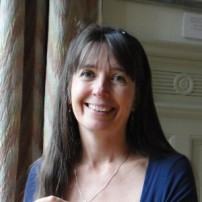
Opening Our Hearts Through Armenian Dance by Laura Shannon

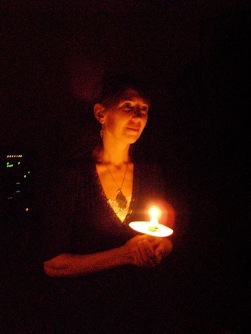
The candle represents the light of love, compassion and connection kindled in our hearts as we dance.
In these challenging times, one of the hardest things to do is to keep our hearts open. Grief and despair tend to shut them down. And even among close friends, colleagues, family members, and people with whom we share worship, when we clash over differing political opinions, trust can swiftly erode. These kinds of losses and sorrows can make us just want to close the doors to our hearts.
Yet hardened hearts and minds are not going to help us overcome conflicts and affirm connections. Only if we can open our hearts to one another, holding the fullness of our (and others’) feelings in a compassionate way, can we weather the storms which threaten to divide us further. And only if we are united can we find our way together through those storms.
One of the best ways I know to connect with others and to open my heart is through the joyful experience of traditional circle dance, particularly Armenian dances. I have written previously on this blog (The Dance of MemoryThe Wishing Tree) about Armenian dances and their ancient roots, their links to the pre-Christian Goddess, and how they affirm survival throughout the traumas of history. I have also written about my friend and colleague Shakeh Major Tchilingirian and her inspiring Circle of Life project, which brings Armenians, Turks, Kurds, Assyrians, and other survivors of atrocities and genocide to dance together for reconciliation.

Continue reading “Opening Our Hearts Through Armenian Dance by Laura Shannon”

If You Can’t Flirt, Don’t Have Sex by Trelawney Grenfell-Muir

If you don’t know how to flirt, you shouldn’t be having sex with anyone.
I admit it… I used to love flirting. It can be incredibly fun. I flirted outrageously with guys I had no intention of dating, and guys flirted with me who weren’t interested in dating me. It wasn’t about sex, either. It was just awesomely fun. The only time I minded was if it turned out they were married/in a committed relationship.
Flirting is like dancing. Both people have to agree to participate. It involves a lot of asking the other person what s/he is comfortable with. Sometimes it is kind of sexual, sometimes it is beautifully spiritual or exciting intellectually. Sometimes it’s tequila body shots, sometimes it’s holding a gaze just a little longer than normal, sometimes it’s making witty but not cruel jokes at the other person’s expense. But it has to be fun, it has to be happy. Like sexual intimacy. If at any point, one party becomes uncomfortable, the other party has to back up and figure out why, and what is needed now.

Continue reading “If You Can’t Flirt, Don’t Have Sex by Trelawney Grenfell-Muir”

Beginning Conversations about the Body at Ease by Stephanie Arel

A topic that continually perplexes me, both personally and professionally, concerns the connection, or harmonization if you will, between our cognitive capacities and our physical expression and comfort, between thinking and feeling. Yoga, dance, working out, meditating, and other modalities which explicitly bring body and mind together often achieve their goal at the point of practice, and while these disciplines have residual effects, how do they have staying power?

For instance, how do we maintain rootedness in the body when we are caught off guard – for instance, by traumatic affect? When we are faced with information about reality that disturbs us – the truth about a relationship or a physical illness – how do we stay physically present? Or when we (I) spend an inordinate amount of time immersed in activities that are essentially not embodied despite the efforts at theorizing such embodiment – reading, researching and writing – what happens to the body?

Sustaining a mind/body (and spirit) connection is a little tricky. Some psychologists would call this connection a kind of attunement (between a dyad) that fosters a form of affective regulation. This means that subjective experiences, correlating thoughts, physiological responses, and the bodily expressions these provoke come into alignment but not in the manner of repression or suppression, rather as a form of accord or modulation that brings us to our best adult selves and enables decision making that supports our most core self. Capable of achieving this? I think it’s an art. Continue reading “Beginning Conversations about the Body at Ease by Stephanie Arel”

The Tree of Life and the Forest of Friendship: Circle Dance to Restore our Hope by Laura Shannon

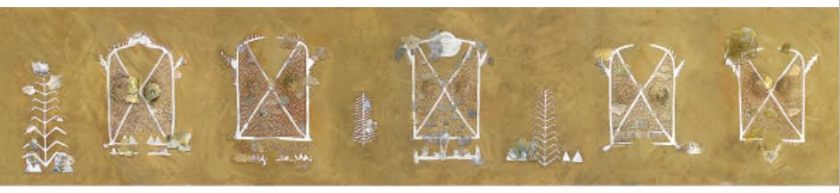
Tree and Goddess motifs on the ‘Wall of the Foremothers’ (Ahninnenwand), Bodensee, Germany, 4th Millenium BCE

Yes, times are tough. But a better understanding of our interconnectedness can help us move beyond the cynicism, frustration, and despair we may be feeling in the modern world. A closer look at trees, and at women’s traditional circle dances, can offer valuable lessons about friendship, community, and the interconnectedness of all life.

The sacred Tree is found in virtually all cultures, often identified with the life-giving figure of the Goddess. Both motifs appear abundantly in archaeological finds dating back to the early Neolithic era. Dance archaeologist Yosef Garfinkel affirms that humans have been dancing in circles since then and probably for far longer.

The Tree of Life is central to the women’s traditional circle dances of the Balkans and the Near East, which I have been researching for over thirty years.  The pattern of the Tree of Life is encoded in the steps of dances, many dance songs refer to women as sacred or magical trees, people often dance around or under sacred trees, and Tree and Goddess motifs are featured on the textiles worn while dancing.  Furthermore, each dancer resembles a tree, with her ‘trunk’ upright and centred, arms symmetrically extended like branches, and hands joined so that we support each other in the circle.   Continue reading “The Tree of Life and the Forest of Friendship: Circle Dance to Restore our Hope by Laura Shannon”

A Serpentine Path: The Dance Is About To Begin by Carol P. Christ

carol-p-christ-photo-michael-bakasEntering the archaeological site of Kato Zakros, which includes a Sacred Center and part of a town on a small hill above it, I felt too tired to continue with the others. As we passed a stone bench to the north and west of the open court, I lay down and closed my eyes. I don’t know if I actually slept, but when I opened my eyes, I was in a trance.

I could see the air vibrating, and as I looked up the hill, I could almost see women walking up and down the stepped paths. My eyes were fixed on the path where women I could not quite see with my eyes went about their daily tasks. After a while Cathleen joined me. “I don’t want to talk,” I said, “but if you sit quietly beside me, you will see women walking in the village. She sat down and said nothing, but smiled broadly and nodded when I asked her if she could see what I saw.

After a while, I moved and sat facing the Central Court. I could still see the vibrations of the air, and as I looked across the court, I felt a sense of anticipation. “The dance is about to begin,” I told Cathleen when she joined me a few minutes later. She nodded. It was an hour before sunset, and the ancient stones were bathed in the last light of day. Jana and Patricia were talking in the central shrine room, while the others leaned over the ancient cistern watching turtles and turtle babies dive into the water and emerge again. “The dance is about to begin,” I said again.

kato-zakros-central-court

Cathleen exclaimed, “I see the path of the dance rising up in the court. It looks like the Processional Paths we saw at Knossos, Phaistos, and Malia. Do you see it?” Though I did not “see” it, I was moved to the court, where I could “feel” it. I raised my arms, bent at the elbows, and slowly wove my way back and forth across the court, following a snakelike path I could feel with my feet. As I neared the center of the court, I almost lost my footing. Turning to face Cathleen, I gazed at her solemnly, sending energy through my palms. Cathleen raised her arms in greeting. I turned again, continuing to trace the snakelike path, back and forth, across the court. When I reached the south end of the court, I turned again to greet Cathleen and Robin who was sitting next to her. “The path you followed was exactly the path I saw,” Cathleen cried out with astonishment. “You were meant to stop at the center.” “It was an ancient path,” I said solemnly. 

Jana and Patricia, who must have been watching, entered from the northwest entrance to the court. Jana was leading, arms upraised, tracing another path, walking with the same slow rhythm in which I had been led. I turned and slowly walked towards Jana until I could sense the energy flowing between our palms, then we softly touched our upraised hands. Carol, Patricia, Cathleen, and Robin formed a circle around us, and stood, arms upraised one in each of the four directions. Sensing that we were meant to share the blessing with the others, Jana and I turned, walking slowly towards the women standing in the north and south, feeling the energy, then touching their palms. Back to the center, we turned to the east and the west, completing the ceremony. As we turned to face each other again, I whispered to Jana, “We were called to this dance. It was an initiation.”

. . .

[A few days later] thinking of the snakelike path I had traced on the ancient stones, my eyes fixed on the gold snake bracelet on my right arm. I reviewed the many meanings the symbol of the snake held in ancient cultures. Goddess temples were used for storing grain, the harvest returned to She who presided over it. Snakes were guardians of the temples, eating the mice and rats that came to take the grain. The coiled snake and the snake biting its tail are symbols of wholeness. Snakes shedding their skins are images of rebirth and regeneration. Snakes hibernate under the earth and are reborn. But there was more: the rhythm of the snake in movement. I picked up a pen and wrote: “a serpentine path.”

These words described our initiation in the dance at Zakros: the serpentine path is the path of life, a snakelike, meandering path, winding in and out, up and down, with no beginning and no end, into the darkness, into the light. There is no goal, only the journey.

A cycle was coming to completion in my life. Through hard work and amazing grace, I found my way back to the Goddess, to myself. The mystery that was revealed to me as my mother died was unfolding in my life. Love had never abandoned me and never would. The Goddess would be with me at every turn in the path, and in that knowledge. I could give up control and open myself to life.

***

a-serpentine-path-amazon-coverThis is an excerpt from A Serpentine Path, Carol P. Christ’s newly released, moving memoir of transformation. Order it now in paperback or on Kindle. Carol’s other new book written with Judith Plaskow is Goddess and God in the World: Conversations in Embodied Theology. Carol also wrote the first Goddess feminist theology, Rebirth of the Goddess.

Join Carol on a Goddess Pilgrimage to Crete in 2017. Save $200.

Read two more the chapters in the book: Mysteries and Dionysian Rites.

Thanks to Judith Shaw for the cover art “Downward Serpent.”

If the paperback is unavailable on Amazon, you can order it from Barnes and Noble.

 

Shared Leadership: The Hidden Treasure of Women’s Ritual Dance by Laura Shannon

Greek women dancing, attributed to a vase in the Museo Borbonico, Naples.  From The dance: Historic Illustrations of Dancing from 3300 B.C. to 1911 A.D. London, 1911
Greek women dancing, attributed to a vase in the Museo Borbonico, Naples.
From The dance: Historic Illustrations of Dancing from 3300 B.C. to 1911 A.D. London, 1911

Traditional women’s dances of Greece, the Balkans and the Near East come from cultures which have survived countless periods of upheaval, and teach skills which can help us through difficult times. I see their gifts as a precious inheritance from the ancestors, passed down through many generations. One particularly valuable skill which the dances emphasizes is that of mutual support and shared leadership among women.

Leadership in traditional dance is not limited to a few who have garnered social rank and power. Dance leadership is shared according to the occasion, and everyone must be prepared to lead dances at important events in their lifetime.

On Greek islands such as Lesvos, a small parea or group of women will typically dance the Syrtós together in a short line or open circle. The first dancer may express herself through turns and graceful flourishes of her free hand, varying her handhold and body position to dynamically interact with the other dancers. The women continually change places in the circle, encouraging one another to take the first position so that everyone eventually has a chance to lead. Continue reading “Shared Leadership: The Hidden Treasure of Women’s Ritual Dance by Laura Shannon”

Women’s Ritual Dances: Secret Language of the Goddess by Laura Shannon

Laura Shannon square crop

My life’s work with traditional women’s circle dances of Eastern Europe and the Near East has been a natural interweaving of feminism, activism and Goddess spirituality. I would like to share how I came to discover these dances and their potential as tools for healing and transformation.

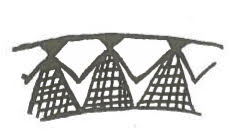
Circles of women dancing with joined hands appear in rock art, pottery shards, vases and frescoes going back thousands of years1, showing that ritual dance was a primary means of women’s worship. I believe that existing women’s circle dance traditions of the Balkans are direct descendants of these rituals. In their expression of values of partnership, sustainability, and peace, they are living links to the matrifocal Goddess culture of Old Europe as articulated by Marija Gimbutas.2

garfinkle2
Tell Halaf, Iraq, ca, 5000-4000 BCE (Garfinkel)

Incorporating symbols of the Goddess in her many guises, these women’s ritual dances are deeply spiritual. They are feminist in the way they provide women with a place of power, not ‘power-over’ but ‘power-from-within.’3 They are an activist practice because the qualities they embody – connection, inclusiveness, balance, empathy, and mutuality – are the principles of a Partnership society, as proposed by Riane Eisler;4 or in Carol Lee Flinders’ term, a society of Belonging.5  Each dance circle is an opportunity to practice being in community in a respectful and cooperative way, which can offer a profound source of healing.6

How did I come to these women’s dances? As a child I was convinced of certain truths: that nature is holy, that God is also female, and that instead of hurting one another, people should celebrate together with music and dance. These longings led me to the rich folk dance traditions of the American melting pot, women’s Middle Eastern Dance circles, and the women’s spirituality network. Around the same time, in the early 1980s, I encountered the meditative communal dance practice known as Sacred Dance. Together with my university training in Intercultural Studies and Dance Movement Therapy, these different streams helped shape the path of my life. Continue reading “Women’s Ritual Dances: Secret Language of the Goddess by Laura Shannon”

Dance of Persephone: The Trata of Megara by Laura Shannon 

Laura Shannon square cropIn a previous post on FAR I explored Greek Easter customs which interweave Christian and pre-Christian beliefs.  Today I would like to take a closer look at one of these customs, the women’s ritual dance known as Tráta, ceremonially performed on ‘Bright Tuesday,’ the Tuesday after Easter. Versions of Tráta survive in the towns of Mégara and Elefsina just west of Athens, on the island of Salamína directly across from them, and in the surrounding area as far as Thebes.

Elefsina, of course, is Eleusis, where for over 2,000 years the Eleusinian Mysteries enacted the story of Demeter and her daughter Persephone’s descent to the Underworld. Choral dance was a central part of the ceremonies at Eleusis – as at other sacred sites including Delphi, Knossos, Athens, and Vravrona – and the ‘Well of the Beautiful Dances’ can still be seen at the archaeological site. It is a a visible reminder of the circle dancing which was a part of the initiatory experience, bringing cosmic order – symbolised by the circle – into the human world. This is still one of the functions of the Tráta as performed today.

Eleusis
Eleusis
Eleusis – ‘Well of the Beautiful Dances’

Continue reading “Dance of Persephone: The Trata of Megara by Laura Shannon “

Caroline Schelling on Birth & Death by Stuart Dean

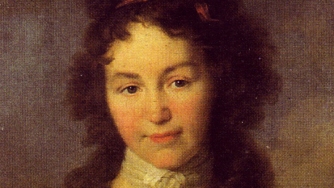
Caroline Schelling

Of the many letters Caroline wrote to her lifelong friend Luise, one of the most intense  (the 57th Letter) dates from seven years after the 4th Letter discussed in my last post.  By then both were married; only a few months earlier Caroline had given birth to her first child (Auguste); though Luise already had children, Caroline knew that one of them was terminally ill.  In the first paragraph Caroline describes how difficult Auguste’s birth was for her; in the second she consoles Luise over the impending death of her child.  She thus subtly parallels birth with death and hence the labor for one with mourning over the other.

Fifteen years later, only a few months after the death of Auguste–the last of her four children to die–Caroline’s generally positive disposition evidenced in the 4th Letter and her experience in grappling with birth and death evidenced in the 57th Letter were being put to the test.  Though she was holding up well, Friedrich Schelling (Friedrich), the man who was to be her third husband, seems to have been suicidal from feeling guilty (rightly or wrongly) for having failed to do enough to cure whatever illness killed Auguste.  Caroline wrote frequently and urgently to him, offering advice and comfort.  In one of those letters (274d) she characterizes the challenge of overcoming grief as a formula to be solved: “(death/pain) x (love/bliss) = (life/peace).”  She terms this one of her ‘primal axioms’ (the “Ursatz”), although she seems playfully to concede to Friedrich that he or perhaps someone else shares responsibility for it. Continue reading “Caroline Schelling on Birth & Death by Stuart Dean”

How the Outdoors Got on Us by Barbara Ardinger

Barbara ArdingerI read some wonderful posts last spring and summer about the beauties of the outdoors. One that especially inspired me was by Molly MeadeIf you missed Molly’s description of how she goes out to the “priestess rocks,” read it now.

But as much as I admire people who like to spend time outdoors in gardens or the wilderness or national parks or anywhere else without kitchens and bathrooms…well, I just don’t like to get the outdoors on me. Most Pagans I know like to camp and hold grand outdoor rituals. Not me. I get lost. I trip over tree roots and get allergic in some large gardens. I don’t like to climb or hike and I stay away from the beach because it’s got all that icky, dirty sand all over it. Although I send money to the Wilderness Society and Friends of the Earth, the wilderness does not need my footprints in it.

So here’s another of my weird little stories. This one’s a fable I wrote several years ago for a friend who was holding regular ceremonies at Joshua Tree National Park in the SoCal desert. (I went to some of those ceremonies. My friends were very proud of me.)

Continue reading “How the Outdoors Got on Us by Barbara Ardinger”