E pluribus unum (‘EPU’), which first began to be used by the U.S. in the 18th century, comes from a poem entitled Moretum that until well into the 19th century was generally attributed to Vergil. During those centuries Latin would have been studied from what was the equivalent of today’s elementary school through at least high school. Because Vergil is to the study of Latin what Shakespeare is to the study of English, Moretum would have been read by anyone lucky enough to receive formal education in those centuries–mostly boys–including the white sons of slave owners.
Those boys, however, would have been motivated not just to read, but to memorize Moretum. That is because Moretum, through a variety of clues, encourages allegorical interpretations, one of which is that it celebrates the sexual intercourse of a single white farmer and his sole companion, his black female slave. Such an interpretation requires ignoring the clues that the author thinks of such sex as rape (as anyone other than a male slave owner would); those clues lead me to think the author may have been a woman.
Illustration of Moretum from a 1558 edition of the works of Vergil available here.
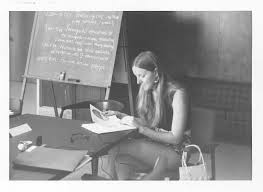
Carol Christ at the Conference of Women Theologians
Today I am publishing an early work on female language for God that I wrote with Emma Trout at the first Conference of Women Theologians in 1971. Highly contested at the conference, this essay is a foreshadowing of my subsequent work on the need for female imagery for divinity.
Rereading this essay more than four decades later, I am gratified to see that though we began our essay with the image of God giving birth (which I still view as an important image), Emma and I were aware of the danger that female imagery for God could reinforce “a false sexual polarity.” We insisted then that female imagery for God must not repeat sex role stereotypes, but rather must shatter them. Continue reading “ALTERNATIVE IMAGES OF GOD BY CAROL CHRIST AND EMMA TROUT”
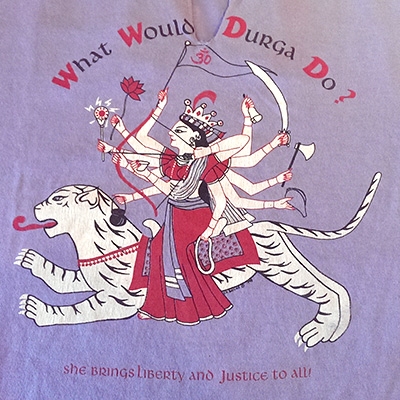
It’s one of my favorite T-shirts. Every time I wear it, people who know who Durga is comment. So do some people who don’t know who the Hindu goddess is.
“What would Durga do?” is of course an echo of the question What would Jesus Do?
I’ve just done a bit of research and learned that this phrase may come from the Middle Ages, that it was famously used in a sermon in about 1891, and that it became very popular among evangelical Christians during the 1990s. What would Jesus do? I think he’d remind us to pay closer attention to the Sermon on the Mount (Matthew 5, 6, 7), especially the Beatitudes and the Golden Rule: “So whatever you wish that others would do to you, do also to them” (Matt.: 7:12). The Golden Rule is of course given in the other major religions, too. WWJD has also been turned into WWBD—“What would Buddha do?” I think the Buddha would tell us to live more mindfully.
But who, you may be asking, is Durga? Why does she have all those arms? Why is she carrying all those weapons? Why is she riding on a tiger? I’ll answer with reference to Patricia Monaghan’s New Book of Goddesses and Heroines (Llewellyn, 1997). While all the Hindu goddesses are ultimately one goddess with the collective name Devi (“goddess”), Monaghan writes, the goddess appears in different forms. “One of the fiercest of Devi’s forms is Durga … [who is] also the eldest.” She appeared during the “primordial war between gods and antigods” and is the “first manifestation of goddess energy” (p. 106). Continue reading “What Would Durga Do? by Barbara Ardinger”
Bas relief of Atropos, shears in hand, cutting the thread of life
In Greek myth, the Fates, the Moirai, are three sisters – Clotho, Lachesis, and Atropos – who spin, measure and cut the thread of life for every person born. Their rule is law; even the gods, so the legend has it, have no power to bargain with the one who cuts the thread and ends the life. Her name, Atropos, means ‘she who cannot be turned’.
In Greece today, others are making the life-or-death decisions. It is not the three sisters of ancient folklore, but a bunch of men in suits now wielding the power to uplift or cast down an entire nation and its millions of citizens. I would like to shine a little light on just two of these groups of (mainly) men who have had the most impact on the recent decisions to bring Greece to the brink of bankruptcy, default and catastrophe. Continue reading “The Unelected and Unaccountable Men Who Decide Our Fate by Laura Shannon”
Recently, I realized the heart’s capacity to hold both extreme tragedy and utmost joy simultaneously. Surely this is something I’ve experienced in the past, but both personal and nation-wide events have served as poignant reminders. First, the racism that primarily persists in microaggressive forms—in the underbelly of a society that too often prides itself in the heinous sin of “colorblindness,” claiming that racism no longer exists in the United States—reared its violent head in the most blatant and painful ways in the slaughter of nine innocent people in Charleston. Because the shooting took place in a church, some media outlets have tried to claim that the shooter’s intentions were to attack persons of faith. It is clear, however, based on Dylann Roof’s words, photos, and history, that these killings were hate crimes targeted specifically at black people. Hearts broke. Lives ended. We, as a nation, were reminded, all too soon and yet again, that the lives of black people are valued less. Racism is present, evil, persistent, both blatant and hidden. It is more than hearts can hold.
Only days later SCOTUS ruled that same-sex marriage is now the law of the land. As my wife and I were packing to leave on a year-long journey throughout the country, we had already made copies of our marriage license (from Maryland before North Carolina recognized the legality of our love), two separate adoption decrees because our state did not recognize us as a family when my wife first adopted our child a brief 20 months ago, and all of the other legal paperwork that we could use to “prove” the legitimacy of our family in the case of an emergency (if medical staff wouldn’t permit us both to be in a hospital room with our child, for example). With those files copied and stored neatly in a suitcase, everything changed for us. Now, no matter what state we visit, our family is legally recognized. And while I’d like to think that our paperwork is no longer necessary, I know that the legality of the court’s decision doesn’t automatically change the hearts and minds of everyone in the country. Heteronormativity still reigns supreme. While we rejoiced at the ruling, we simultaneously acknowledged that marriage is only one small step in dismantling straight supremacy. Though countless couples can now marry, receiving all the legal rights and privileges therein, many may still live in states that allow LGBTQs to be fired for their sexual orientation or gender identity, where housing may be denied, where hate crime protections do not include sexual orientation or gender identity, and the list could continue. Still many queer people, myself included, found ourselves reveling in utter joy. Continue reading “Painting Perpetua and Felicity: Patron Saints of Same-Sex Couples by Angela Yarber”
For our full moon rites coming up on the first of July we will be honoring Aine, Goddess of Love, Light, and Fertility who is also Queen of the Faeries. Aine’s name means “Bright” and She is typically honored at the Summer Solstice when the sun is at its peak of power. The next full moon falls just after the Summer Solstice. The Solstice is associated with abundance, beauty and bounty. It is not necessarily about the harvest season, as that is yet to come. However, everywhere we look we can see the abundance of the Mother and so it is when we first acknowledge, with joy, what is before us.
In my Tradition, the Summer Solstice falls within the Oak Moon, the Moon in which we “court the lightning bolt.” What that means to us is that with our roots planted firmly in the ground, as does the Oak tree, now is the time to take all of our plans and put them into action. “Go for it” is what we are saying to ourselves and to the world. Continue reading “Aine and the Giant Leap by Deanne Quarrie”
In the ancient Celtic world the Goddess was the One who expressed Herself through the many. Grainne is such a one. She is both Winter Queen/Dark Goddess, nurturing seeds through winter, and Solar Sun Goddess, welcoming the rebirth of spring. She is Aine’s sister or another aspect of Aine. She, like Aine, was honored at the summer solstice and the first grain harvest of early August with bonfires and torchlit processions on top of her sacred hill at Leinster, Ireland. Remnants of these festivals are still found in folk ritual today.
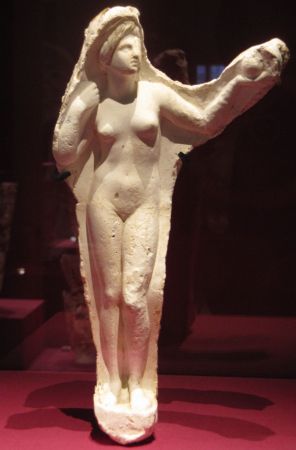
In the 1930s two ancient storerooms in Afghanistan near what is now the Bagram US Air Base were discovered by French archaeologists and unsealed for the first time in about two thousand years. They contained artifacts from all over the ancient world, evidencing just how active trade then was along the complex network of routes known collectively as the Silk Road. Among the artifacts in one of the storerooms was a plaster statuette of Aphrodite (‘Bagram Aphrodite’).
Though it is not known what the motivation originally was for acquiring the Bagram Aphrodite, its presence in Afghanistan arguably evinces an interest in female spirituality–if not in the owner of the storerooms then among some of the people in the market for which she may have been destined. Evidence of such interest among Buddhists is to be found in the Flower Ornament Scripture (FOS), a compendium of sutras dated to approximately the same time (and possibly the same region) as the storeroom containing the Bagram Aphrodite. Female spiritual figures, both mortal and immortal, some portrayed as having official positions, others without any, are prominent in the final chapter of the FOS, so prominent that one scholar suggests Buddhist women of the time in some way influenced its composition (see Douglas Osto, Power, Women and Wealth in Indian Mahayana Buddhism).
Who was Mary Magdalene? The first thought of many today is that Mary Magdalene was a repentant prostitute. But was she? Until the third century, Mary was considered an “apostle.”
Mary as an apostle posed a threat to the early Church patriarchs who denied women all authority in the Church. In addition, by early in the first century C.E., Mary Magdalene had become associated with Christian thought identified as heretical by the Church. The easiest way to eliminate Mary’s importance was to cast aspersions on her moral character.
A friend who is a spiritual teacher speaks often “bringing back the values associated with the Divine Feminine.” For her this has to do with helping women to understand the beauty of our bodies and the importance of ways of being such as giving and caring for others that have been associated with the undervalued so-called “feminine” side of the masculine-feminine polarity. Though she also speaks about the Goddess, I think she prefers the term “the Divine Feminine” because of the implication that men too have their “Divine Masculine.”
This friend has a wonderful husband who is a teacher in his own right and who often ends up spending a lot of his time among powerful women who enjoy talking about the Goddess. In these conversations he sometimes speaks of the need for men to “recover the Divine Masculine” if they are to become whole.
I was reminded of these conversations when a two other friends, in different contexts, recently voiced their concern that Goddess imagery is problematic if it repeats sex role stereotypes. My response to them was that in the West, the feminist association of femaleness with power and value in Goddess symbolism automatically shatters the most important sex role stereotype: the notion that women are less powerful and less valuable than men. But, I said, after that, problems may arise.
I added that (for me) the categories of Divine Feminine and Divine Masculine are problematic because (it seems to me) that at their core these concepts are rooted in the notion that males and females are fundamentally different, and that the so-called “feminine” is relational, loving, giving, while the so-called “masculine” is independent, rational, aggressive, and sometimes violent and warlike. Those who speak of the Divine Feminine and Divine Masculine as oppositional categories usually try to avoid categorizing men and women by stating that “we all have our masculine and feminine sides.” Still it is hard to avoid the implication that men are more masculine and women are more feminine.
Though I agree that men need new images of what it means to be men as much as women need new images of what it means to be women, I hesitate to speak of these as new images of the Divine Feminine and Divine Masculine for two reasons. Although I recognize that others are inspired by images of the Sacred Marriage, for me it has been more important–and more possible–to find power within myself and in a wide variety of relationships, than to find it in a male-female heterosexual couple relationship in which the opposites are “joined.”
More importantly, I find that images of Divine Feminine and Divine Masculine often do justify patriarchal sex-role stereotypes. An internet search for “Divine Masculine” validated this fear. The first (and therefore most popular) website defined the Divine Masculine through six archetypes: God, King, Priest, Warrior, Lover, Sage.
The site’s author seems to want to help men learn new ways to interact with powerful women—as neither dominant over them nor submissive to them. The author writes: “The Divine Masculine represents an archetypal ideal, the best and most inspiring, elevating, and restorative aspects of masculine expression and manifestation in the universe. For those seeking an expanded understanding of the Self, the Divine Masculine is not a distant, detached, jealous and vengeful male deity. The Divine Masculine (along with the Divine Feminine) acts as a shining mirror of the Self, revealing aspects that need compassionate attention and support to become one’s highest potential.”
Following this insight, he redefines the God archetype as “unconditionally loving, inclusive, open, welcoming, heart-centered, spiritually focused, supportive and inspirational.” For him, the King archetype is “benevolent, evenhanded, calm, caring and thoughtfully present.” And the Warrior “finds his place in collaborative projects, being fulfilled and contented with the collaboration and not by ambition or competition.”
While I appreciate the ways in which this man redefines masculinity and male strength in terms that in the past have been associated with “the feminine,” I am concerned that he continues to view the six “archetypes” that include the King and Warrior as universal. He does not explicitly name patriarchy as a system of male dominance enforced through violence as the reason for redefining the meaning of the “archetypes.” I also worry that a good king is still a king, and that a warrior who fights for the good of others is still a warrior. From a feminist perspective, these archetypes are not universal, but rather are the product of patriarchy. Perhaps instead of redefining them, we should discard them.
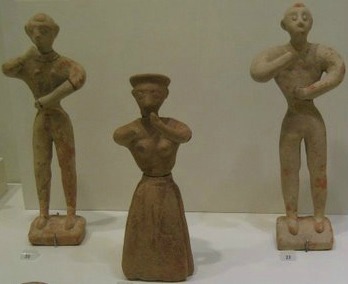
Male and female figures from ancient Crete are not strongly differentiated.
New research suggests that in matriarchies, there is no divine masculine per se, because though men have their own important roles, both males and females are encouraged to embody the values associated with mothers and mothering—in other words to be loving, giving, caring, and generous. In this context there is no opposition or sharp contrast between the divine masculine, the divine feminine, and any other divine gender or transgender.
I believe that that we need a multiplicity of images for divine power that express the diversity and differences of our bodies and all bodies in the web of life. We also need new images of how to be strong and powerful, yet loving and caring above all, in male, female, and other bodies.
However, if the “highest” values are the same for both—and all–genders, then perhaps it is time to retire the oppositional binary of Divine Feminine and Divine Masculine and to speak instead of images of divinity in male, female, and other bodies.


 E pluribus unum (‘EPU’), which first began to be used by the U.S. in the 18th century, comes from a poem entitled Moretum that until well into the 19th century was generally attributed to Vergil. During those centuries Latin would have been studied from what was the equivalent of today’s elementary school through at least high school. Because Vergil is to the study of Latin what Shakespeare is to the study of English, Moretum would have been read by anyone lucky enough to receive formal education in those centuries–mostly boys–including the white sons of slave owners.
 It’s one of my favorite T-shirts. Every time I wear it, people who know who Durga is comment. So do some people who don’t know who the Hindu goddess is.
 Recently, I realized the heart’s capacity to hold both extreme tragedy and utmost joy simultaneously. Surely this is something I’ve experienced in the past, but both personal and nation-wide events have served as poignant reminders. First, the racism that primarily persists in microaggressive forms—in the underbelly of a society that too often prides itself in the heinous sin of “colorblindness,” claiming that racism no longer exists in the United States—reared its violent head in the most blatant and painful ways in the slaughter of nine innocent people in Charleston. Because the shooting took place in a church, some media outlets have tried to claim that the shooter’s intentions were to attack persons of faith. It is clear, however, based on Dylann Roof’s words, photos, and history, that these killings were hate crimes targeted specifically at black people. Hearts broke. Lives ended. We, as a nation, were reminded, all too soon and yet again, that the lives of black people are valued less. Racism is present, evil, persistent, both blatant and hidden. It is more than hearts can hold.


 Though it is not known what the motivation originally was for acquiring the Bagram Aphrodite, its presence in Afghanistan arguably evinces an interest in female spirituality–if not in the owner of the storerooms then among some of the people in the market for which she may have been destined. Evidence of such interest among Buddhists is to be found in the
 Feminism and Religion