In 2003, I picked up a collection of essays on little known Ramayanas. Buried within was a poem by Pathabhi Rama Reddy. Pathabhi, a rebel of Telugu literature, defied not just conventional rules of grammar but also those of popular thinking, best exemplified by his poem, “Sita,” the subject of this post.[1]
Rama’s harsh treatment of Sita in the Ramayana epic when he first doubts her purity, compelling her to undergo a trial-by-fire, and then banishing her despite the fact that she had proved her loyalty to him, has attracted criticism from all quarters – how could the “perfect man” behave so callously towards his own wife who had been Ravana’s helpless victim? The fluidity of the story has ensured a visibility for Sita, no doubt. Continue reading “Wifehood Redefined: The Twentieth Century Sita by Vibha Shetiya”
The Year 2015 is coming to a close. It is a time of endings and a time of beginnings. That is the wonderful thing about our cycles. We all have the opportunity to end and begin – over and over. Each day, each month and each year. We all scurry about making resolutions for the new year only to see them fail almost immediately.

This is where a good basic magical practice can lend a hand with our resolutions. In every magical act we must first know what it is we wish to manifest. I am not talking some empty wish here but a real look at what we want – really want – for the new year to bring.
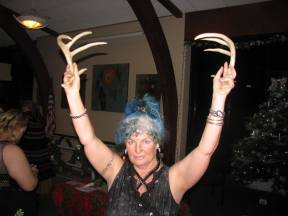
Marie bringing in Elen of the Ways photo by Tony Mierzwicki
One of my colleagues at Feminism and Religion recently wrote of Xmas and Feminine Wisdom.My blog, for Christmas Day continues this exploration.
Elen of the Ways is a figure primarily studied by scholar, Carolyn Wise. She wrote two core articles available on the web hereand here. Wise writes that in order to “track” and find Elen of the Ways she had to peel back the layers:
…to the earliest track ways, the migratory tracks of the Reindeer and Elk. Elen moves across vast tracts of time, and land, cloaked and masked appropriately for each age.
As the Green Lady, she peers out between the trees in forests …As a British Venus… she is guardian of the underground streams that carry the sacred waters. She is the Guardian of the ancient track ways, the Leys, the Kundalini currents in nature. And as the Horned Goddess, she leads us to the first trackways, the migratory tracks of the reindeer and later, to the path of the red deer through the forests. From here she leads us to the lost Shamanism of the isles of Britain and we can follow her across Scandinavia, Russia, Mongolia, Siberia, India and beyond.
…part goddess, part dream, part saint, a green lady and a water nymph, primordial mother and patroness of deer, and guardian of the Old Straight Tracks and solar alignments. …Elen is as real as the roads named after her, as solid as the ancient paths that carry her presence.
What are these tracks? Part of the story can be explained by understanding that there are ley lines, or energy paths throughout the globe. These paths were “tracked” by shamans, pagans, and regular folk and still exert their influence today in very recognizable ways. People celebrated earlier this week on the Solstice (December 21) at Stonehenge. “One of the most important and well-known features of Stonehenge is its alignment on the midwinter sunset-midsummer sunrise solstitial axis,” a spokesperson said. “The midwinter sun sets between the two upright stones of the great trilithon.” The solsitial axis is part of the ley line network that connects sacred sites such as Newgrange in Ireland, a sacred burial mound which lights up only the morning of Solstice.
I wrote this piece in response to an e-mail from a friend that said: “Yes, women’s circles may help you with your headaches that you have every 3 to 7 days (or whatever else ails you.)”

I think women (and men as well, but I think women feel this more deeply in general) are missing a genuine connection to others, a safe place to be heard and accepted, a chance to step outside of their roles and responsibilities in life (if only to see how very similar our challenges are), and a chance to honor beauty whether that be by reading a poem, singing a song or listening to music.
Dahut Ahes, Breton goddess of Love and Sensuality is a Celtic Goddess whose origins are obscured by patriarchal tales which cast Her as wanton and depraved. By weaving together the tales as they are today with an understanding of the life-affirming nature of the old pagan ways Dahut emerges as more than a glittering goddess of beauty; She is revealed as an ancient goddess in a long line of goddesses who holds the rebirth of the old ways in Her loving arms.

After leaving her home and her children in order to take refuge with her guru, in no time, Rukmabai won over hearts. Her guru, Siddharood Swami “with his divine sight” discerned that Rukmabai was no ordinary being. In fact, just before his death, upon realizing that his principle disciple had attained moksha (liberation from the cycle of death and rebirth), he left to her his mission of guiding others to salvation, directing his followers to now address her as Mother Kalawati.
And so it came to be that at the tender age of twenty-one, Rukmabai had a large following herself, and as an intense devotee of Krishna, she almost became synonymous with the god. As many like to point out, she had already internalized the attitude of non-attachment, whether towards individuals, possessions or food or drink; she was already enlightened.
Her disciples were both male and female, although she dedicated herself to the well-being of women. But while directing minds towards god, Kalawati Aai – a high class and high caste woman – also dedicated herself to uplifting the poor and backward Bohari community of Belgaum, Karnataka. It is said that the men used to wile away their time drinking and gambling leaving the womenfolk to run the household. Because of Kalawati Aai’s intervention, some order was brought to their lives; the men stopped drinking, which in turn put an end to the physical abuse they had heaped upon their wives, as well as the neglect their children had faced, who earlier had no choice but to turn to vagrancy. Stability in the homes through prayer and piety – in other words channeling their minds away from vice and towards god – in turn saw not just an economic change but also a change in the lives of these women and children, for the better.
But – and this is interesting – her message to women was not one of directing energy towards god in search of inner peace or salvation, but towards the family, of being a virtuous wife and mother. In fact, she urged women to put aside “just one hour a day of your life to the service of god”; the rest of the time should be aimed towards serving the family. And her advice to women unhappy on account of their domestic life would always be to look deep within themselves to remedy the situation, rather than to blame their husbands. Moreover, at no point should a woman ever neglect her duties towards family on account of her own well-being for that would be tantamount to selfishness. I find this most interesting because she herself broke norms in order to serve a personal calling. Continue reading “Was Mother Kalawati a Feminist? (Part 2) by Vibha Shetiya”
Fall, the time of the Day of the Dead and All Souls Day, is a perfect season for us to contemplate “fearless spirituality” as we face our most essential fear, that of death. Though humans have celebrated these days for millennia, fear with a religious veneer pervades our culture, whether in hate towards women and the LGBTQ community, lies that demonize followers of other religions, terror of eternal punishment and spiritual unworthiness, and more.
When I seek guidance for cultivating spiritual fearlessness, I look to ancient Sumer’s Inanna and her willing descent into death. Her story cycle begins in fear of the Sky and Air gods and her desire to destroy her huluppu-tree, Earth’s first life. Gilgamesh hacks it apart to rid it of a serpent, a bird, and Lilith. The tree’s remains are made into Inanna’s throne and bed. In the next story she takes all the divine powers of her father, Enki, the God of Wisdom, and then joyfully celebrates her body and sexuality in her marriage to Dumuzi. Continue reading “Inanna’s Autumn Gift: Fearless Spirituality by Carolyn Lee Boyd”
I’ve noticed some growing trends in feminist spirituality. Recently, I’ve encountered several feminists who have attended “virtual retreats” from the comfort of their homes. I’ve also been overwhelmed by the number of clergy, scholars, and feministswho have begun coloring. Psychologists claim that coloring can soften stress, relieve anxiety, and be source of playful meditation for adults in an otherwise chaotic world. Similarly, doctors have long pointed to the emotional and physical importance of meditation, spirituality, or prayer in remaining balanced, relieving stress and anxiety. As feminists dwelling in a cisheteropatriarchal world, the need for such balance is even more important. It is these noticings that have led me to write this post.
A fabulous church that cares deeply about inclusion, social justice, and the arts is hosting an exhibition of myHoly Women Iconswith a folk feminist twistfor the month of October and throughout the month, I’m leading several retreats. While planning these retreats, I couldn’t help but think of the Feminism and Religion community. We are spread throughout the world, offering encouragement and challenge online every day. We have different struggles, spiritual paths, and backgrounds, but we gather on this blog to reconcile two seemingly paradoxical parts of our beings: feminism and religion. I have yet to develop these thoughts fully and I’d like to rely on you to share your input and ideas in the comments section about how we can “retreat” together virtually. With this in mind, I’d like share a bit about the Holy Women Icons Arts and Spirituality retreat I’m leading and invite you to participate at home. The entire retreat takes about 3 hours, or you can break it into 4 sections for shorter periods of time. So, if you’d like, play some music to set the mood, light a candle, and get out some paper, scissors, writing utensils, and crayons/markers, and let’s “retreat” together…
During the summer I had the opportunity to interview Edwina Sandys, the creator of the sculpture, Christa. Initially, I was drawn to this sculpture during a seminary class with Whitney Bodman – “Jesus and His Interpreters.”
I came to seminary in 2013, a 47 year old single mom with two teenage kids in tow having left a very difficult sixteen year marriage. Seeing the picture of Christa during our class was a sacred moment for me. It echoed my journey and pain and yet also uplifted the beauty inherent in human suffering and our daily gift of grace and promise of resurrection. The debate over the cross itself and its center in Christianity, its usage to elevate patriarchal power, is ongoing, but for me, in that moment, seeing Christ as female was deeply spiritual. Continue reading “Christa Interview with Edwina Sandys by Nettie Reynolds”
Even after I was ordained as a rabbi, I longed to be a priestess. The spiritual leadership I wanted most was less about leading traditional Torah study and prayer (though I’d done plenty of that) and more about immersing in the ocean, creating new rituals, reading kabbalistic sources on Shekhinah (the divine feminine mentioned in Talmud and kabbalah), or interpreting legends about women. My deepest desire was for there to be a school for Jewish women on a priestess path.
Ten years ago, my dream came true. In 2005, Taya Shere and I founded the Kohenet Hebrew Priestess Institute to bring to life the traces of the priestesshood we were finding in the Bible, in Near Eastern archaeology, and in Jewish lore and history. In Kohenet sacred space, we explore the women of spirit among our ancestors, resist their erasure, and bring forward the practices that were sacred to them. We discover in these forgotten teachings the mysticism of the material: the understanding that in our lived experience on the earth we are closest to divinity. At Kohenet, we meet the submerged version of deity called Shekhinah, Imma Ilaah, Elat, Goddess, Divine Mother, and understand why she has been so feared and rejected, yet also has been a deep and lasting part of our tradition as Jews.
The Kohenet Institute has ordained four classes of women and now meets twice a year for training weeks at the Isabella Jewish Retreat Center in Falls Village, Connecticut, and at Ananda Meditation Retreat in Nevada City, CA. We and our students run workshops and services in venues like Limmud UK and the Parliament of World Religions, as well as classes at retreat centers, local synagogues and women’s centers.Days at Kohenet are filled with spiritual exploration: prayer in the feminine in Hebrew and English; ceremony to grant new names or celebrate elders or heal the sick; making incantation bowls in the style of ancient Babylonia; slideshows of ancient priestess and Goddess art from the lands of the Bible; drum circles and labyrinths; stories of witches dueling with Talmudic sages, immersing in the lake before the Sabbath. At Kohenet, we celebrate and embody the sacred feminine, and prepare our students to lead ritual in an earth-based, embodied, feminist way that is rooted in Jewish tradition.Continue reading “Embracing the Hebrew Priestess by Jill Hammer”