Carol P. Christ’s Legacy: THE LABRYS: A RIVER OF BIRDS IN MIGRATION

Moderator’s Note: Carol Christ died from cancer in July, 2021. Her work continues through her non-profit foundation, the Ariadne Institute for the Study of Myth and Ritual and the Goddess Pilgrimage to CreteThis blog was originally posted July 29, 2013. You can its original comments here.

labrys seal ring

“There’s a river of birds in migration, a nation of women with wings.” Goddess chant, Libana

On the Goddess Pilgrimage to Crete, I explain that many of the names given to “Minoan” (c. 3000-1450 BCE) Cretan artifacts and architecture are products of patriarchal and Eurocentric imaginations, and as such, are misleading.  For example the name “Minoan” was given to the culture of Bronze Age Crete in honor of “King Minos,” who was said to have ruled in Crete a few generations before the Trojan War–several hundred years after the end of the culture to which his name was attached.  In fact, despite his eagerness to find evidence that King Minos ruled at Knossos, the excavator Sir Arthur Evans finally had to concede that the best he could do was to produce a fresco of a “Prince of the Lilies” which he identifed as the image of the male ruler of the culture he called “Minoan.”  Evans’ Prince had white skin, a fact that Evans conveniently overlooked–because according to his own interpretation of “Minoan” iconography, white skin would mark the figure as female.  Mark Cameron, who reviewed Evans’ reconstruction of the fresco, suggested that the Prince is more likely to be a young woman who is perhaps leading a bull to take part in the bull-leaping games.  He also stated that the “crown” belonged to another fresco altogether.

Continue reading “Carol P. Christ’s Legacy: THE LABRYS: A RIVER OF BIRDS IN MIGRATION”

Carol P Christ’s Legacy: Gratitude and Sharing: Two Fundamental Principles of Goddess Spirituality

Moderator’s Note: Carol Christ died from cancer in July, 2021. Her work continues through her non-profit foundation, the Ariadne Institute for the Study of Myth and Ritual and the Goddess Pilgrimage to Crete. This blog was originally posted February 4 2013. You can read it along with its original comments here.

The more I practice the spirituality of the Goddess, the more I understand that earth-based spiritualities are rooted in two fundamental principles:  gratitude and sharing.  We give thanks to the earth for the gift of life. As we recognize our interdependence and interconnection in the web of life, we are moved to share what has been given to us with others. *

When I first began to lead Goddess Pilgrimages in Crete, I was inspired by a line in Homer to begin a pilgrimage tradition of pouring libations of milk, honey, water, and wine on ancient stones. At first I knew the form, but not its deeper meaning.  It gradually dawned on me as I thought about the large number of pouring vessels in the museums, the altar stones, and the Procession Fresco from Knossos, that an important part of Minoan rituals involved processions in which people offered first fruits back to the Mother whose body had produced them, and poured libations on altars.

Continue reading “Carol P Christ’s Legacy: Gratitude and Sharing: Two Fundamental Principles of Goddess Spirituality”

Eden, Eve and a Tale of Seeds by Janet Maika’i Rudolph

Last month I wrote about the Garden of Eden. You can read it here:

In that post, I described how Eden is essentially a garden of treasures. What are those treasures? I believe that they are seeds, the most prolific and creative element for spreading life here on Earth. Below is my own fantastical story about the Garden and how the seeds came to reside there.

Sinuous and serpentine, Hawwah, Hayyat, Eve emerged from Apsû, carrying within her seeds, fertilized eggs, and all the fruitfulness and abundance therein. 

Continue reading “Eden, Eve and a Tale of Seeds by Janet Maika’i Rudolph”

From the Archives: Through the Eyes of the 21st Century Bird Goddess by Carolyn Lee Boyd

Moderator’s note:Today’s blogpost was originally posted March 14, 2018. You can visit it here to see the original comments.

When I raise my eyes to a bird soaring over me in flight, I am no longer bound to the Earth by gravity. I stop my round of daily tasks and widen my vision to view myself and our world from above through birds’ eyes. For just a moment, as I observe beyond my usual narrow horizon, I perceive truths about myself and others that have been hidden and grasp wisdom that has previously eluded me.

From Neolithic times onwards in cultures stretching across the globe, as described by Judith Shaw, bird-shaped goddesses have embodied life, death, rebirth, and more. More recently, as noted by Miriam Robbins Dexter, these beautiful winged beings were perceived of as monsters and flying through the air was one of the accusations made against the women persecuted as witches in the Burning Times. What greater demonstration could there be of the intense terror this powerful relationship between women and birds creates in those who demand dominion over women’s bodies and souls?

Continue reading “From the Archives: Through the Eyes of the 21st Century Bird Goddess by Carolyn Lee Boyd”

From the Archives: The Serpent and the Goddess by Judith Shaw

Moderator’s note: This marvelous FAR site has been running for 10 years and has had more than 3,600 posts in that time. There are so many treasures that have been posted in this decade that they tend to get lost in the archives. We have created this column so that we can all revisit some of these gems. Today’s blogpost was originally posted January 26, 2020. You can visit the original post here to see the comments.

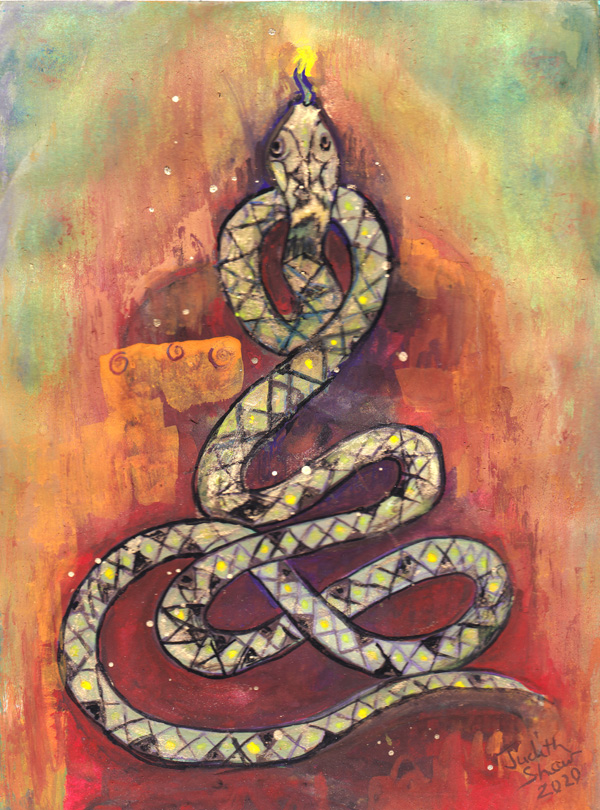
The otherworldly energy of Snake – it’s vitality, its uncanny ability to sense danger, and its ability to shed its skin and reappear as if reborn must have invoked feelings of awe in our ancestors. All across the pre-historic world one finds depictions of Snake and the spiral or meander as Snake’s symbols.

Creation, Primal Energy, Life Force
Snakes are mysterious, cold-blooded creatures –  slithering silently across the land, sleeping with open lidless eyes, hearing without ears but by feeling Earth’s vibrations, and using their forked tongues to smell in lieu of a nose.

Snake Spirit Animal-painting-by-judith-shaw

To the human imagination this enigmatic being is both chthonic and spiritual – tying together Heaven and Earth. Though no stories survive from the early Neolithic period of Old Europe, the preponderance of imagery leads us to the conclusion that the Snake Goddess, often appearing as one with the Bird Goddess, was felt everywhere – ruling earth, water and air – nurturing the world with the feminine principle – Mistress of life-giving cosmic forces.

Continue reading “From the Archives: The Serpent and the Goddess by Judith Shaw”

Earth Is Our Community by Carolyn Lee Boyd

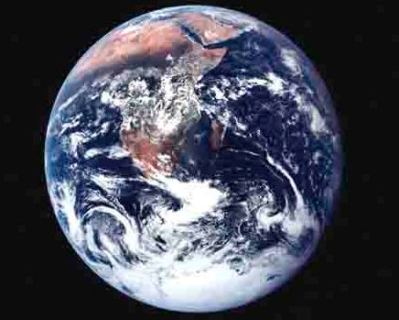
Earth from space, NASA

“The beauty of the planet from 100,000 miles should be a goal for all of us, to help in our struggle to make it as it appears to be.” Astronaut Michael Collins said these words reflecting on seeing the Earth from space. To me, he is expressing the truth that the Earth is our community that we share with all other beings on the planet, our home base. But what does this really mean in its most profound perspective?

Over the years, I have heard people express over and over how they desire “community,” whether that means a neighborhood café or an ongoing circle to share our deepest lives over decades, or any of many other expressions. The emotional and physical impact of isolation and divisiveness over the past months of the pandemic has shown how essential “community” is to our well being, and how we need to think of it as more than just a sense of being part of a group. True community provides us with a sense of belonging and relationship, of being part of a vibrant, interdependent web, of assuming everyone will act in the best interests of all. 

Continue reading “Earth Is Our Community by Carolyn Lee Boyd”

Days Like These, by Molly M. Remer

Sometimes the best rituals
are those we cannot plan,
requiring only pine needles and wind,
open eyes
and a long, slow-sinking sun
settling gently into shadows.
Sometimes the best magic
of all is made with
what is exactly right now,
bluestem grass and gray feathers,
raccoon footsteps
between the trees,
laughter and joined hands,
a faith in the cycles of retreat
and renewal.
This is what we are here for,
days like these.

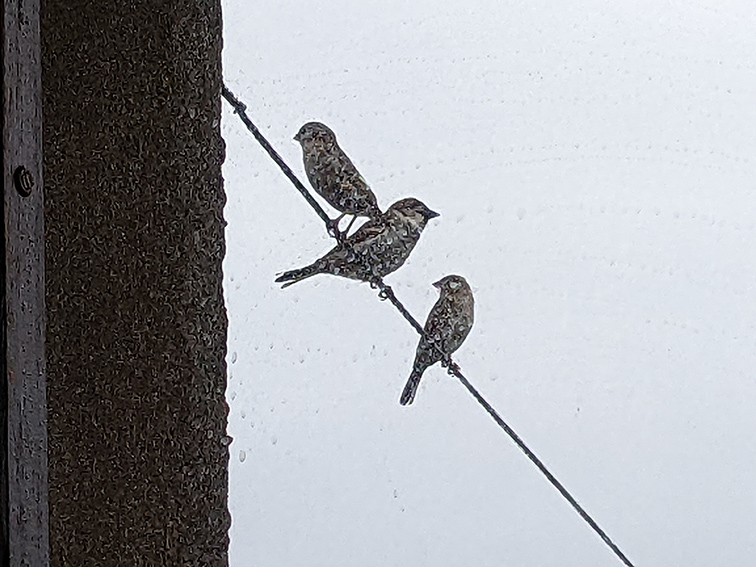
One crow behind the house greeted me on a frosty solstice morning. Five more slid across the road in front of me as I reluctantly left home to go to the dentist. A red-shouldered hawk glided across the road next and I spotted a kestrel perched on a wire. I drove and sang, memories of our bright candles and solstice spiral the night before behind my eyes, sun bread left rising golden on the counter at home. The dentist has devised a pulley system to hang bird feeders by each of his second story windows and I watch house finches collect sunflower seeds as I lie in the chair. I spot a vulture circling in the distance slow and graceful above the trees. The sky is blue. When I leave the office, I hear a crow’s voice call from across the street and as I drive back home to my family and our winter holiday celebrations, another red-shouldered hawk swoops in front of me, while a red-tailed hawk sits solemnly in a tree by the field, watching the ground. I’m amazed how birds, so unbound, tether me so reliably to the magic of place, to being present with the ensouled and singing world as I move within it and I am grateful.

In the late afternoon on the solstice, my family and I carry the sun bread we have made out to the field by our studio. We join hands and sing and then toss small bits of our golden bread to the sun, calling out our wishes for the year to come and offering our thanks to the spinning world we walk on, beneath this burning sun.

The kids go inside and my husband, Mark, and I walk down the road to finish watching the sun set. It sinks low and slow behind the bare oak trees, growing larger and redder as it goes. It seems to be one of the most drawn out sunsets of this year and we sit down in the frost-crisped dittany by the side of the road, our backs against the oak trees, watching. I turn to look at Mark smiling and say: this is what I am here for, days like these.

I decided to take social media break as 2021 drew to a close, something I’ve wanted to do for a long time, something I’ve needed to do for a long time, and yet, something I’ve always talked myself out of. I need this for our business, I think. It is part of my work. How else will I reach people? I will just post a few more things. While, inside, the hunger to really listen, to de-fragment my mind and re-collect my soul continued to build to a peak of fervency and desire. The blessing and the curse of social media is that everything is in one place. Convenient, yes. Holds you hostage, also yes. Exposes you to more information than you can reasonably hold and process, also yes. The first day of my break, I was amazed how often I was tempted to cheat, how many ways I came up with to sneak around the limit and to just do one little thing anyway. I was also surprised to discover how much extra space there is in my mind and how liberating it is to step away from the clamor of so many other voices. As Cal Newport explains, we all need time each day when we are outside of the influence of other minds. And, I was surprised by how invisible I felt, how unseen and unheard. As the days passed, I felt it though, my scattered pieces coming home. I knew that social media was affecting my focus and my brain functioning, could feel it fragmenting my thoughts, and making my focus and attention jumpy and scattered. In these days of silence, something began to heal inside. I feel a bit invisible, yes, but I also feel whole. I feel like I am coming back online, to my own life.

What was intended only as a ten day break over the winter solstice, extended through the first month of new year and while I’m not saying I’m never going back, I find I am in no rush to re-engage, certainly not in the way I had before.

In the reclaimed attentional space within, I discovered the soulsong of a new book walking up to me, hands extended and eyes wide.

We walk again under long wings of twilight, last vestiges of day sinking purple and mauve into the horizon. Somehow we end up talking about cryptocurrency and NFTs.

Give me dirt and give me stars, I say, as our feet crunch across the brown gravel, our shoulders hunched slightly against the wind. Give me life, right here, where it is.

As we come back up our driveway, we spot a doe at the compost pile, she watches us silently as we turn to make one more lap down the dusky gravel road.

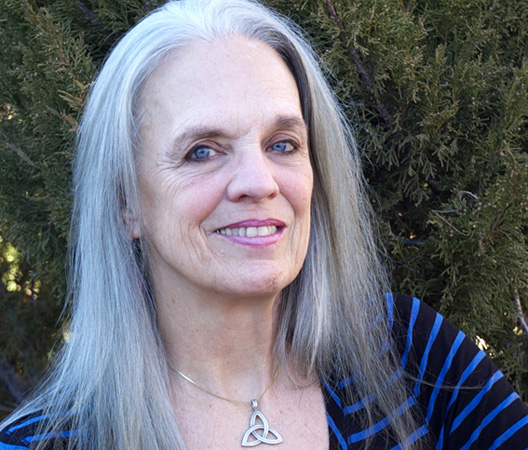
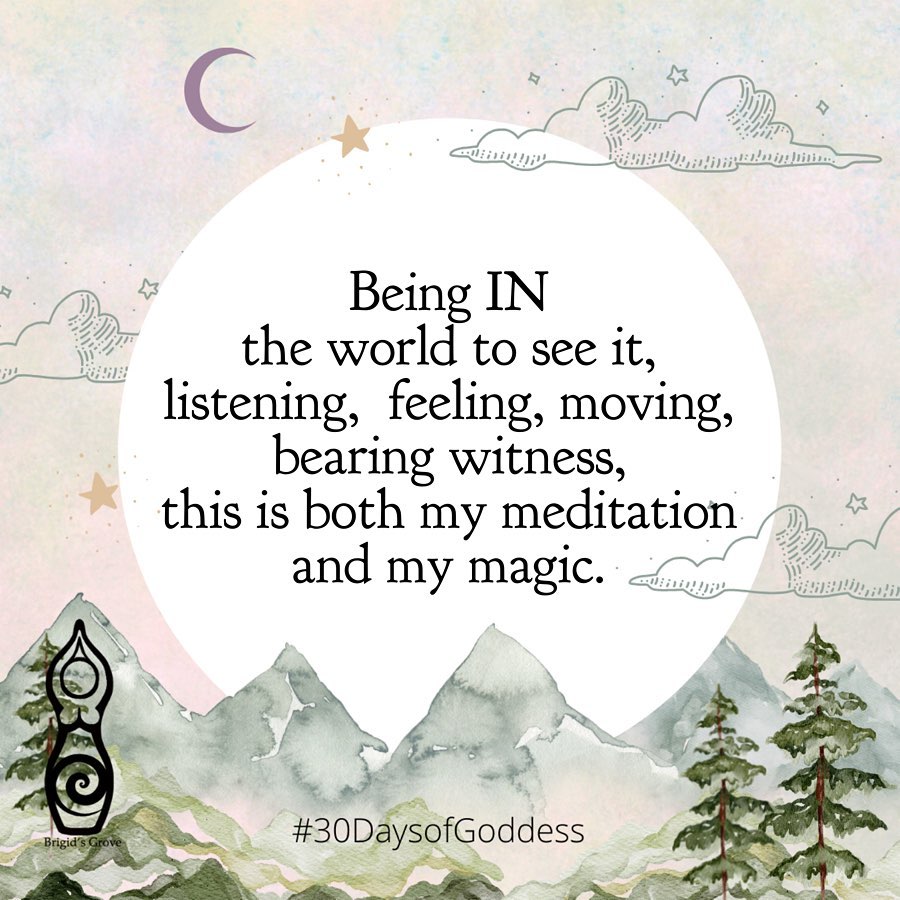
Molly Remer, MSW, D.Min, is a priestess facilitating women’s circles, seasonal rituals, and family ceremonies in central Missouri. Molly and her husband Mark co-create Story Goddesses at Brigid’s Grove. Molly is the author of nine books, including Walking with Persephone, Whole and HolyWomanrunes, and the Goddess Devotional. She is the creator of the devotional experience #30DaysofGoddess and she loves savoring small magic and everyday enchantment.

Note: this essay is excerpted in part from a book in progress, tentatively titled Walking with the Goddess.

Slaying Dragons Our Own Way, Part II by Carolyn Lee Boyd

Cailleach Beira
Cailleach Beira

Assipattle and the Mester Stoorworm is a Scottish dragon-slayer folk tale with many enticing details linking it to elements of an older culture centering the Earth with a reverence for female spiritual power. You can read a summary of the story and these clues in Part I.

While the tale was obviously not originally meant to reflect the 21st century, it has echoes of our own society’s challenges today, including inequality, injustice, violence, and ecological disaster. It may be a revision of an older story but, not knowing what that story was, we can perhaps re-envision the story to be meaningful for our own time with the characters and practices hinted at in the details. Maybe something like this (I’ve named Assipattle’s unnamed sister Morag) …

Continue reading “Slaying Dragons Our Own Way, Part II by Carolyn Lee Boyd”

Slaying Dragons Our Own Way, Part I by Carolyn Lee Boyd

Monster of the Sea

In winter people traditionally gather around the fire to enjoy stories as the stormy winds thunder outside. Come closer to the hearth as I regale you with Assipattle and the Mester Stoorworm, a centuries-old dragon-slayer folk story from Scotland’s Orkney Islands with many Norse elements. On the surface, it is a fairy tale about a village threatened by a gigantic sea serpent and how they responded to this existential threat. Though meant to entertain with its adventure and romance, it also has many details that perhaps link it to older roots of a culture that centered the Earth and healing and revered female spiritual power, all of which are profoundly needed in our own time. If we re-envision the tale through the lens of these clues, we may be able to find guidance for how our own communities — local, national, and global — can more successfully confront profound challenges.

Here is the summarized original tale:

Continue reading “Slaying Dragons Our Own Way, Part I by Carolyn Lee Boyd”

Carol P. Christ’s Legacy: Of Birds, Angels, and Tidings of Great Joy

Moderator’s Note: We here at FAR have been so fortunate to work along side Carol Christ for many years. She died in July this year from cancer. To honor her legacy as well as allow as many people as possible to read her thought-provoking and important blogs we are pleased to offer this new column to highlight her work. We will be picking out special blogs for reposting. This blog was originally posted December 23, 2013. You can read it long with its original comments here

A link to a video of a Crow Uses Plastic Lid to Sled Down Roof Over and Over Again on a mayonnaise-lid sled appeared on my Facebook timeline a few days ago. {moderator’s note: I believe this is the same video that Carol originally posted. The link has been updated since 2013 } For me this crow expresses the “spirit of the season” as aptly as anything I can think of.  She brings a smile to my face on a grey and cold morning.  She makes me want to climb up on the rooftop and slide down with her.  She reminds me that we humans are not alone–we share the world with a vast multitude of other intelligent creatures.  She tells me that there is nothing more sacred than the joy of life.

Continue reading “Carol P. Christ’s Legacy: Of Birds, Angels, and Tidings of Great Joy”